
Search is no longer just a list of links. Ask Google a question and you’ll often see an AI Overview before any website. Ask ChatGPT, Gemini or Perplexity and you’ll get a complete answer, sometimes with a handful of sources linked underneath. For businesses, that raises a new question: how do you make sure your brand is part of that answer?
The answer is generative engine optimization, usually shortened to GEO. In this beginner’s guide to generative engine optimization, you’ll learn what it means, how AI tools decide what to include in their answers, and the practical steps you can take to improve your chances of being mentioned and cited.
Table of Contents
What is generative engine optimization (GEO)?
Generative engine optimization is the practice of creating and structuring content so that AI-powered search tools can easily find it, understand it, trust it and use it in the answers they generate.
A “generative engine” is any system that writes an answer rather than just listing results. Examples include ChatGPT, Google Gemini, Google AI Overviews and AI Mode, Microsoft Copilot, Perplexity and Claude.
The term was popularised by a 2023 academic research paper, GEO: Generative Engine Optimization, which studied how content changes affect visibility in AI-generated answers.
Traditional SEO focuses on ranking a page in a list of results. GEO focuses on being included in a generated response: as a brand mention, a recommendation, a quoted fact or a cited source.
Why generative engine optimization matters now
There are three big reasons GEO has moved from a niche idea to a mainstream marketing priority.
- People are getting answers without clicking. When an AI answer satisfies the question, many users never visit a website. If you’re not in the answer, you may not be seen at all.
- AI answers create shortlists. When someone asks for “the best project management tools for a small team,” the brands named in the response get a huge head start.
- Citations carry authority. Being cited as a source in an AI answer signals expertise and can still drive high-quality, high-intent visitors.
How generative engines build their answers
To get generative engine optimization right, it helps to understand, at a simple level, how these tools produce an answer. The exact process differs between platforms, but most follow a similar pattern.
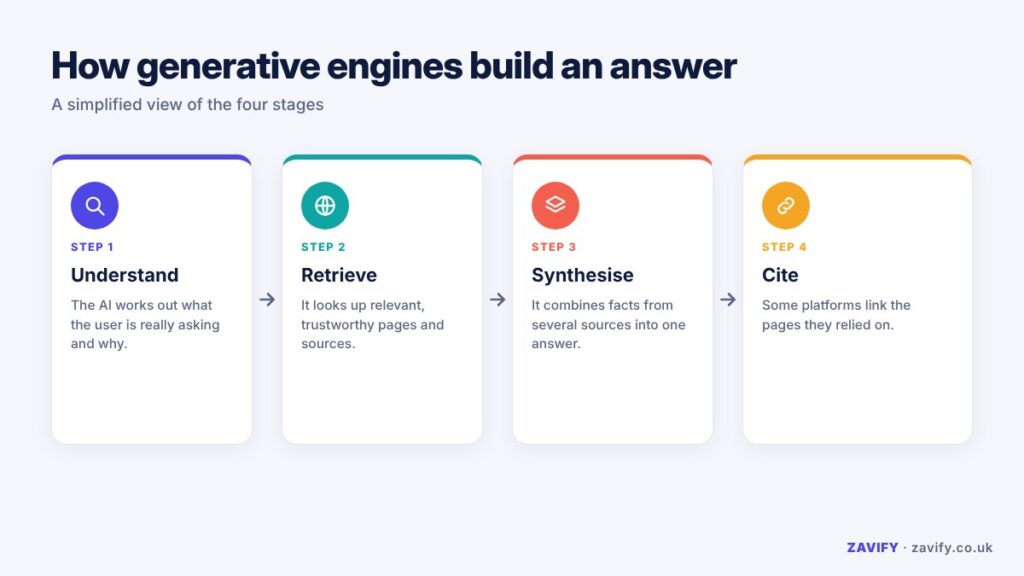
1. Understanding the question
The AI interprets what the user is really asking, including the intent behind it. A question like “is GEO worth it for a small business?” is about value and practicality, not just a definition.
2. Retrieving information
Many AI search tools look up current information from the web or a search index. Google describes how this works for its own products in AI features and your website. They pull in pages that seem relevant and trustworthy. Others also lean on what the model learned during training.
3. Synthesising an answer
The AI combines information from several sources into one clear response. Content that is well organised, factual and easy to quote is much easier to use at this stage.
4. Citing sources
Some platforms show links to the pages they used. Those citations are the GEO equivalent of a top ranking.
The key insight is simple: AI tools favour content that is easy to extract, easy to verify and consistent with other trusted sources.
The core principles of generative engine optimization
Generative engine optimization isn’t a single tactic. It’s a set of principles that make your content more useful to both humans and machines.
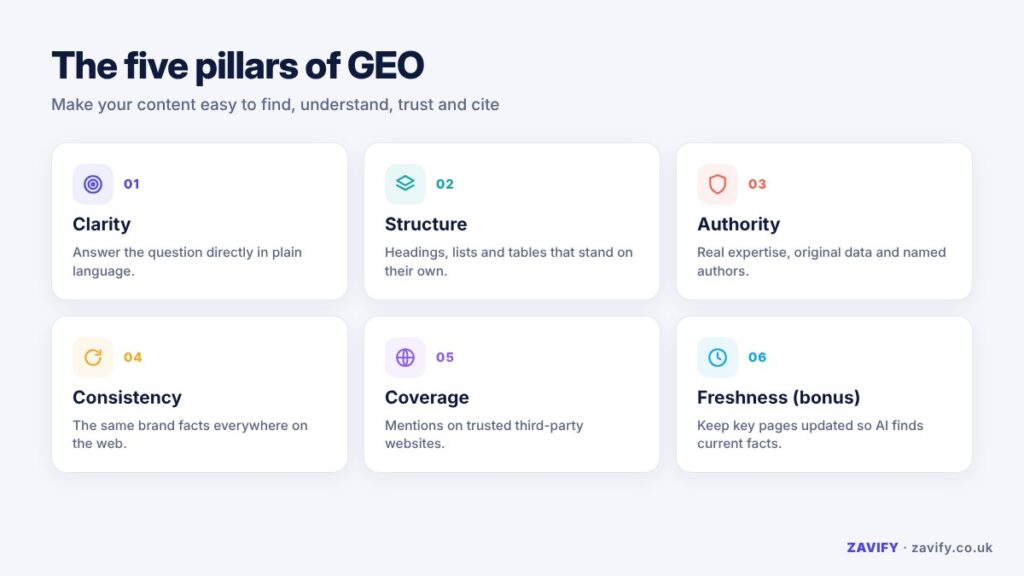
Clarity: answer the question directly
Put the most important answer near the top of the page and under the relevant heading. If someone asks “what is X?”, your first sentence should define X in plain language. AI tools often pick up these concise, self-contained statements.
Structure: make content easy to extract
Use descriptive headings, short paragraphs, bullet points, numbered steps and tables. Our guide to improving content extractability for AI goes deeper on this. Each section should make sense on its own, because an AI may use only one part of your page.
Authority: show real expertise
Add author bios, first-hand experience, original data, examples and case studies. Content that demonstrates genuine knowledge is more likely to be trusted than generic, rewritten material.
Consistency: tell the same story everywhere
AI tools compare information across many sources. Make sure your company name, services, pricing approach, locations and key facts match across your website, social profiles, business listings and review sites.
Coverage: be mentioned beyond your own site
Generative engines often rely on third-party sources such as industry publications, comparison articles, forums, reviews and news coverage. Earning mentions on trusted sites is one of the strongest GEO signals you can build, and it’s the heart of any AI citation strategy.
Practical generative engine optimization tactics you can use today
Here are concrete actions any business can take, even with a small team.
Write answer-first introductions
Open each article with a two- or three-sentence summary that directly answers the main question. Then go deeper.
Turn headings into questions
Use headings that mirror how people ask questions, such as “How much does GEO cost?” or “Is GEO different from SEO?” Then answer each one immediately below.
Add FAQs to key pages
FAQ sections capture the follow-up questions people ask AI assistants. Keep answers short, specific and factual.
Include statistics and specific facts
Concrete numbers, dates and definitions are easier for AI to quote than vague claims. Only use data you can stand behind, and keep it up to date.
Use structured data
Schema markup for articles, FAQs, products, reviews and your organisation helps machines understand what your content is about and who is behind it.
Build topic clusters
Instead of one page on a topic, create a main guide supported by several detailed articles that link together. This signals depth of knowledge on the subject.
Keep content fresh
Update important pages regularly, especially ones with dates, prices, tools or statistics. Outdated information is less likely to be used.
Pursue digital PR and partnerships
Contribute expert quotes, publish original research and get listed in respected industry roundups. These third-party mentions shape how AI describes your brand.
Generative engine optimization for different types of businesses
The principles are the same for everyone, but the priorities change depending on what you sell.
Local service businesses
For plumbers, dentists, salons and law firms, AI tools often answer questions like “best emergency plumber near me” or “is this dentist good with nervous patients?” Focus on complete, accurate business listings, consistent contact details, genuine reviews and service pages that clearly explain what you do, where you work and what makes you different.
B2B and SaaS companies
Buyers increasingly ask AI assistants to compare vendors and explain options. Publish detailed comparison pages, use-case guides, honest pricing explanations and integration documentation. Earn mentions in industry roundups and analyst-style reviews, because AI tools lean heavily on these when building shortlists.
Ecommerce brands
Shoppers ask questions such as “best running shoes for flat feet” or “is this jacket waterproof?” Clear product descriptions, specification tables, sizing guides, FAQs and reviews help AI tools match your products to specific needs. Buying guides that answer real shopping questions are especially valuable.
Publishers and bloggers
Generic information is the easiest content for AI to summarise without credit. Stand out with original research, expert interviews, first-hand testing and strong opinions backed by evidence. The more unique your insight, the more likely AI tools are to cite you as the source.
How to measure generative engine optimization success
Measuring GEO is newer and less precise than measuring SEO, but you can still track meaningful progress.
- AI mention rate: how often your brand appears for a set of tracked questions.
- Citations: how often your pages are linked as sources.
- Share of voice: your mentions compared with competitors.
- Referral traffic from AI platforms: visits from ChatGPT, Perplexity, Gemini and similar tools, visible in your analytics.
- Branded search growth: more people searching for your name after seeing it in AI answers.
Dedicated AI visibility tools can automate much of this tracking by running your chosen prompts regularly and reporting the results.
Common GEO mistakes to avoid
- Stuffing content with keywords. AI rewards clarity and usefulness, not repetition.
- Publishing thin, generic articles. If your content says the same thing as hundreds of other pages, there’s no reason for an AI to choose yours.
- Ignoring your off-site reputation. Your own website is only part of the picture.
- Hiding answers. Long, rambling introductions make it harder for both people and AI to find the point.
- Expecting instant results. Like SEO, GEO builds over time.
Your GEO starter checklist
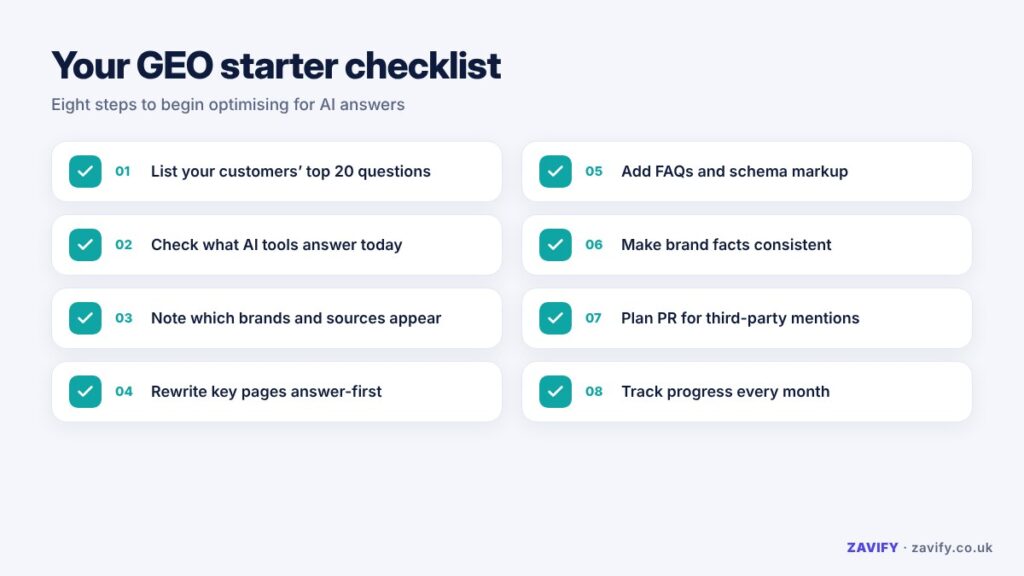
- List the 20 questions your customers ask most often.
- Check what ChatGPT, Gemini, Perplexity and Google AI Overviews say for each.
- Note which brands and sources appear.
- Rewrite your key pages with answer-first summaries and clear headings.
- Add FAQ sections and relevant schema markup.
- Make your brand facts consistent across the web.
- Plan PR and partnership activity to earn third-party mentions.
- Track your progress monthly.
Frequently asked questions
What does GEO stand for in marketing?
In marketing, GEO stands for generative engine optimization: the practice of optimising content so AI tools include and cite it in their generated answers.
Is GEO replacing SEO?
No. GEO builds on SEO. Many AI tools use search results to find information, so strong SEO foundations such as crawlable pages, quality content and authority still matter. We compare the two in detail in GEO vs SEO. GEO adds a focus on being extracted and cited in AI answers.
How long does GEO take to work?
It varies. Changes to your own content can be picked up relatively quickly by AI tools that search the web in real time, while building authority and third-party mentions usually takes several months.
Do small businesses need GEO?
Yes, especially for local and niche questions. Clear, accurate information about your services, location and expertise helps AI tools recommend you when customers ask for options nearby or in your specialty.
Final thoughts
Generative engine optimization is about making your expertise easy for AI to find, understand and trust. The good news is that the principles behind it — clear answers, solid structure, real authority and consistent information — also make your content better for people. Start with the questions your customers ask, give them the best answers on the web, and make sure the rest of the internet agrees with what you say.