
People don’t just “search” anymore. They ask. They ask Google a full question, ask Alexa or Siri while cooking, or ask ChatGPT to explain something step by step. In each case, they want one clear answer, fast. The brands that provide that answer win attention, trust and, increasingly, customers.
That’s where AEO comes in. In this guide, you’ll learn what AEO in marketing really means, how it differs from SEO and GEO, how to structure content so it gets picked as the answer, and which AEO tools can help you track and improve your results.
Table of Contents
What is AEO in marketing?
AEO stands for answer engine optimization. It’s the practice of creating and structuring content so that “answer engines” select it as the direct response to a user’s question.
An answer engine is any platform that tries to answer a question directly instead of only listing links. That includes:
- Google’s featured snippets, “People also ask” boxes and AI Overviews
- Voice assistants such as Google Assistant, Siri and Alexa
- AI assistants and chatbots such as ChatGPT, Gemini, Copilot and Perplexity
In simple terms, SEO helps you rank, while AEO helps you become the answer.
Why AEO in marketing matters now
- Questions are getting longer and more conversational. People type and speak to search tools the way they’d talk to a person.
- Zero-click results are growing. When an answer appears directly on the page or in an AI chat, many people never click a link, so being the answer is the visibility.
- Answers build trust. The brand quoted as the answer is seen as the expert on that topic.
- Voice search returns one result. A voice assistant usually reads out a single answer, not ten options.
AEO vs SEO vs GEO: what’s the difference?
These three terms overlap, which is why they’re often confused. Here’s the simplest way to separate them.
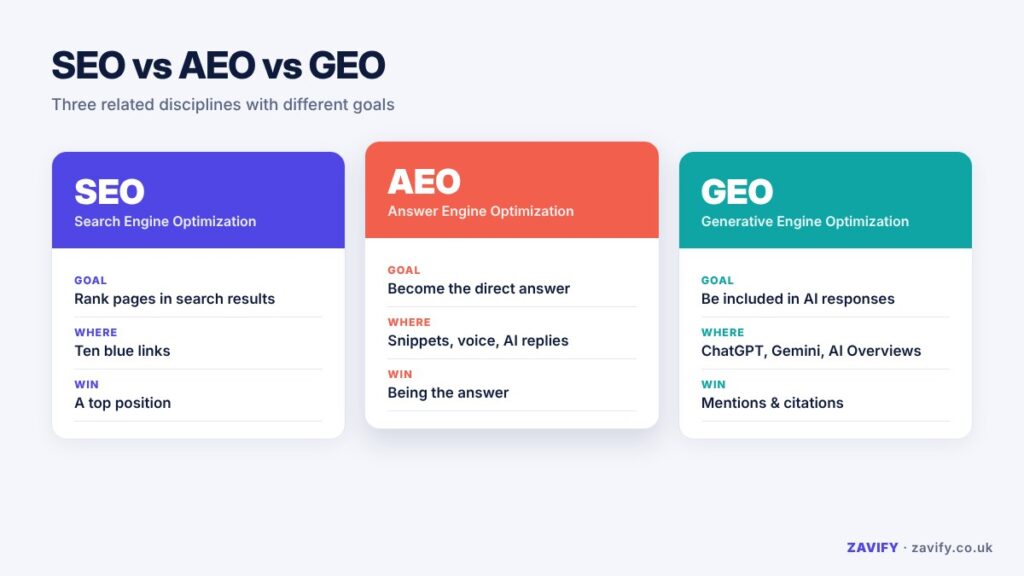
- SEO (search engine optimization) focuses on ranking your web pages in traditional search results.
- AEO (answer engine optimization) focuses on getting your content selected as the direct answer to a specific question, whether in a featured snippet, a voice response or an AI reply.
- GEO (generative engine optimization) focuses on being included and cited in longer, AI-generated responses that combine information from many sources.
In practice, AEO sits between the two: it uses SEO foundations and shares GEO’s focus on clear, extractable answers. Read our guides to generative engine optimization and GEO vs SEO for more detail. A strong strategy uses all three together.
How answer engines choose an answer
Answer engines look for content that is:
- Relevant: it matches the exact question and the intent behind it.
- Concise: the core answer is stated clearly, usually in 40 to 60 words.
- Well structured: headings, lists, steps and tables make the answer easy to extract.
- Trustworthy: it comes from a credible source with clear expertise.
- Accessible: the page is crawlable, fast and marked up so machines understand it.
How to do answer engine optimization: 8 practical steps
1. Find the questions your audience asks
Start with question-based research. Look at “People also ask” boxes, autocomplete suggestions, forums, customer emails, sales calls and support tickets. Our list of SEO keyword examples shows how question keywords fit into a wider strategy. Keyword tools can also filter search terms phrased as questions, such as “how,” “what,” “why” and “can.”
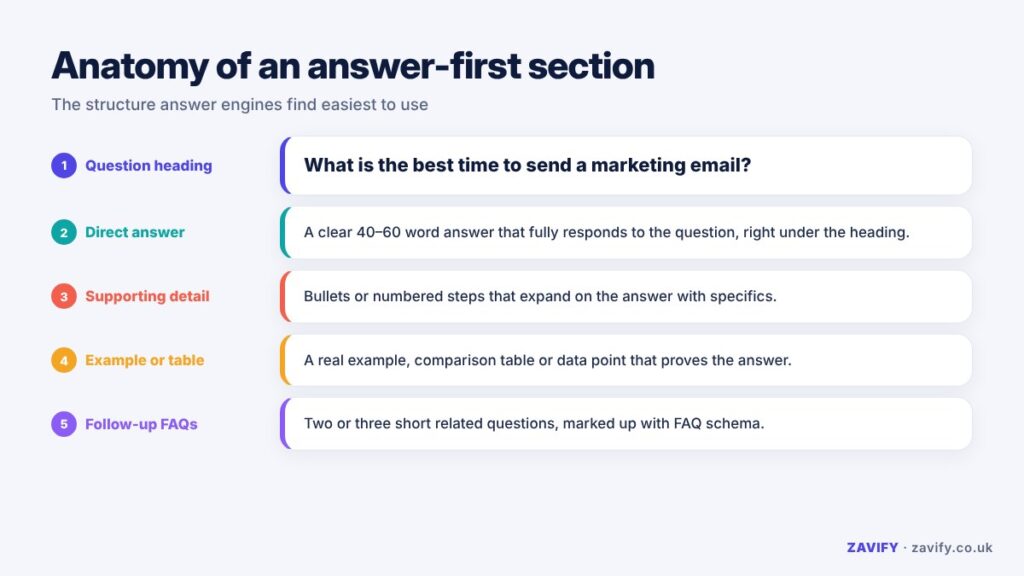
2. Use the question as your heading
Turn each important question into an H2 or H3 heading, written the way people actually ask it: “What is AEO in marketing?” rather than “AEO Overview.”
3. Answer immediately, then expand
Put a clear, direct answer of one to three sentences right below the heading. Then add detail, examples and context underneath. This “answer-first” structure is the single most important AEO technique.
4. Match the format to the question
- “What is…” questions → a short definition paragraph.
- “How to…” questions → numbered steps.
- “Best…” or “types of…” questions → a bulleted list.
- “X vs Y” questions → a comparison table.
Answer engines often reuse these formats directly.
5. Add an FAQ section
FAQs capture the follow-up questions people ask. Keep each answer short and specific, and avoid repeating the same information across several questions.
6. Use schema markup
Structured data such as FAQ, HowTo, Article, Product, Organization and LocalBusiness schema helps search engines and AI tools understand your content. Some rich results depend on it. Google’s introduction to structured data explains how it works.
7. Write for voice search
Use natural, conversational language and include the kind of full questions people speak aloud. For local businesses, make sure your Google Business Profile, address, opening hours and services are complete and accurate.
8. Strengthen trust signals
Add author names and credentials, cite reliable data, show real experience and keep information up to date, in line with Google’s guidance on helpful, people-first content. Answer engines prefer sources they can trust, especially for health, finance and legal topics.
AEO in marketing: a before and after example
Here’s a quick example of how a small change in structure can make content far more answer-friendly.
Before: A marketing agency’s blog post is titled “Thoughts on Email Timing.” The first three paragraphs discuss the history of email marketing and the agency’s own experience. The actual advice about when to send emails appears halfway down the page, mixed into a long paragraph.
After: The heading becomes “What is the best time to send a marketing email?” Directly beneath it is a two-sentence answer explaining that the best time depends on your audience, and that testing a few weekday morning and early afternoon slots is a sensible starting point. Below that, a short list explains how to test send times, followed by a table showing how to read the results. The page ends with three FAQs, such as “Should I send emails on weekends?”, each answered in a sentence or two.
The information hasn’t changed much, but the second version is far easier for Google to show as a featured snippet, for a voice assistant to read aloud and for an AI tool to quote. That’s AEO in a nutshell: the same expertise, packaged as a clear answer.
Answer engine optimization best practices checklist
- Lead with the answer in the first sentence of each section.
- Keep core answers between 40 and 60 words.
- Use one clear question per heading.
- Use lists, steps and tables where they fit naturally.
- Add FAQ schema to pages with genuine FAQs.
- Keep paragraphs short and scannable.
- Update facts, dates and statistics regularly.
- Make sure pages load quickly and work well on mobile.
The best answer engine optimization tools
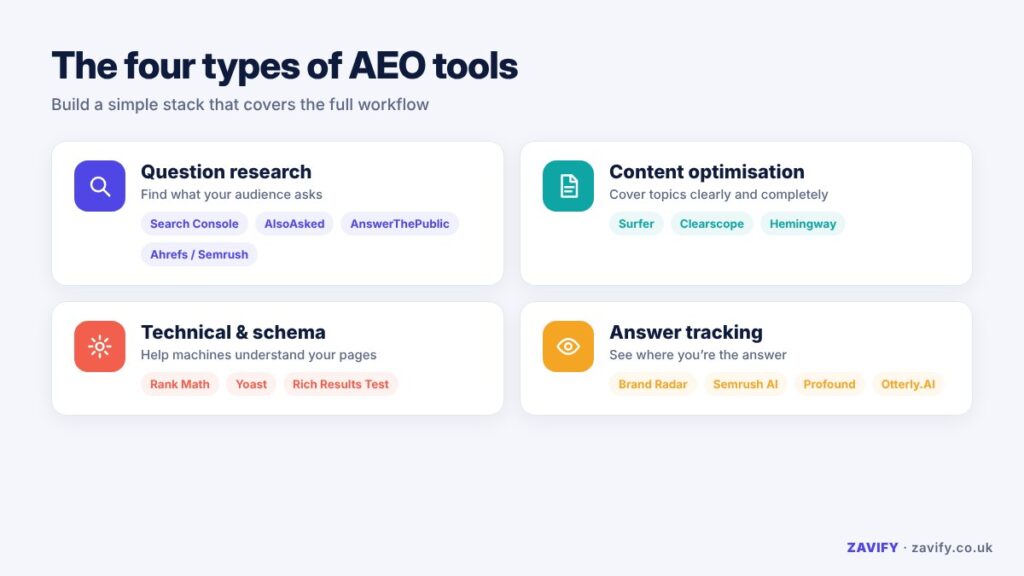
AEO doesn’t require expensive software, but the right tools make research and tracking much easier. They fall into four main groups.
Question research tools
- Google Search Console: shows the real queries, including questions, that already bring visitors to your site.
- AlsoAsked and AnswerThePublic: visualise the questions people ask around a topic.
- Ahrefs and Semrush: both let you filter keyword ideas to show only question-based searches, with search volume and difficulty.
Content optimisation tools
- Surfer, Clearscope and similar content editors: help you cover a topic thoroughly and spot missing subtopics.
- Readability checkers such as Hemingway: help you keep answers clear and concise.
Technical and schema tools
- Rank Math or Yoast (for WordPress): make it easy to add FAQ, HowTo and other schema without code.
- Google’s Rich Results Test: checks that your structured data is valid.
Answer and AI visibility tracking tools
- Ahrefs Brand Radar, Semrush’s AI Visibility Toolkit, Profound, Peec AI and Otterly.AI: track whether your brand is mentioned or cited in AI answers across platforms like ChatGPT, Gemini, Perplexity and Google AI Overviews. See our full comparison of the best AI visibility tools.
- Rank trackers with SERP feature tracking: show when you win or lose featured snippets and “People also ask” placements.
Tool features change often, so check each vendor’s current capabilities before you commit.
How to measure answer engine optimization success
Track a mix of traditional and newer metrics:
- Featured snippets and “People also ask” placements won
- Impressions for question-based queries in Google Search Console
- Mentions and citations in AI answers for your tracked questions
- Branded search growth over time
- Conversions from visitors who arrive on question-focused pages
Common answer engine optimization mistakes
- Burying the answer under long introductions.
- Writing vague answers that don’t actually commit to a clear response.
- Overusing FAQ schema on content that isn’t a genuine FAQ.
- Chasing every question instead of the ones that matter to your customers.
- Forgetting to update answers when facts change.
Frequently asked questions
What does AEO stand for?
AEO stands for answer engine optimization: optimising content so search engines, voice assistants and AI tools choose it as the direct answer to a question.
Is AEO the same as SEO?
No, but they’re closely related. SEO focuses on ranking pages in search results, while AEO focuses on being selected as the answer. Good AEO depends on solid SEO foundations.
What is the difference between AEO and GEO?
AEO focuses on providing the single best answer to a specific question, while GEO focuses on being included and cited in longer AI-generated responses. They use many of the same techniques.
Why is AEO in marketing important for small businesses?
Voice assistants and AI tools often recommend only one or two options. AEO in marketing helps small businesses compete with bigger brands by giving the clearest, most trustworthy answer to local and niche questions.
Do I need special tools for AEO?
Not to get started. Google Search Console, a schema plugin and careful writing go a long way. Dedicated AI visibility tools become useful when you want to track mentions across AI platforms.
Final thoughts
AEO in marketing is about meeting people at the exact moment they ask a question and giving them the clearest, most trustworthy answer available. Find the questions your audience cares about, answer them directly, structure your content so machines can understand it and track where you show up. Do that consistently and your brand becomes the answer people hear, see and remember.