
For two decades, the goal of search marketing was simple: get your page to the top of Google. Today, many searches end with an AI-written answer instead of a click. That’s why marketers are now asking about GEO vs SEO: is generative engine optimization a replacement for search engine optimization, a new name for the same thing, or something else entirely?
The short answer: SEO helps your pages rank in search results, while GEO helps your brand and content appear inside AI-generated answers. They share the same foundations, but they measure success differently and reward slightly different kinds of content. This guide breaks down the differences, the overlap and a practical plan for doing both well.
Quick definitions
What is SEO?
Search engine optimization (SEO) is the process of improving your website so it ranks higher in traditional search results on engines such as Google and Bing. It covers technical health, content quality, keywords, user experience and backlinks.
What is GEO?
Generative engine optimization (GEO) is the process of making your content and brand easy for AI systems — such as ChatGPT, Gemini, Perplexity, Copilot and Google AI Overviews — to find, trust and include in the answers they generate.
GEO vs SEO: the key differences at a glance
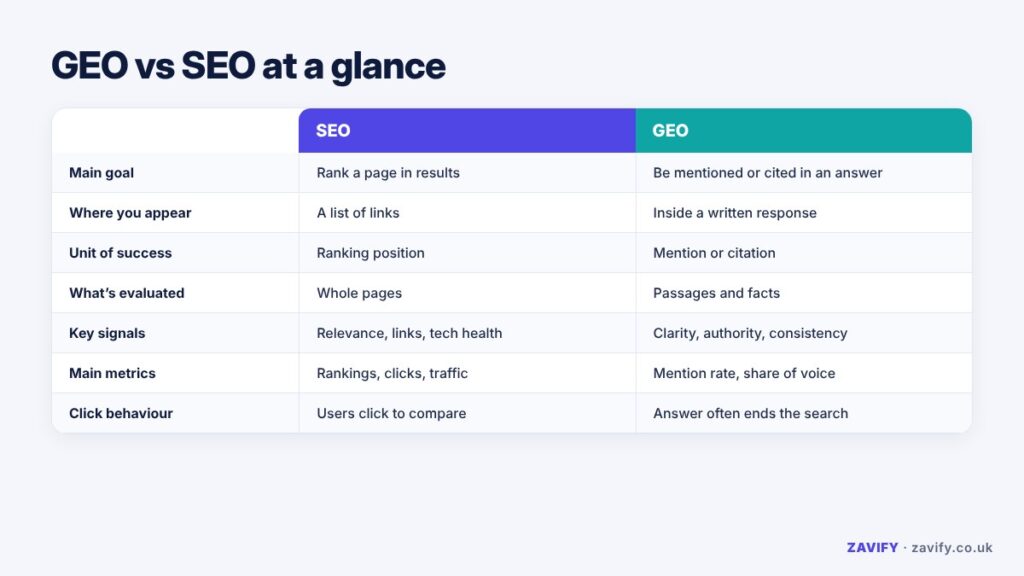
| SEO | GEO | |
|---|---|---|
| Main goal | Rank a page in search results | Be mentioned or cited in an AI answer |
| Where you appear | A list of links on a results page | Inside a written response |
| Unit of success | A ranking position | A mention, recommendation or citation |
| What gets evaluated | Mostly whole pages | Often individual passages and facts |
| Key signals | Relevance, backlinks, technical health, user experience | Clarity, extractability, authority, consistency across sources |
| Role of your website | Central | Important, but third-party mentions matter just as much |
| Main metrics | Rankings, clicks, organic traffic, conversions | Mention rate, share of voice, citations, AI referral traffic |
| Click behaviour | Users click through to compare results | Users often get the answer without clicking |
The 6 biggest differences explained
1. Ranking vs being included
In SEO, there are ten blue links on page one and you compete for a position. In GEO, there may be no list at all, just one answer that names a few brands. You’re either in it or you’re not, and being first in the answer matters a lot.
2. Pages vs passages
Search engines rank pages. AI tools often lift a single sentence, definition, statistic or list from a page and combine it with information from other sources. That means every section of your content needs to stand on its own and make sense out of context.
3. Links vs mentions
Backlinks remain one of the strongest SEO signals. For GEO, unlinked mentions of your brand on trusted websites, in reviews, forums and articles can also shape how AI describes you. Your reputation across the web becomes part of your optimisation.
4. Keywords vs questions
SEO has traditionally been built around short keywords like “CRM software.” AI users tend to ask longer, conversational questions, such as “what’s the easiest CRM for a three-person agency that already uses Gmail?” GEO content needs to answer those detailed, specific questions.
5. Clicks vs influence
SEO success is easy to see in your analytics: rankings rise and traffic follows. GEO success is often invisible in traffic reports because the user may never click. Instead, it shows up as more branded searches, more direct visits and more “I heard about you from ChatGPT” in sales conversations.
6. Stable results vs changing answers
Search rankings move, but they’re fairly stable from day to day. AI answers can change each time a question is asked. GEO has to be measured across many prompts over several weeks, not from a single check.
Where GEO and SEO overlap
Despite the differences, GEO and SEO have far more in common than many people think. In fact, most good GEO starts with good SEO.
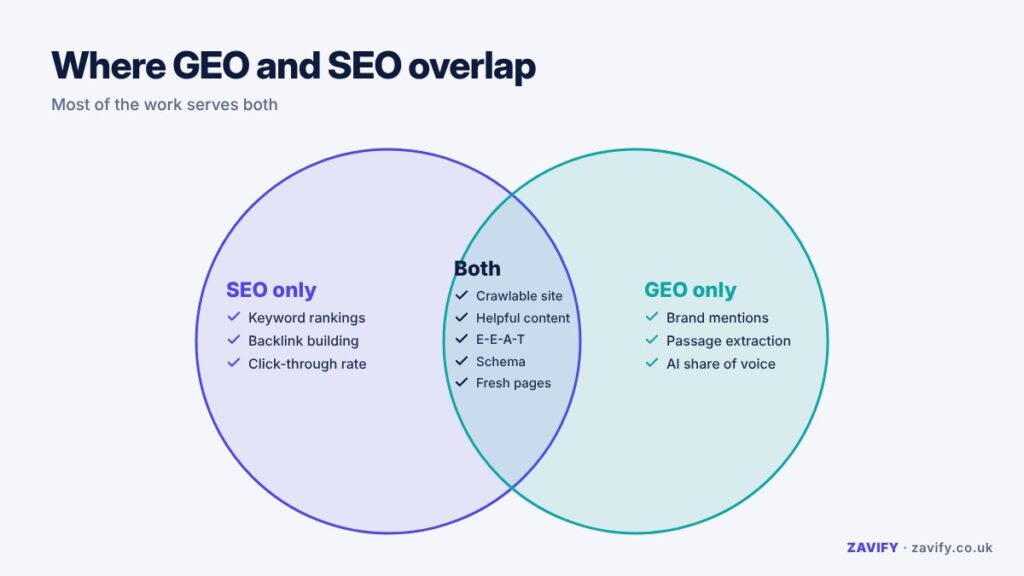
- Crawlability: if search engines and AI crawlers can’t access your pages, neither strategy works.
- Helpful, original content: both reward expert, people-first content over generic articles.
- Search visibility: many AI tools look up current information from search results, so ranking well increases your chance of being used as a source.
- E-E-A-T signals: experience, expertise, authoritativeness and trustworthiness matter to both.
- Structured data: schema markup helps search engines and AI systems understand your content.
- Fresh information: up-to-date pages perform better in both.
Is GEO replacing SEO?
No. GEO is an extension of SEO, not a replacement. Traditional search still drives an enormous amount of traffic, and AI tools frequently depend on search indexes to find their information. Abandoning SEO to focus only on GEO would weaken the very foundations AI tools rely on.
What is changing is the definition of success. A modern search strategy should measure both how well you rank and how often you’re included in AI answers.
How to measure each
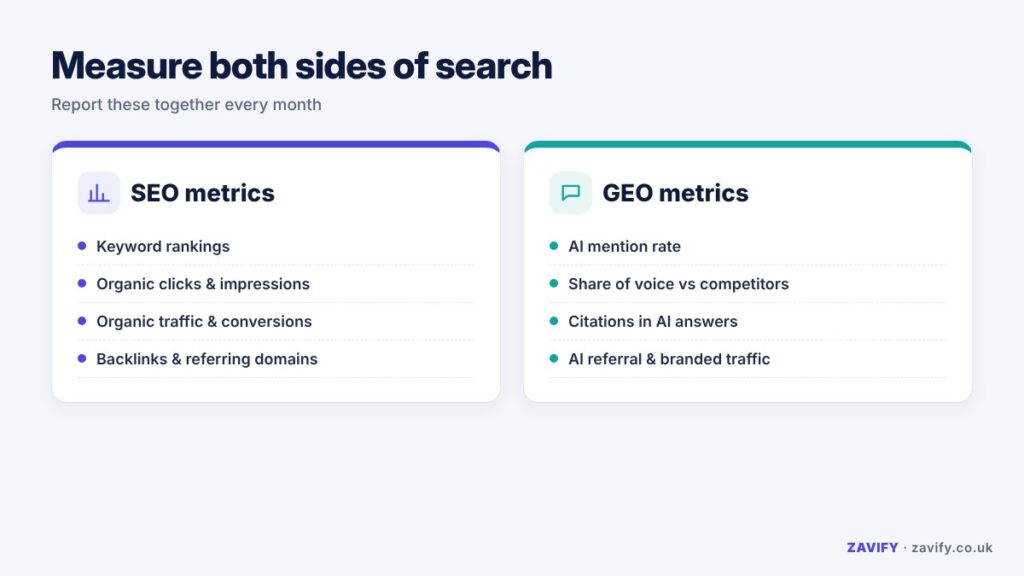
SEO metrics
- Keyword rankings
- Organic clicks and impressions (from Google Search Console)
- Organic traffic and conversions
- Backlinks and referring domains
GEO metrics
- Mention rate across a set of tracked prompts
- Share of voice compared with competitors
- Citations of your pages in AI answers
- Referral traffic from AI platforms such as ChatGPT and Perplexity
- Growth in branded search and direct traffic
How to build one strategy that wins both
You don’t need two separate teams or two separate content plans. Use this combined approach.
Step 1: Fix the technical foundations
Make sure your site is fast, mobile-friendly and crawlable. Check that you’re not accidentally blocking important search or AI crawlers in your robots.txt file, unless you’ve made a deliberate decision to do so.
Step 2: Research keywords and questions
Use keyword tools for search demand, then expand each topic with the conversational questions customers ask. Sales calls, support tickets, community forums and “People also ask” boxes are excellent sources.
Step 3: Write answer-first, well-structured content
Start each page and section with a direct answer, then add depth. Use clear headings, short paragraphs, lists and tables. This helps your page rank and makes it easy for AI to extract.
Step 4: Show real expertise
Add first-hand experience, original examples, data and named authors. This is what separates your page from the hundreds of similar articles AI tools have already seen.
Step 5: Build authority beyond your website
Earn backlinks for SEO and brand mentions for GEO through digital PR, guest contributions, partnerships, reviews and expert commentary. Aim to be included in the comparison and “best of” articles your audience reads.
Step 6: Keep your brand facts consistent
Your company description, services, locations and key claims should match across your website, social profiles, directories and review sites.
Step 7: Measure both, monthly
Report rankings and organic traffic alongside AI mention rate and share of voice. Over time, you’ll see which topics win in search, which win in AI answers and where to focus next.
A simple example: one topic, optimised for both
Imagine a small accounting firm that wants to attract freelancers. Here’s how the same topic might be handled with an SEO-only mindset compared with a combined SEO and GEO approach.
SEO-only approach: The firm targets the keyword “freelancer tax tips,” writes a 1,500-word article with the keyword in the title and headings, and builds a few backlinks. The page may rank well, but the key advice is spread across long paragraphs.
Combined SEO and GEO approach: The firm keeps the same keyword target but also lists the real questions freelancers ask, such as “how much should a freelancer set aside for taxes?” and “can freelancers deduct home office costs?” Each question becomes a heading with a short, direct answer underneath, followed by examples. The article includes a simple table of common deductible expenses, an FAQ section with schema markup and a named author who is a qualified accountant. The firm also contributes expert quotes to two finance publications and keeps its business listings up to date.
The second version is just as strong for search rankings, but it’s also far easier for an AI assistant to quote and far more likely to be trusted as a source. That’s the practical difference between treating GEO and SEO as rivals and treating them as one strategy.
Which should you prioritise?
It depends on your audience:
- Local and service businesses should keep SEO and local listings as their foundation, while making sure their information is accurate wherever AI might look.
- B2B and SaaS companies should invest heavily in GEO, because buyers increasingly use AI assistants to research and shortlist vendors.
- Ecommerce brands need both: SEO for product and category pages, and GEO for the “best product for…” questions buyers ask.
- Publishers and content sites should focus on original insight and expertise, since generic information is the easiest thing for AI to summarise without sending a click.
Frequently asked questions
What is the main difference between GEO and SEO?
SEO aims to rank your pages in traditional search results, while GEO aims to get your brand and content mentioned or cited inside AI-generated answers.
Do I need separate content for GEO and SEO?
Usually not. Well-structured, expert, answer-first content serves both. The main extra work for GEO is building third-party mentions and tracking AI answers.
Does good SEO help with GEO?
Yes. Many AI tools retrieve information from search results, so strong rankings and authority increase the chance that your content is used and cited.
What about AEO?
Answer engine optimization (AEO) focuses on getting your content chosen as the direct answer to a question, for example in featured snippets, voice assistants and AI responses. It overlaps heavily with both GEO and SEO.
Final thoughts
The GEO vs SEO debate has a simple conclusion: you need both. SEO earns your place in search results, and GEO earns your place in the answers that increasingly sit above them. Build on strong SEO foundations, write content that answers real questions clearly, earn trust across the web and measure your presence in both worlds. That combination is what search success looks like in 2026.