
I’ll be honest with you—when I first heard about generative AI transforming e-commerce, I was sceptical. It sounded like another tech buzzword that would overpromise and underdeliver.
But after spending the last two years implementing AI tools across multiple online stores, I’ve seen firsthand how this technology actually works in the real world. Some applications have been game-changers. Others? Not so much.
In this article, I’m sharing what I’ve learned from real implementations—the wins, the failures, and the practical strategies that actually move the needle for e-commerce businesses.
What Generative AI Actually Means for E-commerce
Let me explain how this actually works, step by step.
Generative AI refers to artificial intelligence systems that can create new content—text, images, code, or other outputs—based on patterns they’ve learned from massive amounts of data. This is the core technology behind modern generative AI development services, powering tools like ChatGPT, Midjourney, or Claude (which you might be familiar with).
For e-commerce, this means AI can now:
- Write product descriptions in seconds
- Generate unique images for marketing campaigns
- Create personalised email content for different customer segments
- Answer customer questions through intelligent chatbots
- Analyse customer data and suggest targeted product recommendations
The key difference from older AI tools? An AI ad generator doesn’t just analyse or categorise—it actually creates original ad content tailored to your specific needs, often guided by AI strategy and consulting services.
I remember writing product descriptions by hand for a 200-item catalogue. It took me three weeks. When I tested AI-powered content generation for a similar project last year, it took about six hours (including editing and quality checks). That’s the practical difference we’re talking about.
Real-World Use Cases I’ve Implemented (And What Actually Works)
Here’s where theory meets reality. I’ve tested generative AI across various AI in e-commerce functions, and these are the applications that delivered measurable results:
AI Product Descriptions That Don’t Sound Robotic
I was managing a home decor store with over 500 products. Writing unique, SEO-optimised descriptions was eating up hours every week.
I started using AI to generate first drafts of product descriptions. This works well across a wide range of categories. Stores selling anything from home decor to dog food have used AI drafts to speed up catalogue builds without sacrificing quality. The process looked like this:
- Feed the AI basic product specs and key features
- Generate 3-4 variations
- Edit for brand voice and accuracy
- Add personal touches and unique selling points
The result? We cut content creation time by 70% while actually improving consistency across the catalogue. The trick was never publishing AI content raw—it always needed human editing to sound authentic. Many ecommerce teams now use a dedicated tool to humanize AI output as a finishing step before publishing, keeping product copy and email content sounding natural and on-brand.
Personalised Email Marketing at Scale
One of my most successful implementations was using AI for email personalisation. Instead of sending the same promotional email to 10,000 subscribers, we used an AI Instagram post generator alongside AI to create personalised subject lines and content blocks based on customer behaviour. For WooCommerce email marketing, this kind of behavioral targeting can also be part of a broader email marketing strategy, helping businesses follow up with customers based on what they viewed, bought, or left behind.”
For example, customers who previously bought running shoes a wireless office headset with mic received different product recommendations than those who browsed yoga equipment.
The impact? Open rates increased by 23%, and click-through rates jumped by 31% compared to our generic campaigns.
AI Chatbots That Actually Help Customers
Businesses are increasingly adopting AI-powered customer support solutions to improve response times, reduce operational workload, and deliver better shopping experiences at scale. At Techvoot, we develop custom AI chatbot solutions for ecommerce businesses tailored to customer journeys, support workflows, and business goals. I’ve implemented several AI chatbots, and here’s what I learned: they’re great for handling common questions but terrible at complex problem-solving.
The sweet spot is using AI chatbots for:
- Order tracking inquiries
- Basic product questions
- Store policy information
- Initial customer screening before human handoff
We saw a 40% reduction in simple support tickets, freeing up our team to handle more complex issues that required human judgment.
Visual Content Creation for Social Media
Generating product images and social media graphics with AI tools like Midjourney or DALL-E has been hit-or-miss. many teams now create engaging videos with free AI video generator tools, transforming static visuals into short, attention-grabbing content for social media. I’ve found it works best for:
- Background images and lifestyle scenes
- Concept mockups and mood boards
- Social media templates and patterns
What doesn’t work well? Product photography needs to be accurate. I learned this the hard way when AI-generated images showed product details that didn’t match reality, leading to customer confusion. In such cases, using an AI image detector can help verify whether visuals are AI-generated before publishing them. For creating more structured presentations of these visuals, exploring Gamma alternatives can offer different approaches to showcase ideas effectively.
Dynamic Product Recommendations
AI-powered personalisation engines analyse browsing behaviour, purchase history, and similar customer patterns to suggest relevant products.
I implemented this in a fashion accessories store, and it increased average order value by 18%. The AI noticed patterns I never would have spotted—like customers who bought leather bags were also likely to purchase specific types of sunglasses.
It also helped us optimize stock planning, ensuring we always had the right PLG supplies ready for packaging, storage, and safe product handling during high-volume fulfilment periods. For structured product mockups like custom apparel, a hoodie design tool such as Adobe Express lets store owners create print-ready designs without needing a graphic designer. Print on demand has also benefited from this shift, AI lets sellers generate and test new designs in hours instead of weeks, without needing a dedicated designer on staff.
The Real Benefits of Generative AI for Online Stores
Based on my hands-on experience, here are the tangible benefits of Generative AI in Industries that actually matter:
Time savings are massive. Tasks that used to take days now take hours. I’m not exaggerating—content creation, email drafting, and basic customer service have been dramatically accelerated. For teams tracking this shift in Jira, starting from a Jira task template makes it easier to standardize how these AI-assisted tasks get logged and assigned as the workload changes.
Consistency improves. AI doesn’t have bad days. When you nail down the right prompts and processes, you get reliable output that maintains your brand voice across hundreds or thousands of pieces of content.
Personalisation becomes affordable. Previously, personalised marketing at scale required expensive enterprise software. Now, smaller stores can implement sophisticated personalisation without breaking the bank.
You can test more ideas faster. Need five different versions of an ad headline? Done in 30 seconds. Want to see how a product description would sound in different tones? Easy. This speed lets you experiment more and find what works.
It fills skill gaps. Not every small business owner is a talented copywriter or designer. AI provides a competent baseline that you can build from, even if you’re not an expert.To sustain these benefits as usage expands, an llm evaluation framework ensures output quality, consistency, and performance remain aligned with business goals.
The Challenges and Limitations Nobody Talks About
Let me share the frustrating parts that most AI hype articles skip over:
AI Content Still Needs Human Oversight
I learned this lesson when I published a batch of AI-generated product descriptions without careful review. Several contained subtle inaccuracies that confused customers. Running AI-generated content through an AI detector before publishing is one practical step that helps catch these issues early, flagging sections that still read as machine-generated before they reach customers. One description mentioned a feature that didn’t exist. In some cases, teams also use AI humanizer tools to refine AI-written text so it sounds more natural and closer to human writing before final review.
The reality: AI is a powerful assistant, not a replacement for human judgment. You still need someone who understands your products, customers, and brand to review everything. This experience highlights why clearly defining AI use cases within your business is essential, as it helps set proper boundaries for automation and ensures human oversight remains in place where accuracy and brand trust matter most.
The “Generic Voice” Problem
AI content often sounds a bit same-ish. It often misses the personality and unique perspective that make content truly memorable. That’s why I’ve developed strict editing protocols to bring back a human touch especially when writing about topics like the best Generative AI course so the content feels more authentic, relatable, and original.
When a customer reads your product description, they should feel your brand’s personality, not ChatGPT’s default tone.
Customer Trust Concerns
Some customers don’t like knowing they’re interacting with AI chatbots. We tested being transparent (“You’re chatting with our AI assistant”) versus vague (“Our support team is here to help”), and transparency performed better—but there was still a 15% drop in engagement compared to advertising human support.
Initial Setup Takes Real Work
Don’t believe anyone who says AI implementation is “plug and play.” Getting AI to understand your brand voice, product categories, and customer preferences requires significant upfront investment in:
- Training and fine-tuning
- Prompt engineering
- Integration with existing systems
- Testing and quality assurance
For e-commerce businesses that want expert-level help implementing custom AI solutions without the lengthy setup curve, partnering with specialized AI Development Services from Acquaint Softtech ensures your AI chatbots, recommendation engines, and personalization systems are properly architected and trained from day one.
My first AI chatbot took three weeks to set up correctly and another month of tweaking based on fundamental customer interactions.
Data Privacy and Security
Using AI tools means feeding them customer data, product information, and potentially sensitive business details. I’ve had to evaluate carefully:
- Where data is stored
- Who has access to it
- Whether AI providers use our data for training
- Compliance with GDPR and other regulations
This isn’t something to gloss over—it’s a real responsibility.
Best Practices for Successfully Implementing Generative AI
After multiple implementations (and a few expensive mistakes), here’s what actually works:
Start small and specific. Don’t try to AI-ify your entire business at once. Pick one clear use case—like product descriptions for a specific category—and nail that before expanding.
Develop clear brand guidelines for AI. Create a document that specifies your tone, key phrases, things to avoid, and examples of good vs. bad content. Feed this to AI tools as context.
Always have a human review. Set up a workflow where AI generates content, but humans always review before publishing. I use a simple three-tier system: AI draft → editor review → final approval.
Test everything with real customers. What sounds great to you might confuse customers. A/B test AI-generated content against human-created content and let the data decide.
Combine AI with human creativity. Use AI for the heavy lifting (first drafts, variations, research) and humans for strategy, emotional intelligence, and final polish. Platforms like Invideo Agent exemplify this approach by combining human direction with capabilities such as cinematic motion control.
Keep learning and iterating. AI tools improve constantly. What didn’t work six months ago might work great now. Stay curious and keep testing.
Be transparent with customers when it matters. If you’re using AI chatbot development services or personalization, consider being upfront about it. Transparency builds trust more than trying to hide it.
Tools and Platforms I’ve Actually Used
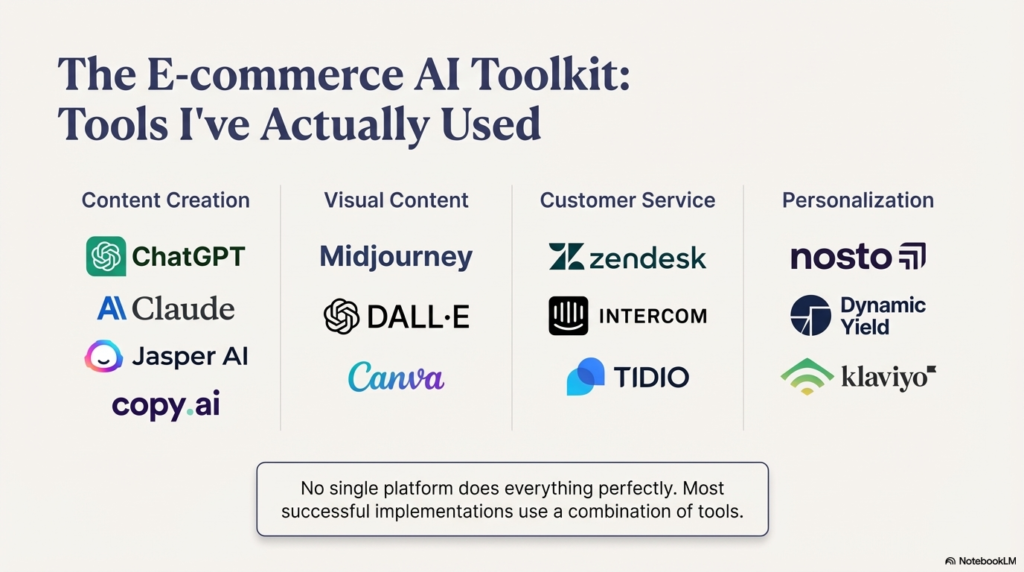
Here are the AI tools I’ve implemented in real e-commerce scenarios:
Content Creation:
- ChatGPT and Claude for product descriptions, email copy, and blog content
- Jasper AI is specifically designed for marketing copy
- Copy.ai for quick variations and brainstorming
- ChatGPT AI Content Generator for generating product and collection descriptions, blog posts, titles, meta descriptions, and other SEO content.
Visual Content:
- Midjourney for lifestyle and background images
- DALL-E for quick mockups and concepts
- Canva’s AI features for social media graphics, alongside AI 3d model generator tools for creating product visuals
Customer Service:
- Zendesk AI for intelligent ticket routing
- Intercom’s AI chatbot for initial customer screening
- AI cost calculator for software project cost estimation
Personalization:
- Nosto for product recommendations
- Dynamic Yield for website personalization
- Klaviyo’s AI features for email marketing
SEO and Analytics:
- Surfer SEO for content optimization
- MarketMuse for content strategy
- Google Analytics with AI-powered insights
- Apify for data and competitor price tracking
- For stores that outgrow GA4’s basic reporting, a dedicated ecommerce analytics tools comparison is worth a look – especially once you’re layering AI-driven personalisation on top and need to see what’s actually driving revenue.
Each tool has strengths and weaknesses. I’ve found that no single platform does everything perfectly, so most successful implementations use a combination of tools.
Comparing Generative AI Use Cases in E-commerce
Use CaseKey Benefits Business Impact Implementation Difficulty
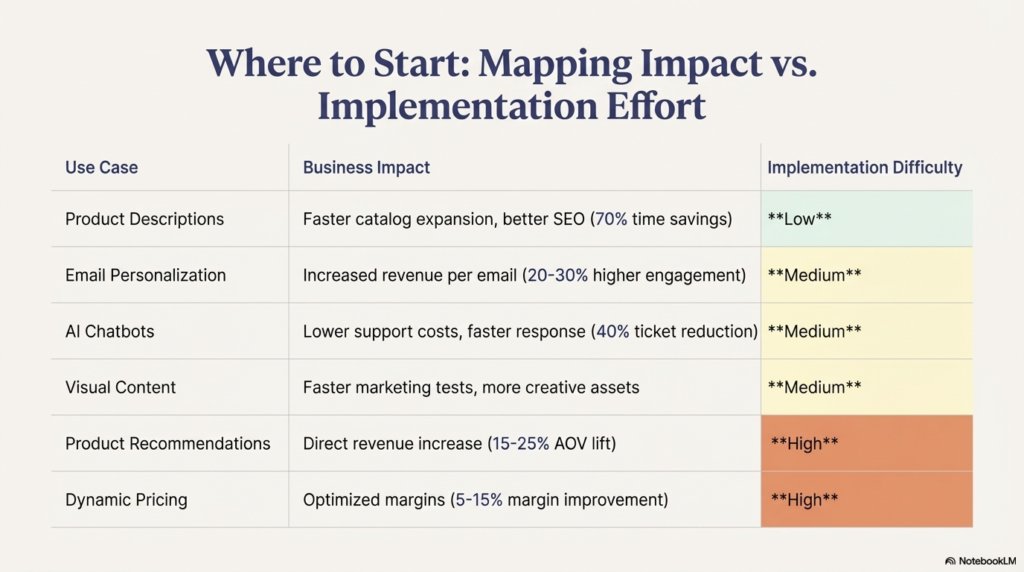
| Use Case | Key Benefits | Business Impact | Implementation Difficulty |
|---|---|---|---|
| Product Descriptions | 70% time savings, consistent brand voice | Faster catalog expansion, better SEO | Low – Easy to start |
| Email Personalization | 20-30% higher engagement rates | Increased revenue per email | Medium – Requires customer data |
| AI Chatbots | 40% reduction in simple tickets | Lower support costs, faster response | Medium – Needs training period |
| Product Recommendations | 15-25% increase in AOV | Direct revenue increase | High – Complex integration |
| Visual Content | Fast concept creation | More marketing tests possible | Medium – Still needs editing |
| Dynamic Pricing | Optimized margins and competitiveness | 5-15% margin improvement | High – Requires expertise |
Frequently Asked Questions
Is generative AI expensive to implement in e-commerce?
Not necessarily. Basic tools like ChatGPT start at $20/month, and many AI features are now built into platforms you might already use (like Shopify or Klaviyo). I’ve seen small stores implement useful AI features for under $100/month. Enterprise solutions cost more, but you can start small and scale as you see results.
Will AI replace human workers in online stores?
From what I’ve seen, no. AI changes the nature of work but doesn’t eliminate the need for humans. It handles repetitive tasks, freeing people to focus on strategy, creativity, and complex problem-solving. In my own teams, AI let us redirect people to higher-value work rather than eliminating positions.
How do I know if AI-generated content is accurate?
You verify it the same way you’d verify any content—by checking facts against reliable sources. I never publish AI content without review. Create a checklist: Does it accurately describe the product? Is the tone right? Are there any claims that need verification? Does it match our brand guidelines?
Can AI help with e-commerce SEO?
Yes, but with limitations. AI is excellent at generating SEO-optimized content structure, incorporating keywords naturally, and creating meta descriptions. However, it can’t replace strategic SEO thinking. I use AI to execute SEO tactics faster, but humans still need to define the strategy.
What’s the biggest mistake to avoid when using AI in e-commerce?
Treating it as “set it and forget it.” The biggest failures I’ve seen come from businesses that implement AI tools and never monitor or optimize them. AI requires ongoing management, testing, and refinement. Start with high expectations for yourself, not just the technology.
How do customers react to AI-powered features?
It depends on implementation. When AI works invisibly (like product recommendations), customers love the results without thinking about the technology. When AI is obvious (like chatbots), transparency helps. I’ve found that customers appreciate AI when it genuinely helps them, but they get frustrated when it’s used as a cheap replacement for human service.
Practical Takeaways and Next Steps
Here’s what I’d recommend based on my real-world experience:
If you’re just starting: Pick one specific problem that generative AI can solve. Product descriptions are a great entry point because they’re low-risk and high-impact. Use a tool like ChatGPT to generate drafts, then edit them to match your voice.
If you’re ready to scale: Look into AI-powered personalization for email marketing or product recommendations. These have direct ROI that’s easy to measure.
If you’re advanced: Consider custom AI implementations that integrate deeply with your systems—dynamic pricing, predictive inventory management, or sophisticated customer segmentation.
The most important thing I’ve learned? Generative AI is a tool, not magic. It amplifies what you already do well and helps you do it faster. But it still requires strategy, oversight, and a deep understanding of your customers.
Start small, test everything, and never lose sight of what actually matters: creating genuine value for your customers. The technology is just a means to that end.
The e-commerce stores winning with AI aren’t the ones using the fanciest tools; they’re the ones who understand their customers deeply and use AI to serve them better.