Building AI-First Applications: Best Practices for Businesses in 2026
It’s not the same as an application that incorporates AI, versus an application that is built around AI. Most of the businesses that have introduced AI features into their software in the last couple of years have been doing the latter: applying AI to top existing products. Recommendation Engine here. There, an AI-generated summary of that. A chatbot attached to a platform originally built for other purposes.
Creating an AI-first is a different ballgame. It involves creating the app architecture with AI built into it from the start, not as an afterthought. It involves making decisions from the outset regarding data structures, user experience, workflow design, and system architecture, all influenced by AI insights.
The difference is significant because applications that are AI First perform better and better than those that are AI added, every single time. They can be iterated on faster than the others; they are coherent in their use of the AI capabilities, and they are more reliable in production because the architecture was designed to support the use of AI capabilities, not to fit them into.
In 2026, it is one of the most impactful investments for businesses that is both technically and strategically sound.It is one of the most impactful investments for businesses, both technically and strategically, in 2026 to build AI-first software, let alone well.
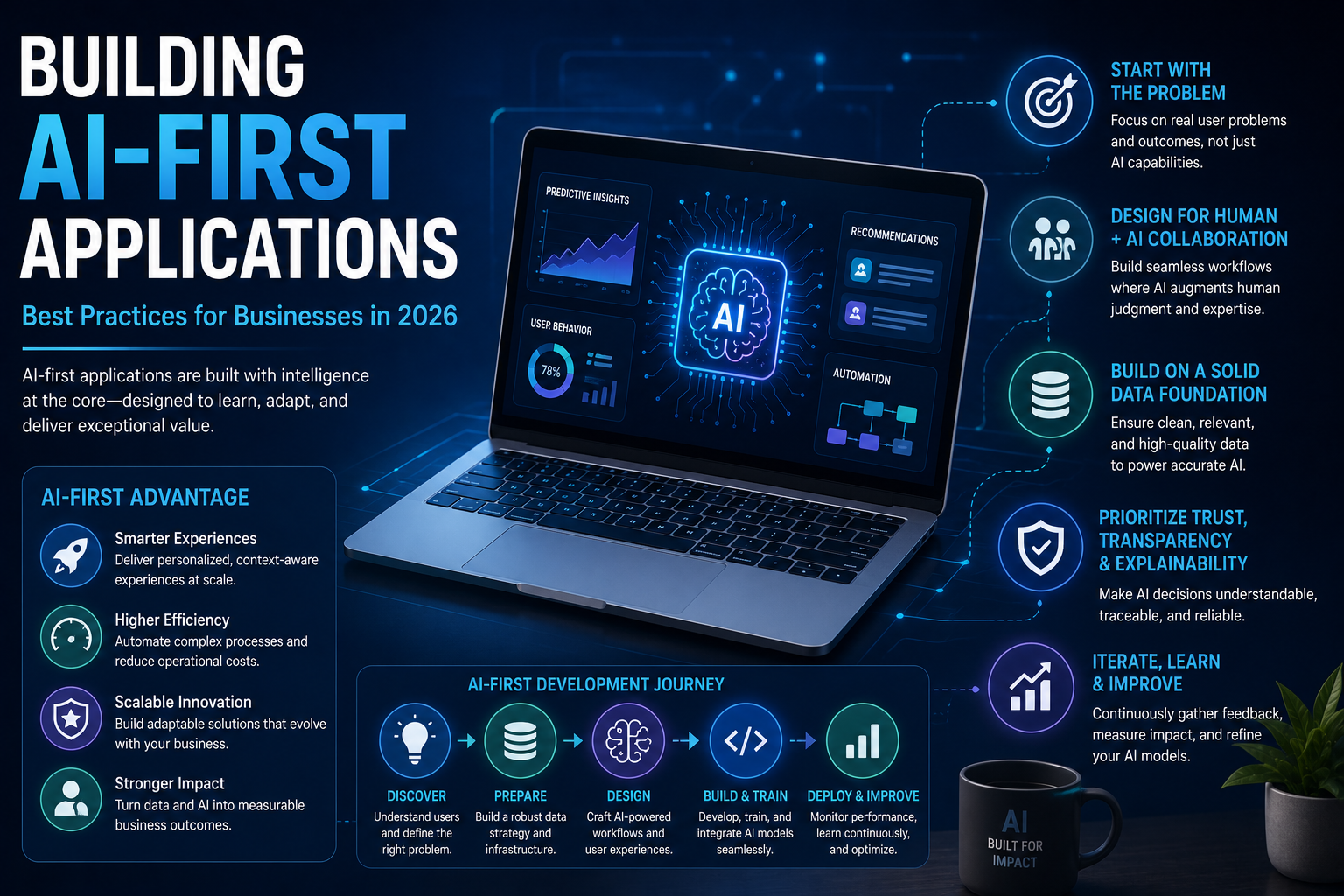
Start with the Problem, Not the Technology
The greatest challenge that most companies encounter when building an AI-first application is basing their decision on technology rather than a problem definition. A leadership team determines that the company should develop its AI-first product. An AI architecture is selected.
A development team is formed. Only after that does the organization start to work on understanding exactly how this AI-first product will solve a problem. This sequence will always create technically outstanding apps that aren’t necessarily linked to user value. The AI features are indeed sophisticated. The problem they are set is not very clearly defined.
The companies that create AI-first apps in a way that’s effective begin on the other side of the field. They start with a user problem that is clearly stated. They know the problem well and how it happens, how often it happens, how the problem affects the user in terms of time or quality, and what a perfect solution to the problem would be. Once they ask themselves that question, they then start to consider which AI solutions and capabilities are the right tools to deal with it.
This is the problem-solving paradigm that can lead to applications that are not new to AI, but are doing something useful. The user experience is coherent because the AI capabilities are developed to solve a problem, not to show a general capability. Success of the application is measurable and not based on the sophistication of the AI used.
Design for the Human and AI Collaboration Model
AI first does not imply human-less. In the design of AI-first applications, one of the most critical factors to consider will be the location of AI autonomous operation, its role as an assistant to humans in decision-making, and the area where human judgment is still the most important factor.
Implementing the model properly requires honest consideration of the part of the domain where the application is firmly in the category of domains where AI is reliable at solving problems and where, due to quality or safety concerns, it is not.
For most business applications, the most valuable collaboration is between humans who make decisions that are more consequential, more context dependent, or more ethically nuanced, and AI that processes information, recognizes patterns, and performs repetitive tasks at speed and scale. This collaboration should be natural and not forced in the application design.
This involves creating interfaces where the AI-generated decision is explicitly shown on the interface as an input for human judgment, not as the final decision. It involves creating systems for users to be able to correct the output of the AIs and the corrected output to be incorporated into the improvement of the AI. It also involves communicating with users about the actions and reasoning behind AI, fostering the trust needed for real usage instead of fleeting interactions.
The applications that users trust and are dependent on are not the ones that obscure the fact that there is something happening in the back end that’s being driven by the AI. It is these that make the role of the AI clear and allow users to have authority in the collaborative process.
Build on a Data Foundation That Is Ready for AI
As with any other AI application, AI-first applications are only as capable as the data that feeds into them. This may not be a novel discovery, but it’s a point that’s still not fully taken to heart when making applications decisions.
The data architecture should be well designed before writing any application code. What information will be fed into the application to produce AI outputs? Where is this data from? How will it be stored, cleaned, and made available to the AI layer in a form that will be useful to it? How will data quality be tracked over time and what would happen if the quality declines over time?
These questions are far from the glamorous ones of designing AI features or creating UI’s for users. However, it is almost always the cases where data architecture was taken seriously upfront that get reliable AI output in production. The applications that don’t work well in production are often ones where the data is treated as an afterthought of the built AI capabilities.
The data design question becomes relevant when businesses are embedding AI solutions from third-party vendors or accessing AI through an API, as it requires them to design the context they pass into the AI system. Good outputs do not occur when there is a lot of information that is not organized well and is not relevant.
A lot of information that is not well organized and is not relevant produces poor output, only well structured relevant and concise information produces good output. It is just as critical to design for good context provision as it is to design for good data storage.
Build Evaluation Into the Development Process From Day One
The most obvious difference between AI-first teams that deliver high-quality products and those that fail in production is whether evaluation is considered a second-class citizen or a primary development practice.
Unlike traditional software, AI systems do not have to be discarded when they fail. A normal bug is a bug that will cause a known error that is relatively straightforward to detect and correct. When an AI system fails, it can manifest as seemingly minor errors in output, which may only be easily identified through systematic evaluation.
The factually correct but inappropriately toned response. The technically right suggestion that lacks meaning in the context. The summary that conveys the main ideas but fails to convey the main ideas that matter.
Evaluation frameworks must apply to go beyond unit tests to capture these failures. It involves creating test sets that represent the spectrum of inputs that your app may encounter in production, including edge cases and inputs that are adversarial to the AI’s performance, which can reveal its shortcomings.
It indicates having clearly specified quality criteria for outputs generated by AI, and developing automated evaluation pipelines that continuously evaluate outputs against those criteria. It means looking at the scores on an assessment as a development measure and treating them as such, as opposed to a measure of performance and error rates.
Early teams that create this evaluation infrastructure can make quicker decisions on the long run because they can detect the onset of a regression more rapidly, they are able to have objective data on whether change is leading to an improvement or deterioration in the quality of the AI, and they can make confident decisions on deployment based on the objective data instead of a subjective feeling of whether the AI is working well.
Design for Continuous Learning and Improvement
Static AI applications decay. The world evolves, the user needs change, input distribution the application receives changes with time and if the AI system is not adaptable then it becomes less useful over time.
Developing an AI-first application with continuous learning in mind involves designing the data pipelines to collect the production feedback, the labeling workflows to transform the production feedback into a training signal, and the retraining and evaluation cycles to integrate new learning without sacrificing previous performance.
This is not training models from scratch on a frequent basis as is done for most business applications. It is about the development of the technology that allows further adjustment of existing models on domain-specific data, further updating of retrieval systems with new data, and in the continuous improvement of AI outputs the use of feedback signals from users.
Developing AI solutions that will have a compounding positive effect over time is the ones that have the improvement loop built in from the start. All user interactions are learning signals. Each correction is treated as a data point. The application is not static; it improves the more you use it and it becomes more relevant.
Security, Privacy, and Compliance Cannot Be Retrofitted
AI-first applications deal with sensitive data: customer information, financial records, proprietary business data, healthcare details, personal communications. The use of this data in AI workflows for security and privacy reasons is important, and is quite difficult to resolve after development when compared to prior to development.
Application security is not the only area that concerns security in AI-first applications. They cover data storage and access for training and inference, validation of AI outputs before they are acted upon, how the application responds to adversarial inputs that might try to manipulate the AI’s behavior, and how user data is safeguarded throughout the AI processing pipeline.
The privacy considerations, such as regional data protection laws, are directly relevant to the types of AI solutions a business can deploy, data processing and storage methods, and user consent and transparency requirements. These requirements must be considered in the architecture design, and not be considered as a compliance box-ticking exercise at the end of development.
The companies that design their applications to be secure and private, without being a constraint, create applications that can be trusted with sensitive data and can be deployed globally without incurring hugely costly architectural adjustments for compliance with various regulators.
Think About Reliability and Fallback From the Beginning
AI systems generate outputs that are subject to variation. Despite good design, even AI products work best on certain inputs and all production environments will encounter inputs not fully foreseen during development. Creating robust AI-first applications doesn’t just involve building them to accommodate AI uncertainty, but rather to embrace it as a key component of the design.
This means developing trust levels that trigger when scores fall below the threshold, and show the AI results with uncertainty instead of just as a definitive result. It involves creating alternative routes in case the AI service is not available, as opposed to assuming it will always be there. It means keeping a close eye on the performance of production Artificial Intelligence at all times, to identify degradation and rectify it before it can affect their user experience.
AI-first applications have a different kind of reliability engineering approach, which differs from traditional software reliability and AI research. You need to understand how AI systems can fail in production, how to design application architecture that’s resilient in the face of failure, and how to monitor the application with practices that provide teams with visibility to spot and respond to reliability problems in real time.
Final Thoughts
Developing AI-first apps in 2026 is more than just putting AI capabilities in an existing product, it’s about technical skill, clarity of the product, and organizational commitment. Not all businesses with the most sophisticated AI tools available are the ones that make it work.
They are the ones that begin with problem definitions that are well-defined, they are designed thinking about the human and AI collaboration, they have a good foundation of data, and they invest time in evaluating from the outset, and they consider security and reliability as constraints that are not to be compromised.
The AI solutions that are available today are really powerful solutions. However, the applications that they power are only as good as the procedures that are used to create them. As AI-first becomes a real competitive advantage in a market, the quality of these practices is what sets the applications apart that drive change in how work is done, versus those that make great demos but fail to impress in production.
Design accordingly. Those who do will be the ones to reflect on their investment in becoming AI-first at the outset and seeing that it was one of the best.