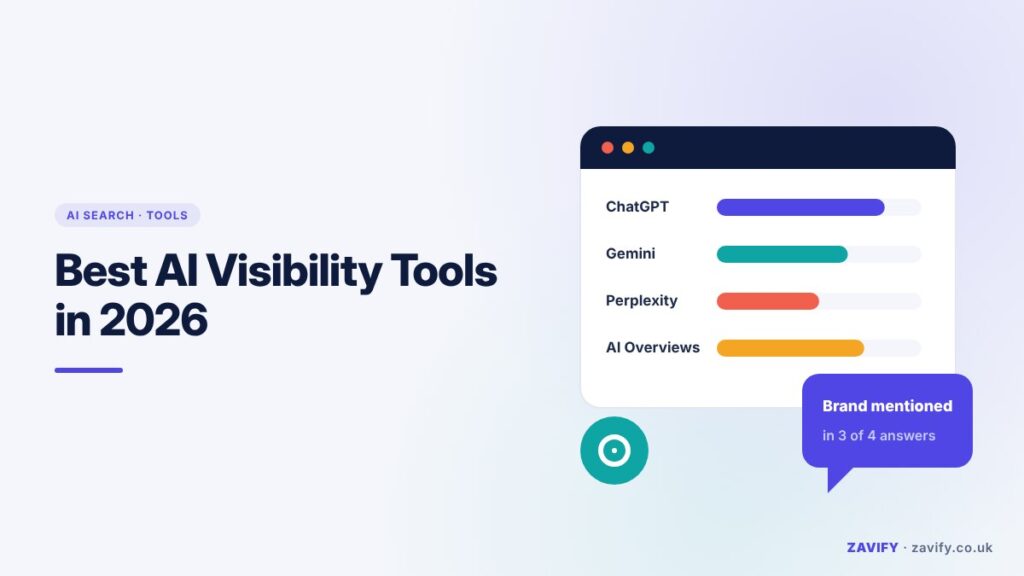
A growing share of buying journeys now starts with a question typed into an AI assistant rather than a search box. Someone asks ChatGPT for “the best CRM for a small agency,” or Google shows an AI Overview before the first blue link, and a shortlist of brands appears instantly. If your brand isn’t in that answer, you’ve lost the customer before they ever saw your website.
That’s the problem AI visibility tools are built to solve. They monitor how often AI platforms mention, recommend and cite your brand, and how you compare with competitors. In this guide to AI visibility tools, you’ll learn what they actually measure, which ones are worth shortlisting in 2026, and how to pick the right tool for your budget and goals.
Table of Contents
What is an AI visibility tool?
An AI visibility tool is software that repeatedly asks AI platforms a set of questions (called prompts) that your customers are likely to ask, then records the answers. Over time, it shows you:
- whether your brand is mentioned in the answer,
- where it appears in the answer compared with competitors,
- which websites the AI cites as its sources, and
- whether the way your brand is described is positive, neutral or negative.
Think of it as rank tracking for the AI era. Instead of tracking a position on page one, you’re tracking your presence inside a generated answer. Google explains how these answers work for site owners in its guide to AI features and your website.
Why AI visibility tools matter for marketers
Traditional SEO tools can’t see inside AI answers. You might rank first on Google for a keyword and still be missing from the AI Overview above it, or from ChatGPT’s recommendation for the same question. AI visibility tools matter because:
- Buyers trust shortlists. When an assistant recommends three products, most people investigate those three first.
- Citations drive referral traffic. The websites an AI cites as sources earn clicks and credibility.
- Competitors can overtake you quietly. Without tracking, you won’t notice when a rival starts showing up in answers you used to own.
- Brand accuracy is at stake. AI models sometimes describe products incorrectly. Monitoring helps you spot and correct those errors through better content and PR. For a deeper look at the measurement debate, see what AI visibility startups are not measuring.
Key metrics AI visibility tools track
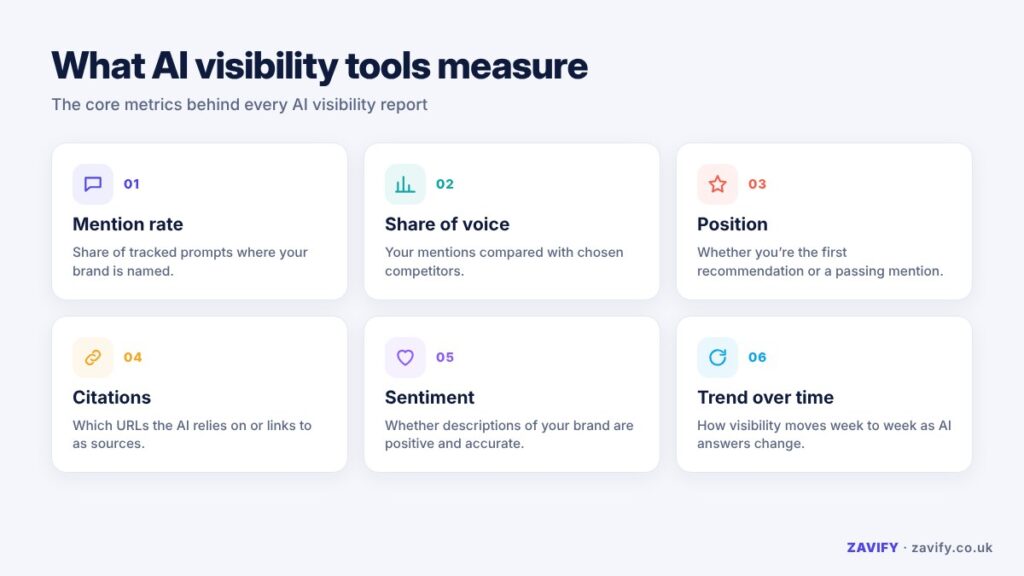
Before comparing AI visibility tools, it helps to know the language they use. Most platforms report some version of these metrics.
Mention rate
The percentage of tracked prompts where your brand is named in the answer. This is the headline number for most teams.
Share of voice
How often you’re mentioned compared with a defined set of competitors. A 30% share of voice means you account for 30% of all brand mentions across your tracked prompts.
Position or prominence
Where you appear within the answer. Being the first recommendation is worth far more than a passing mention at the end.
Citations and sources
The URLs the AI links to or relies on. These show which pages, from your site or third-party sites, are shaping how AI talks about your brand.
Sentiment
Whether the description of your brand is positive, neutral or negative, and whether the facts are accurate.
The best AI visibility tools in 2026
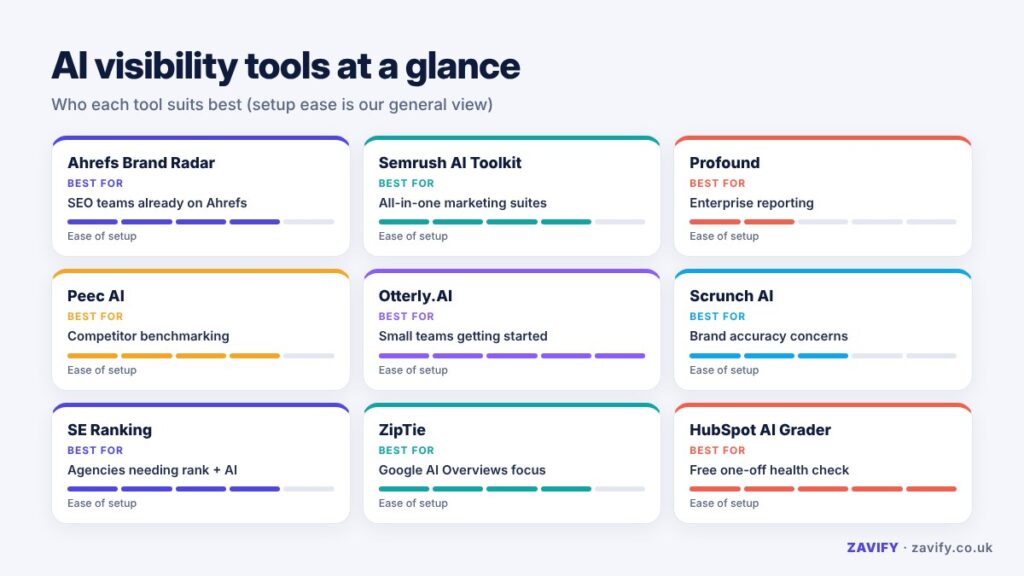
The market is moving quickly, with new tools launching every month. The AI visibility tools below are well established, cover the major AI platforms and suit different types of teams. Features and supported platforms change often, so always confirm the current details with each vendor before buying.
1. Ahrefs Brand Radar
Best for: SEO teams already using Ahrefs.
Brand Radar adds AI visibility monitoring to Ahrefs’ SEO toolkit. It tracks brand mentions across AI Overviews, AI Mode, ChatGPT, Copilot, Gemini, Perplexity and Grok, and draws on a large, search-based database of prompts so you don’t have to invent every question yourself. You can also add custom prompts and compare visibility against competitors. Its biggest advantage is having AI and traditional search data side by side.
2. Semrush AI Visibility Toolkit
Best for: marketing teams that want AI tracking inside an all-in-one suite.
Semrush’s AI toolkit covers AI visibility tracking, prompt tracking, brand performance and sentiment analysis, along with competitor insights. For teams already running keyword research, content and PPC in Semrush, it keeps AI reporting in the same workflow.
3. Profound
Best for: enterprise brands that need deep reporting.
Profound is a dedicated AI visibility platform focused on large organisations. It offers visibility dashboards, prompt and conversation insights, citation analysis and share-of-voice reporting across major AI platforms including ChatGPT, Perplexity and Google AI Overviews. It’s a strong fit when multiple teams need reliable, board-level reporting.
4. Peec AI
Best for: growing brands and agencies focused on competitor benchmarking.
Peec AI tracks how your brand appears across ChatGPT, Perplexity, Gemini and other AI surfaces, with an emphasis on topic-level tracking, competitor comparison and source analysis. Its share-of-voice views make it easy to see who is winning each topic.
5. Otterly.AI
Best for: small businesses and marketers who want a simple starting point.
Otterly.AI focuses on brand mention and citation tracking across platforms such as ChatGPT, Perplexity, Google AI Overviews and Microsoft Copilot. It’s known for being approachable, with clear reports and exportable data, which makes it a good first tool for teams new to AI visibility.
6. Scrunch AI
Best for: brands worried about accuracy and how AI describes them.
Scrunch AI combines visibility monitoring with features designed to help AI systems understand your brand correctly, including misinformation detection and content prioritisation insights. It suits companies where an inaccurate AI description could cause real damage.
7. SE Ranking AI Search Toolkit
Best for: agencies that want classic rank tracking and AI tracking in one place.
SE Ranking combines traditional keyword rank tracking with AI search visibility tracking across Google AI Overviews, AI Mode, ChatGPT, Perplexity and Gemini, depending on plan. Agencies benefit from its client reporting and website audit features.
8. ZipTie
Best for: teams focused specifically on Google AI Overviews.
ZipTie concentrates on tracking AI Overviews, alongside ChatGPT and Perplexity. If Google is your most important channel and you want detailed AI Overview monitoring, it’s worth a look.
9. HubSpot AI Search Grader
Best for: a free, one-off health check.
HubSpot’s free grader gives you a quick snapshot of how AI platforms perceive your brand. It’s not an ongoing monitoring tool, but it’s a useful way to make the case internally before investing in a paid platform.
How to choose the right AI visibility tool
The best AI visibility tools for you depend on what you need. Use these questions to narrow the field.
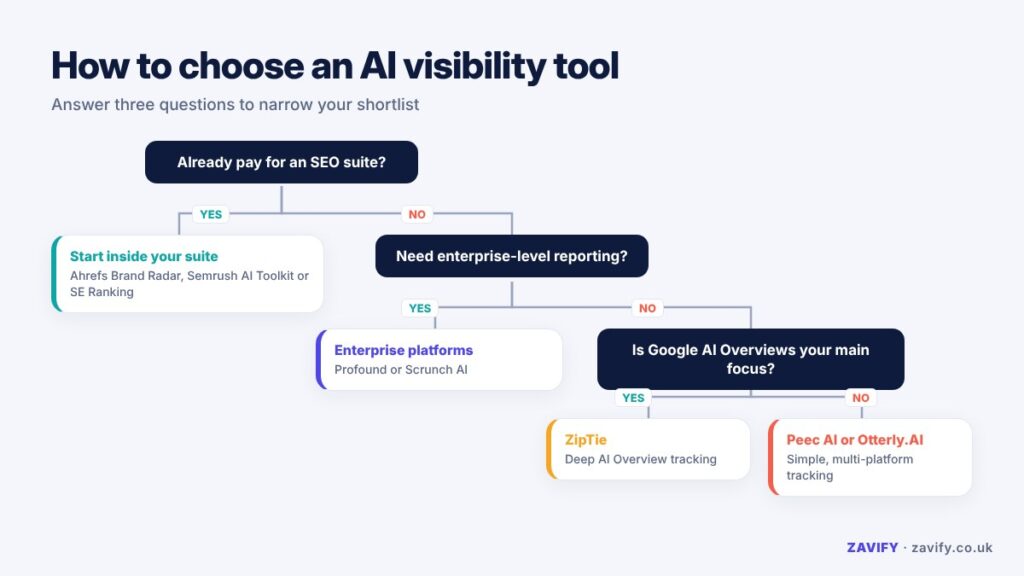
- Which AI platforms matter most to your audience? A B2B software company may prioritise ChatGPT and Perplexity, while a local or ecommerce business may care most about Google AI Overviews.
- Do you already pay for an SEO suite? If you use Ahrefs, Semrush or SE Ranking, start with their AI features before adding a separate platform.
- How many prompts do you need to track? Pricing for AI visibility tools usually scales with the number of prompts and platforms. Start with 25 to 50 high-value prompts rather than hundreds.
- Who needs the reports? Agencies need white-label client reports. Enterprises need multiple users and dashboards. Small teams need simplicity.
- Do you need recommendations or just data? Some tools only report what’s happening; others suggest content and PR actions to improve your visibility.
How to set up AI visibility tools in 5 steps
Buying one of these AI visibility tools is the easy part. Getting useful data depends on how you set it up.
Step 1: Build a prompt list from real customer questions
Pull questions from sales calls, support tickets, keyword research and “People also ask” boxes. Group them by stage: problem-aware (“how do I reduce churn?”), solution-aware (“best churn tools for SaaS”) and brand-aware (“Brand A vs Brand B”).
Step 2: Choose three to five competitors
Track the brands you actually lose deals to, not just the biggest names in your category.
Step 3: Record a baseline
Run your prompts for two to four weeks before making changes. AI answers vary from day to day, so you need an average, not a single snapshot.
Step 4: Study the citations
Look at which sources the AI relies on for your most important prompts. These are often review sites, comparison articles, forums and industry publications. They show you where to focus content and digital PR, and they’re the foundation of a strong AI citation strategy.
Step 5: Act, then measure again
Improve the pages that should be cited, earn mentions on the third-party sites AI trusts, and keep tracking. Review results monthly rather than daily to avoid chasing noise.
How to improve your AI visibility
Tracking only helps if you act on what you learn. The brands that appear most often in AI answers tend to do a few things consistently:
- Publish clear, answer-first content that directly addresses the questions customers ask. Our guide to generative engine optimization (GEO) explains how.
- Keep facts consistent everywhere, including your website, social profiles, directories and review sites, so AI models get the same story from every source.
- Earn mentions on trusted third-party sites through PR, partnerships, reviews and expert commentary.
- Use structured data to help machines understand your products, organisation and FAQs.
- Refresh key pages regularly so the information AI finds is current.
Frequently asked questions
What are AI visibility tools?
AI visibility tools track how often and how positively AI platforms such as ChatGPT, Gemini, Perplexity and Google AI Overviews mention or cite your brand when answering questions.
Are there free AI visibility tools?
Yes. Free graders such as HubSpot’s AI Search Grader offer a one-time snapshot, and several paid tools offer free trials or limited free plans. For ongoing tracking, a paid tool is usually needed.
How often should I review data from AI visibility tools?
Most teams review data weekly and report monthly. Because AI answers fluctuate, trends over several weeks are more reliable than daily changes.
Can I improve my brand’s visibility in ChatGPT?
You can’t directly control AI answers, but you can influence them by publishing clear, accurate content, earning mentions on trusted websites and keeping your brand information consistent across the web.
Final thoughts
AI visibility is quickly becoming as important as search rankings. The right AI visibility tools will show you where you stand, who’s beating you and which sources shape the answers your customers see. Start small with a focused prompt list, pick a tool that fits your existing workflow, and treat the data as a guide for better content and PR. When visibility improves, learn how to turn AI mentions into revenue. The brands that start measuring now will have a clear head start.