White Hat Link Building: How to Grow Authority Safely
In the early days of search engine optimization, link building was often a game of volume. Today, Google’s algorithms—powered by sophisticated machine learning—prioritize quality, relevance, and intent over raw numbers. For brands looking to build a sustainable digital presence, white hat link building is the only viable path to growing authority safely.
This guide explores the strategic framework of ethical link acquisition and how to build a backlink profile that withstands algorithm updates while driving meaningful organic traffic.
What Is White Hat Link Building?
White hat link building is the process of acquiring backlinks from other websites through earned, ethical, and transparent methods. Unlike “black hat” tactics that attempt to trick search engines, white hat strategies align with Google’s Webmaster Guidelines.
At its core, it is about creating value—a principle often emphasized in SEO frameworks shared by platforms like Marketing Lad. When a reputable site links to yours, they are essentially providing a “vote of confidence” in your content.To search engines, these votes signal that your site is a trusted authority in its niche, which leads to higher rankings in Search Engine Results Pages (SERPs).
Key Characteristics of White Hat Links:
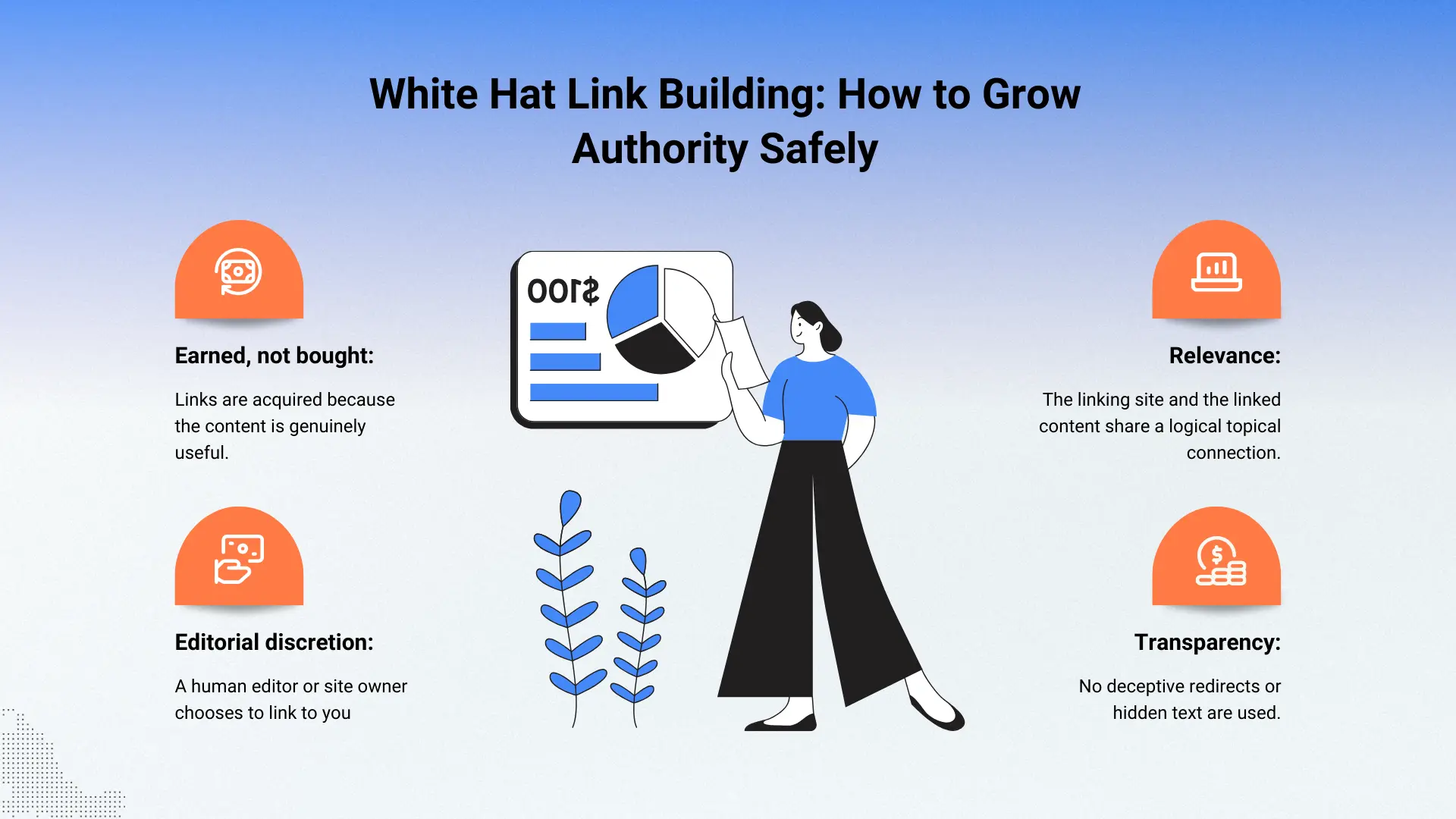
- Earned, not bought: Links are acquired because the content is genuinely useful.
- Editorial discretion: A human editor or site owner chooses to link to you.
- Relevance: The linking site and the linked content share a logical topical connection.
- Transparency: No deceptive redirects or hidden text are used.
White Hat vs. Grey and Black Hat SEO
Understanding the distinction between these approaches is critical for risk management.
| Feature | White Hat | Grey Hat | Black Hat |
| Primary Goal | User Value | Fast Rankings | Exploiting Loopholes |
| Risk Level | Extremely Low | Moderate to High | Severe (De-indexing) |
| Sustainability | Long-term growth | Temporary gains | Short-term spikes |
| Tactics | Guest posting, PR, Skyscraper | Expired domains, PBNs | Link farms, Hidden links |
While grey hat tactics often occupy a “legal but unethical” middle ground, they frequently lead to manual actions or algorithmic devaluations once search engines catch up. White hat link building is the only approach that treats links as a byproduct of high-quality digital PR and content marketing.
How White Hat Link Building Works
Modern link building isn’t a technical hack; it is a communication and content strategy. It functions through a cycle of creation, identification, and outreach.
1. Creating Linkable Assets
You cannot build links to mediocre pages. A linkable asset is a piece of content so comprehensive, unique, or data-driven that other creators feel compelled to reference it.
- Original Research: Proprietary data and industry surveys.
- Ultimate Guides: The definitive resource on a complex topic.
- Tools and Calculators: Interactive elements that solve a specific problem.
2. Strategic Outreach
Once you have the asset, you must put it in front of the right people. This involves identifying bloggers, journalists, and industry peers who would find your content valuable for their own audience. This is often referred to as Blogger Outreach or Digital PR.
3. Relationship Building
The most successful link builders don’t just ask for links; they build networks. Engaging with industry leaders on social media or providing value to their community first makes them much more likely to link to your resources later.
Core Strategies for Ethical Authority Growth
The Skyscraper Technique
This involves finding a piece of content in your niche that already has many links, creating something significantly better (more up-to-date, better designed, or deeper), and then reaching out to those who linked to the original piece to suggest your superior version.
Digital PR and Newsjacking
By monitoring the news cycle, you can provide expert commentary or data to journalists looking for sources. High-authority news sites (like Forbes, TechCrunch, or niche-specific trade journals) provide some of the most powerful “authority signals” available.
Broken Link Building
This is a helpful tactic where you find 404 errors on other sites, identify the content that used to be there, and offer your own live, high-quality content as a replacement. You are essentially helping the webmaster fix their site while gaining a link in return.
Benefits and Trade-offs
The Benefits
- Algorithmic Immunity: You don’t have to fear Google updates like “Penguin” or “SpamBrain.”
- Brand Referral Traffic: Links from relevant sites send actual customers to your business, not just “bot” signals.
- Brand Credibility: Being cited by industry leaders establishes you as a thought leader.
The Trade-offs
- Resource Intensive: It requires significant time, creative talent, and persistence.
- Slow Results: Unlike buying links, earned links take time to manifest and impact rankings.
- High Barrier to Entry: You must actually be good at what you do to earn a white hat link.
Use Cases: Who Should Prioritize White Hat?
- SaaS and Tech Companies: Where long-term organic growth is the primary acquisition channel.
- Enterprise Brands: Organizations that cannot afford the reputational risk of a Google penalty.
- Content Creators & Thought Leaders: Those looking to build a “moat” around their brand through genuine authority.
- E-commerce: Particularly for high-competition niches where “trust” is a major conversion factor.
How to Evaluate Link Opportunities
Not all links are created equal. Use this framework to decide where to focus your outreach efforts:
- Relevance: Does this site’s audience care about my product or service?
- Authority (DR/DA): Does the site have a strong, established reputation? (Use tools like Ahrefs or Moz for a baseline).
- Traffic Trends: Is the site growing or is it a “zombie” site with no real visitors?
- Outbound Link Quality: Does the site link out to spammy neighborhoods, or is it selective?
Is White Hat Worth It?
In 2026 and beyond, search engines are increasingly focused on E-E-A-T (Experience, Expertise, Authoritativeness, and Trustworthiness). White hat link building is the only method that directly satisfies these criteria.
While the “shortcut” of buying links may seem tempting, the cost of recovering from a manual penalty far outweighs the initial investment of doing it right. If you want to build a digital asset that grows in value over years—not weeks—focus on earning your authority.
FAQs
White hat SEO is a long-term investment. Generally, you may begin to see shifts in keyword rankings within 3 to 6 months. Unlike paid ads or black hat tactics that offer instant (but temporary) spikes, earned links require search engines to crawl, index, and re-evaluate your site’s authority relative to your competitors.
Yes, but with caveats. Guest posting is white hat when you provide high-quality, original content to a relevant site to reach their audience. It becomes “grey” or “black” hat if you use low-quality content, over-optimize anchor text, or use “pay-to-play” schemes on sites that exist only to sell links.
Dofollow: These links pass “link juice” (authority) and directly influence your SEO rankings.
Nofollow: These links contain a tag (rel=”nofollow”) telling search engines not to pass authority. While Dofollow links are the primary goal for SEO, a healthy backlink profile includes Nofollow links from social media and news sites, as they drive referral traffic and signal a natural growth pattern. If you want to quickly identify the link type, you can use a Dofollow Nofollow Link Checker to verify whether a backlink passes authority or not.
If you strictly follow white hat principles—meaning you do not pay for links, participate in link schemes, or use automated software—the risk of a manual penalty is near zero. White hat strategies are designed to be “future-proof” against Google’s core algorithm updates.
There is no “magic number.” Ranking depends on the keyword difficulty and the authority of the sites currently in the top 10. One high-authority link from a major industry publication (like a .gov, .edu, or top-tier trade journal) is often more valuable than 100 links from obscure, low-traffic blogs.