
What Is a Vanity URL?
Executive Summary
I’ve spent the better part of two decades working in technical SEO and content strategy, and I can tell you that vanity URLs are one of those deceptively simple concepts that most marketers misunderstand until they’ve broken something in production.
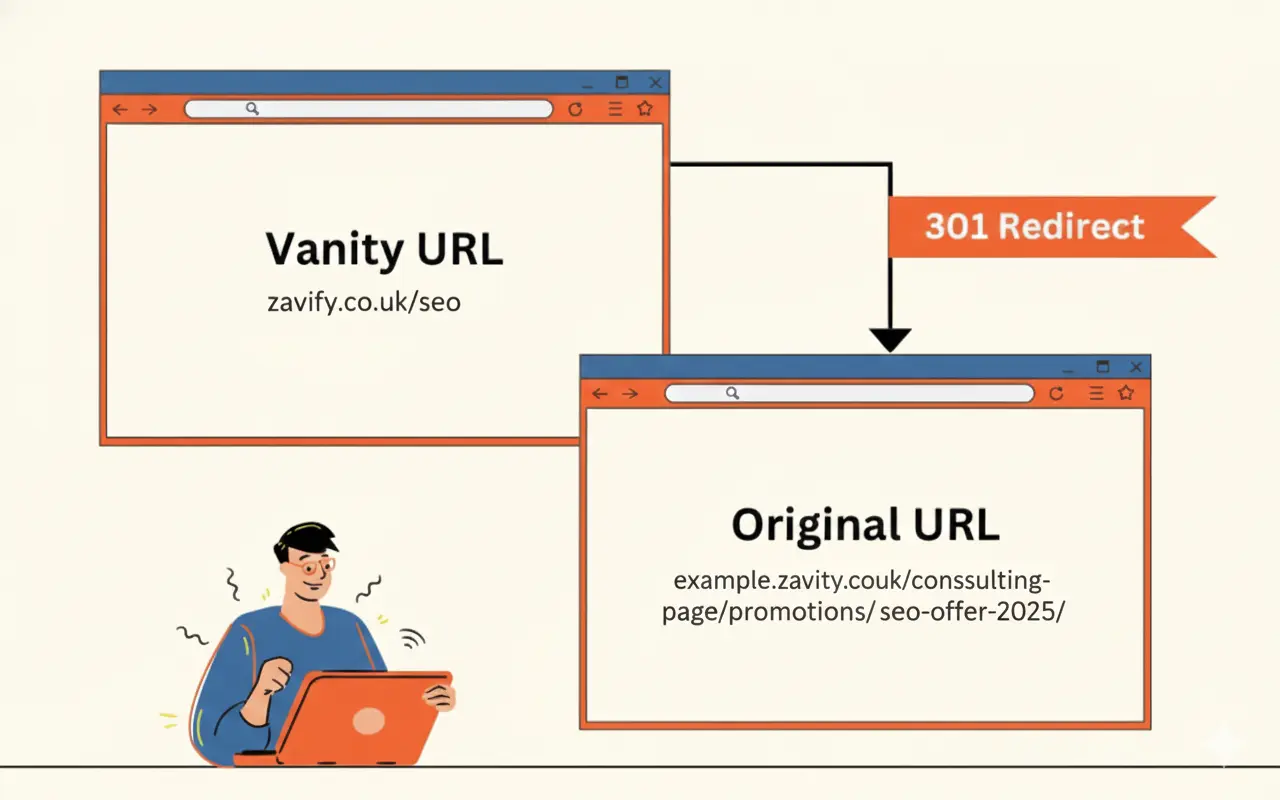
A vanity URL is a custom, branded, human-readable web address that redirects to a longer, more complex destination URL. Think brand.com/report instead of brand.com/resources/2024/q3/whitepaper-download?utm_source=email&campaign=nurture_v3. The core value proposition isn’t just aesthetics—it’s persistence, memorability, and control over your link equity distribution in an environment where destination URLs change constantly.
This matters now because modern marketing stacks have created an explosion of tracking parameters, dynamic content URLs, and platform-specific landing pages that make direct linking fragile. I’ve seen campaigns collapse because someone changed a Marketo form URL without updating 47 places where it was hardcoded. Vanity URLs solve this by creating a stable front door that you control, even when the back-end rooms get renovated.
When I Learned Vanity URLs Actually Matter
Early in my career, I worked with a B2B SaaS company launching a product comparison guide. Marketing wanted to promote it across email marketing, social media, partner sites, and a small print component in an industry magazine.
The actual URL was something like:
website.com/resources/guides/product-comparison-tool/v2.1/interactive-version?source=campaignWe printed that in the magazine. Two weeks after distribution, Product decided the interactive tool needed a complete rebuild and moved it to a new subdomain: tools.website.com/compare. Nobody told Marketing until a partner asked why their link returned a 404.
We lost three months of referral traffic, broke inbound links from two industry publications, and—this was the painful part—had zero way to recover the equity from those print placements. The magazine wasn’t reprinting. We just… ate the loss.
After that, I never launched a campaign-critical asset without a vanity URL. The current approach: website.com/compare redirects to whatever the current version is. Product can refactor, migrate, experiment—doesn’t matter. The front door stays constant. The referral traffic keeps flowing. The print links work indefinitely.
That’s the strategic insight most people miss: vanity URLs aren’t about making links “pretty.” They’re about decoupling your public promises from your private infrastructure changes.
How Vanity URLs Function in Practice
At the infrastructure level, a vanity URL is typically a 301 permanent redirect, though I’ve seen valid use cases for 302s in testing scenarios. When someone requests brand.com/guide, the server immediately responds with “this resource has permanently moved to [actual destination],” and the browser follows that redirect automatically.
The user experience is seamless—they never see the redirect happen unless they’re inspecting network traffic. But from an SEO perspective, that 301 passes roughly 90-95% of link equity to the destination page, consolidating ranking signals rather than fragmenting them across multiple URLs.
Here’s where people get confused: a vanity URL doesn’t create a separate page that needs to rank. It’s not duplicate content. Search engines understand redirects and treat them as instructions to consolidate signals around the destination URL. When Google crawls brand.com/guide, it follows the redirect, indexes the destination, and attributes inbound links to that destination.
The practical implication: if you’ve built links to brand.com/guide over time, then change what it redirects to, those links now benefit the new destination. That’s powerful for campaigns where you’re evolving content but want to preserve accumulated authority.
The Technical Implementation Nobody Talks About
Most marketing teams don’t control their web server configuration directly. You’re probably working with:
- Marketing automation platforms (Marketo, HubSpot, Pardot) that offer branded short domains
- Link management tools (Bitly, Rebrandly) that create custom short URLs
- CMS redirect managers (WordPress plugins, Webflow redirect rules) that let you define URL mappings
- CDN-level redirects (Cloudflare rules, Fastly VCL) for enterprise setups
I’ve seen companies try to implement vanity URLs by creating actual HTML pages with meta refresh tags or JavaScript redirects. This is a mistake. Meta refresh and JS redirects don’t pass link equity reliably and create a brief page load before the redirect executes, which looks broken to users.
The correct implementation is server-side: 301 redirects configured at the web server (Apache, Nginx) or CDN level. If you don’t have server access, use your CMS’s redirect manager. If you don’t have that, a link management platform with a custom domain is acceptable, though it introduces a third-party dependency.
Strategic Use Cases Where Vanity URLs Solve Real Problems
1. Campaign Persistence Across Asset Versions
You’re running a demand gen campaign promoting a whitepaper. Initial URL: site.com/resources/2024-industry-report.pdf. Six months later, you update it with fresh data: site.com/resources/2025-industry-report.pdf.
Without a vanity URL, every placement of the old link now points to outdated content or breaks entirely. With site.com/report → update the redirect, and every historical reference now delivers current content.
I’ve used this pattern for:
- Annual benchmark reports that refresh yearly
- Product comparison tools that change as features ship
- Case study collections that rotate as new customers agree to be featured
2. Print and Offline Media Bridge
Any URL that appears in print, outdoor advertising, conference materials, or packaging needs to be:
- Short enough to type manually
- Memorable enough to survive the gap between seeing it and accessing a device
- Permanent, because you can’t update physical materials post-distribution
We ran a conference sponsorship where our booth backdrop included brand.com/demo. That redirect has pointed to four different demo request forms over three years as our demand capture infrastructure evolved. The booth backdrop is the same physical material, still works perfectly.
3. Affiliate and Partner Link Stability
When you’re distributing links to partners for content syndication or affiliate relationships, you need to maintain those links even as internal URLs change. Partners aren’t going to update their links when you refactor your blog structure or migrate to a new platform.
I worked with a company that migrated from WordPress to a headless CMS. Every blog post URL changed from /blog/post-title/ to /content/post-title/. They had 200+ inbound links from partner sites, guest posts, and press mentions. Vanity URLs weren’t in place. They either had to:
- Implement 200+ individual redirects mapping old URLs to new ones (labor-intensive, error-prone)
- Accept the broken links and loss of referral traffic
They chose option 1. It took three weeks and still had errors. The better pattern: strategic vanity URLs for high-value content from the start.
4. A/B Testing and Progressive Rollout
Sometimes you want to test different landing page treatments without fragmenting your link equity. Pattern I use:
- Vanity URL:
brand.com/pricing - Test A:
brand.com/pricing-variant-a - Test B:
brand.com/pricing-variant-b
The vanity URL redirects to whichever variant is currently winning or the control if no test is running. All external promotion points to brand.com/pricing. Link equity consolidates around that vanity URL, which passes it to the current best-performing destination.
When the test concludes, you implement the winner permanently, update the redirect, and nobody external to your team ever sees the testing infrastructure.
Vanity URLs vs. Similar Concepts: What’s Actually Different
| Concept | Core Function | Primary Use Case | SEO Impact | Limitations |
|---|---|---|---|---|
| Vanity URL | Custom branded redirect to any destination URL | Campaign stability, print media, link equity consolidation | Passes ~90-95% link equity via 301 | Requires redirect infrastructure; adds server processing time |
| URL Shortener | Compress long URL into shorter form | Character-limited platforms (Twitter pre-expansion), QR codes | Minimal if using 301; some services use 302 (doesn’t pass full equity) | Often uses third-party domain; link rot if service shuts down |
| Pretty URL / Slug | Clean readable URL structure as actual destination | Permanent site architecture, user experience | Full equity—no redirect needed | Changing it later breaks direct links unless you add redirects |
| Canonical URL | Signal preferred version of duplicate/similar content | Consolidate signals when content exists at multiple URLs | Tells search engines which version to index | Doesn’t redirect users; purely a search engine hint |
| Custom Short Domain | Branded domain for link shortening (bit.ly → brand.co) | Brand consistency in shared links, click tracking | Same as URL shortener but with brand trust signals | Cost of maintaining separate domain; potential brand confusion |
The strategic difference that matters: vanity URLs give you a stable public identifier that you control while allowing complete flexibility in the underlying destination. Pretty URLs are rigid. Shorteners are often third-party dependencies. Canonicals don’t redirect users. Vanity URLs are the only pattern that truly decouples your public-facing link structure from your private infrastructure.
Common Mistakes I See Marketing Teams Make
Mistake 1: Creating Vanity URLs That Are Too Generic
I’ve reviewed redirect configurations where companies created brand.com/report, brand.com/guide, brand.com/whitepaper as vanity URLs. This seems logical until you have four reports running simultaneously and nobody can remember which vanity URL points where.
The pattern that works: include just enough context to be self-documenting. brand.com/2024-security-report is much more maintainable than brand.com/report. When you’re managing 50+ redirects, future-you will thank past-you for the specificity.
Exception: if you truly only ever have one flagship asset in a category (your annual State of the Industry report, for example), a generic vanity URL can work. Just document it clearly.
Mistake 2: Using 302 Temporary Redirects by Default
Some redirect management interfaces default to 302s. Marketing teams implement them without understanding the distinction. The problem: 302s tell search engines “this is temporary, don’t transfer ranking signals to the destination.” If you’re using vanity URLs for campaign stability, you want the link equity to flow through—that requires a 301.
I only use 302s when:
- Running a genuine temporary promotion (Black Friday landing page that reverts to homepage after the event)
- A/B testing where the destination might change frequently
For everything else: 301. Always 301.
Mistake 3: Implementing Vanity URLs Without Tracking Parameters
You’ve created brand.com/webinar to promote an event. It redirects to your webinar platform. Six months later, someone asks “how much traffic came from that vanity URL?” and you realize… you have no idea, because the redirect doesn’t append any tracking parameters.
The better implementation:
brand.com/webinar → webinar-platform.com/event-registration?utm_source=vanity&utm_campaign=webinar-promoNow you can isolate traffic from that specific vanity URL in your analytics.This is especially critical when the same destination page receives traffic from multiple sources. The same tracking principle also applies to offline-to-online campaigns using tools like Uniqode’s QR code Generator, where QR scans can be tracked with campaign parameters to measure engagement accurately. This is especially critical when the same destination page receives traffic from multiple sources.
Mistake 4: Not Documenting the Redirect Map
This is the operational killer. Someone on your team creates a vanity URL. Six months later, they’ve left the company. New person wants to update where it points. Nobody knows what destinations are currently mapped to what vanity URLs without manually testing each one or digging through server config files.
I maintain a simple spreadsheet:
| Vanity URL | Current Destination | Campaign/Purpose | Owner | Last Updated |
|---|---|---|---|---|
| brand.com/demo | website.com/request-demo?src=vanity | Lead gen | Marketing Ops | 2024-03-15 |
This sounds basic, but I’ve consulted with companies managing hundreds of redirects with zero documentation. It becomes technical debt that eventually breaks something customer-facing.
Mistake 5: Creating Vanity URLs That Conflict With Real Site Structure
You decide brand.com/blog should redirect to your latest blog post as a promotional tactic. Problem: you already have a real /blog directory with all your blog content. Now you’ve created a conflict—the redirect overrides the actual blog index page.
This seems obvious, but I’ve seen it happen with paths like /resources, /products, /contact where teams forget these are actual sections of their site navigation.
The safe pattern: use a path that’s clearly campaign-specific and wouldn’t naturally be part of your information architecture. /annual-report is safer than /report. /webinar-series is safer than /webinar.
When Vanity URLs Aren’t the Right Solution
I want to be clear about limitations because this isn’t a universal pattern.
Internal linking architecture: If you’re debating whether to use vanity URLs for internal site navigation, you probably shouldn’t. They add redirect overhead (slight performance hit) for no real benefit since you control your own internal links and can update them easily.
High-volume traffic paths: Every redirect adds latency—typically 20-100ms depending on server configuration. For your homepage or primary product pages receiving millions of visits, that cumulative delay matters. Use vanity URLs for campaign-specific paths, not core site infrastructure.
When you need to rank the vanity URL itself: Remember, vanity URLs redirect—they don’t create independent pages. If you need /glossary/vanity-url to rank as its own entity with unique content, a redirect won’t work. You need an actual page with content.
Brand confusion scenarios: If your vanity URLs use a different domain than your main brand (common with custom short domains like brnd.co when your main site is brand.com), you introduce a trust signal problem. Users and search engines may not immediately recognize the relationship. This isn’t a dealbreaker, but it requires brand education.
The Verdict: How I Actually Use Vanity URLs
After working with dozens of companies across SaaS, ecommerce, and B2B, here’s my current framework:
Always use vanity URLs for:
- Any URL appearing in print, packaging, or physical media
- High-value gated content (reports, tools, calculators) that might change versions
- Campaign landing pages promoted to external partners or press
- Event-specific promotions with defined end dates
Consider vanity URLs for:
- Product pages if your product naming/numbering scheme might change
- Pricing pages if you frequently test different structures
- Collections or curated content sets that evolve over time
Skip vanity URLs for:
- Internal navigation and cross-linking
- Blog posts in your standard publishing workflow (unless it’s a flagship piece)
- Pages you’re trying to rank organically where the URL itself carries keyword signals
The strategic principle: use vanity URLs when the cost of broken or outdated links exceeds the operational overhead of managing redirects. For a five-person startup, that might be 10 carefully chosen redirects. For an enterprise, it might be hundreds organized by campaign and lifecycle stage.
Implementation Checklist: Setting This Up Correctly
When you decide a vanity URL is warranted:
- Choose the pattern thoughtfully — Include enough context to be self-documenting (
/2024-benchmark-reportnot/report) - Implement as 301 unless you have specific reason for 302 — Link equity should flow through
- Append tracking parameters — Ensure you can isolate traffic in analytics
- Document immediately — Spreadsheet with vanity URL, destination, purpose, owner, date
- Test the redirect — Verify it works in incognito/private browsing (no cache)
- Monitor for breaks — Set up alerts if the destination returns 404 or 500 errors
- Review quarterly — Audit which vanity URLs are still in active use vs. candidates for retirement
The goal isn’t to create vanity URLs for everything. It’s to recognize the scenarios where the stability and control they provide justifies the added complexity. Done right, they’re infrastructure that makes your marketing more resilient. Done carelessly, they’re technical debt that confuses your team and fragments your link equity.
If you’re managing campaigns that span multiple channels, evolving content, or any offline components, vanity URLs should be part of your standard operating procedure. Not because they’re trendy or because the links look nicer—because they prevent the expensive breakage I’ve watched countless teams experience when their public promises and private infrastructure drift apart.
You can also learn more about vanity URLs, best practices, and examples in this detailed guide by Neil Patel.