
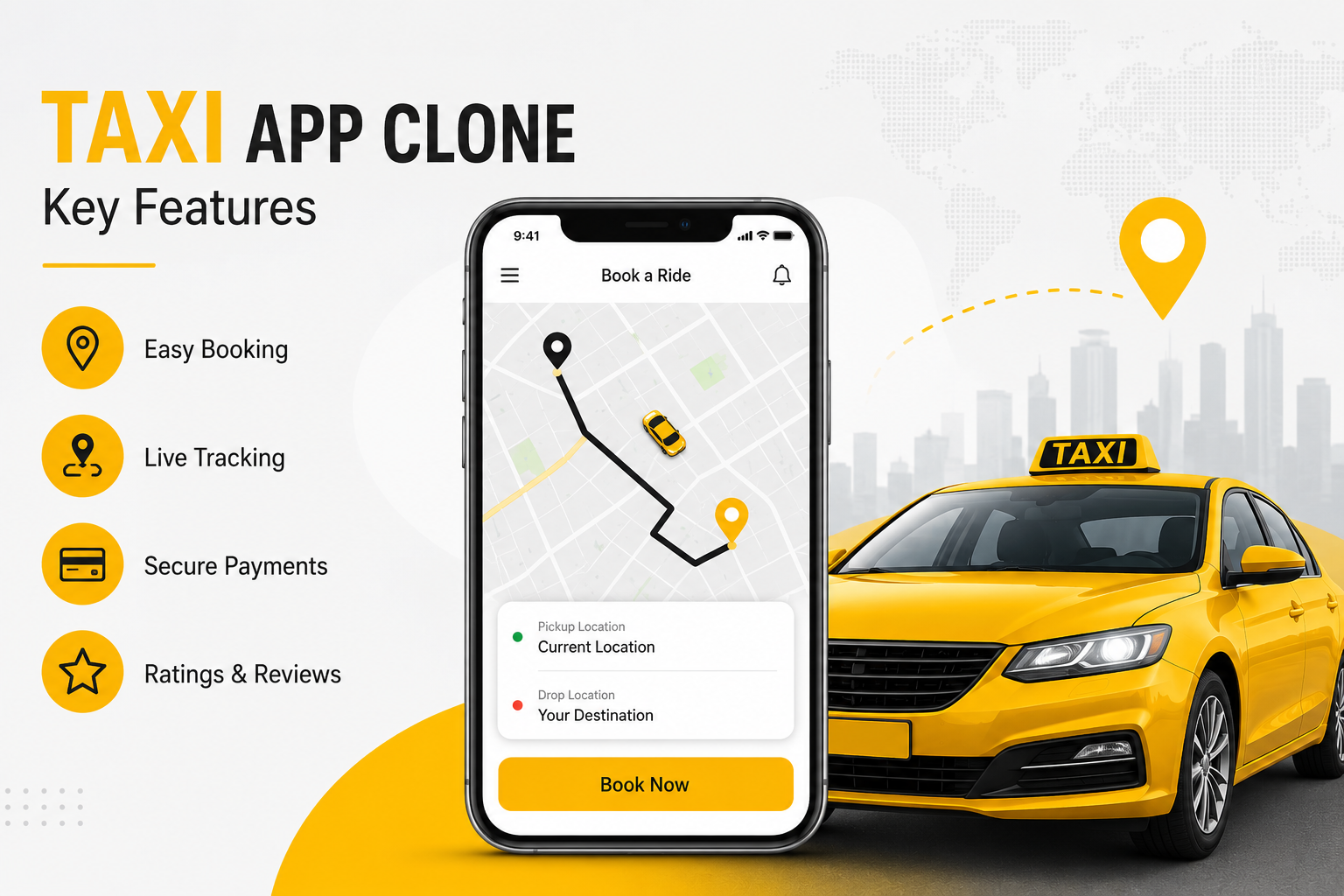
What Features Should a Taxi App Clone Include?
What Features Should a Taxi App Clone Include?
A taxi business used to depend heavily on phone calls, street visibility, and a reliable fleet of drivers. Today, passengers expect something much more immediate. They want to open an app, enter their destination, see the estimated fare, choose a ride, and know when the driver will arrive. For operators, the challenge is different: they need a system that can coordinate drivers, manage bookings, process payments, monitor trips, and keep customers informed without creating unnecessary manual work.
That is where a taxi app clone becomes useful. Rather than developing every component from the ground up, a business can start with a proven app structure and adapt it to its own brand, service model, and operating area.
However, simply having a passenger app and a driver app is not enough. The quality of the product depends on the features behind the booking experience. A well-planned taxi platform should make everyday operations easier for passengers, drivers, dispatchers, and administrators.
So, what should a modern taxi app clone actually include?
1. Passenger Registration and Profile Management
The first interaction users have with the platform is usually registration. The process should be quick enough that a new customer does not abandon it before requesting a ride.
A taxi app can support several sign-up methods, such as:
- Mobile number with OTP verification
- Email registration
- Social account login
- Guest browsing before registration
- Profile creation after the first booking
Once registered, passengers should be able to update their name, profile picture, phone number, preferred language, and other account information from one place.
Keeping the account section simple matters because passengers may need to make changes while they are travelling or preparing for an urgent ride.
2. Location Detection and GPS Integration
Location is at the heart of a taxi booking application. The passenger should not have to manually type their current location every time they request a ride.
GPS integration can automatically identify the pickup point and display it on an interactive map. Users can then adjust the pin if their actual pickup location is slightly different from the detected position.
The same mapping infrastructure can help the platform calculate routes, estimate travel distance, identify nearby drivers, and provide trip updates.
For businesses operating in busy areas such as airports, shopping districts, hotels, and transport hubs, accurate pickup positioning can make a noticeable difference to the overall experience.
3. Easy Ride Booking
The booking screen should answer the passenger’s most important questions without making them move through multiple pages.
A typical booking flow can include:
- Select pickup location.
- Enter the destination.
- Choose a vehicle category.
- Review the estimated fare.
- Select a payment method.
- Confirm the request.
The system can also support scheduled bookings when customers need transportation at a later time.
For example, someone heading to an airport early in the morning may prefer to arrange a ride the previous evening. Scheduled rides can therefore become an important part of the platform rather than an optional extra.
4. Multiple Vehicle Categories
Not every customer has the same transportation requirement. A business may operate economy cars, premium vehicles, SUVs, taxis for larger groups, or other specialized categories.
The app should allow administrators to create and manage different vehicle types according to the business model.
Each category can have its own:
- Pricing rules
- Passenger capacity
- Luggage capacity
- Driver requirements
- Availability
- Service area
This gives the operator more flexibility when expanding the fleet or introducing a new type of transportation.
5. Real-Time Driver Matching
Once a passenger confirms a trip, the system needs to find an appropriate driver.
Driver matching can consider several factors instead of simply selecting the closest vehicle. These may include driver availability, distance from the pickup point, vehicle category, service area, driver status, and other business rules.
A smart dispatch mechanism can reduce the time passengers spend waiting while helping drivers receive relevant ride requests.
For operators managing a large fleet, automated dispatch can also reduce the amount of manual coordination required from the control team.
6. Driver App With Availability Controls
Drivers need a dedicated interface that is built around their daily workflow.
The driver application should allow them to:
- Go online or offline
- Receive ride requests
- Accept or reject trips
- View passenger details
- Navigate to pickup points
- Start and end trips
- Check earnings
- Review completed rides
- Manage their profile
Drivers should have clear control over their availability. If someone has finished their shift, they should be able to switch to offline mode instead of continuing to receive requests.
7. Live Ride Tracking
After a driver accepts a booking, passengers naturally want to know where the vehicle is and how long it may take to arrive.
Live tracking allows the customer to follow the driver’s movement on a map. The same system can provide status information such as driver assigned, driver arriving, trip started, and trip completed.
This feature is particularly useful when a passenger is waiting outside a large building or unfamiliar location.
It can also help reduce unnecessary calls between passengers and drivers because both sides have access to current trip information.
8. Fare Calculation and Pricing Management
A taxi platform needs a pricing engine capable of handling different business rules.
Depending on the operating model, fares may include:
- Base fare
- Distance charges
- Time-based charges
- Minimum fare
- Waiting charges
- Booking fees
- Airport fees
- Service charges
- Dynamic pricing
The administrator should be able to configure pricing without requiring developers to modify the application every time a rate changes.
For businesses working across multiple cities, pricing may also vary from one service area to another.
9. Digital Payment Options
Cash may still be relevant in some markets, but passengers increasingly expect digital payment choices.
A taxi app clone can integrate payment gateways and support options such as cards, mobile wallets, online banking, or other locally preferred payment methods.
The platform should also record transaction details so that passengers can review their payment history while administrators can reconcile earnings and refunds.
Security is particularly important here. Payment processing should rely on established payment infrastructure rather than storing sensitive financial information unnecessarily inside the application.
10. Promo Codes and Customer Offers
Discounts can help a taxi company attract new users and encourage existing customers to book again.
An administrator can create promotional campaigns based on different conditions, such as:
- First booking discounts
- Percentage-based offers
- Fixed-value coupons
- Location-specific promotions
- Limited-time campaigns
- Minimum booking amounts
- Referral rewards
The management panel should provide controls for setting validity dates, usage limits, eligible customers, and other conditions.
This prevents promotional campaigns from becoming difficult to manage as the customer base grows.
11. Ratings and Reviews
After completing a ride, passengers should have an opportunity to rate the service and provide feedback.
A rating system can cover areas such as:
- Driver behavior
- Vehicle condition
- Overall experience
- Ride quality
Drivers can also be given appropriate feedback mechanisms where the business model supports two-way ratings.
Reviews are more than a customer-facing feature. They can help operators identify recurring service problems and recognize drivers who consistently deliver good experiences.
12. In-App Communication
Passengers and drivers occasionally need to communicate before a trip begins. They may need to clarify a pickup point or identify the correct vehicle.
Instead of exposing personal phone numbers, the platform can provide in-app communication options such as messaging or masked calling.
This creates a communication channel connected directly to the booking and can provide an additional layer of privacy for both parties.
13. Trip History and Digital Receipts
Customers should be able to find their previous bookings without contacting customer support.
A trip history section can display:
- Pickup and destination
- Date and time
- Vehicle category
- Driver information
- Fare
- Payment status
- Booking status
After a completed ride, the application can also provide a digital receipt.
For business travellers, detailed receipts can be particularly useful when they need to track transportation expenses.
14. Driver Earnings and Payout Management
The driver’s side of the platform should make earnings easy to understand.
Drivers can view completed trips, gross earnings, commissions, incentives, bonuses, adjustments, and available balances from their dashboard.
The administrator can define commission structures according to the company’s operating model.
For example, different vehicle categories or driver groups may follow different earning arrangements. A flexible system allows the business to make these changes without maintaining separate applications for every driver segment.
15. Admin Dashboard
The admin panel is arguably one of the most important components of a taxi platform because it brings the entire operation into one place.
From the dashboard, administrators can manage:
- Customers
- Drivers
- Vehicles
- Bookings
- Payments
- Pricing
- Promotions
- Service zones
- Complaints
- Reviews
- Reports
A centralized dashboard gives the business a clearer view of what is happening across the platform.
Read also: Email Marketing Mastery
What Makes These Features Valuable?
The real value of an on-demand taxi app does not come from having the longest feature list. It comes from how those features work together.
A passenger may only see a booking screen, map, fare estimate, and driver profile. Behind that simple experience, however, the system may be handling GPS data, dispatch rules, payment processing, notifications, pricing calculations, driver availability, and administrative controls simultaneously.
For that reason, businesses should prioritize operational reliability alongside interface design.
A smaller platform that performs consistently can be more useful than an application overloaded with features that are difficult to maintain.
Final Thoughts
A modern taxi app clone should serve more than the basic purpose of booking a vehicle. It needs to connect passengers and drivers while giving the business the tools required to manage pricing, payments, fleet activity, customer service, safety, and growth.
The essential features include GPS tracking, ride booking, driver dispatch, digital payments, live trip monitoring, ratings, notifications, driver earnings, administration, reporting, and security-focused tools. Businesses can then add specialized functions according to their target market and service model.
Before selecting or developing a taxi platform, it is worth mapping the complete journey of a booking—from the moment a passenger opens the app to the point when the driver receives payment and the operator records the transaction. That approach makes it easier to identify which features are genuinely necessary and which can be introduced later as the business expands.