
When someone in Toronto searches “emergency plumber” at 11 p.m., they’re ready to act. Search engine marketing is how businesses make sure they appear at that exact moment. It’s one of the fastest ways to reach customers who are already looking for what you sell.
This guide explains what search engine marketing is, how it differs from SEO, how the Google Ads auction works and the steps to launch your first SEM campaign without wasting your budget.
Table of Contents
What is search engine marketing (SEM)?
Search engine marketing (SEM) is the practice of promoting your business in search engine results pages. Today, the term most often refers to paid search advertising, such as Google Ads and Microsoft Advertising, where you pay to appear above or below the organic results.
Some marketers use SEM as an umbrella term that includes both paid ads and SEO. Either way, the goal is the same: get your business seen by people who are actively searching for products or services like yours.
SEM vs SEO: what’s the difference?
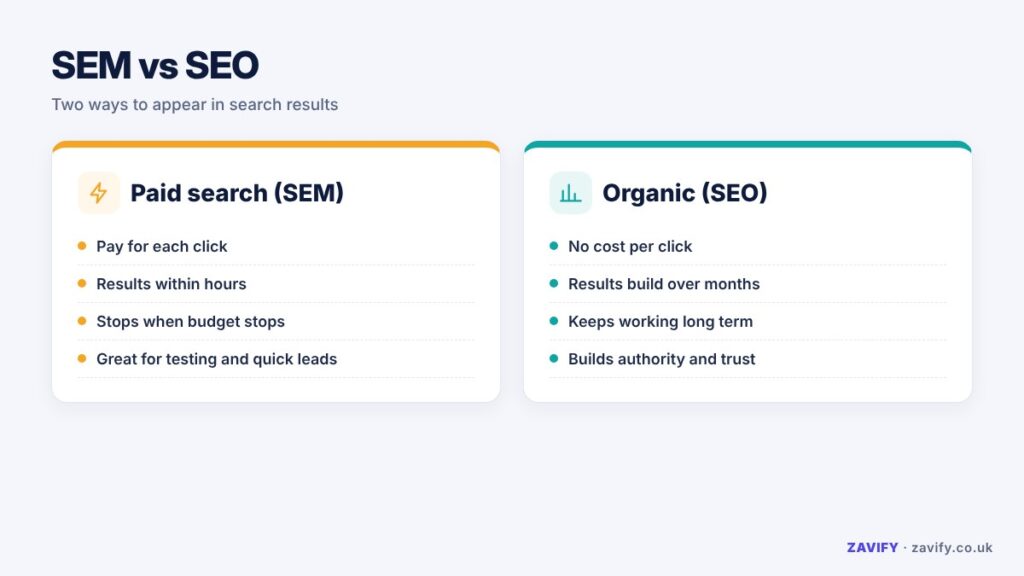
| SEM (paid search) | SEO (organic search) | |
|---|---|---|
| Cost model | Pay per click | No cost per click; costs time and expertise |
| Speed | Results within hours or days | Results build over months |
| Visibility | Stops when budget stops | Can continue long term |
| Placement | Marked as “Sponsored” | Standard organic listings |
| Best for | Quick leads, testing offers, seasonal campaigns | Long-term growth and authority |
The smartest strategy uses both. Search engine marketing delivers immediate traffic and data about which keywords convert, while SEO builds long-term visibility. New to the organic side? Read our guide: what is SEO?
How search engine marketing works
Paid search runs on an auction that happens every time someone searches. You don’t simply pay the most to win.
The Google Ads auction explained
When a search happens, Google looks at all the ads targeting that keyword and decides which ones to show and in what order. According to Google’s own explanation of how the Google Ads auction works, the outcome depends on factors including:
- Your bid: the maximum you’re willing to pay for a click.
- Ad quality: how relevant your ad and landing page are to the search, and how likely people are to click.
- Ad Rank thresholds: minimum quality levels an ad must meet to show.
- Context of the search: the person’s location, device, time of day and the search terms used.
- Expected impact of assets: extra information such as phone numbers, sitelinks and locations.
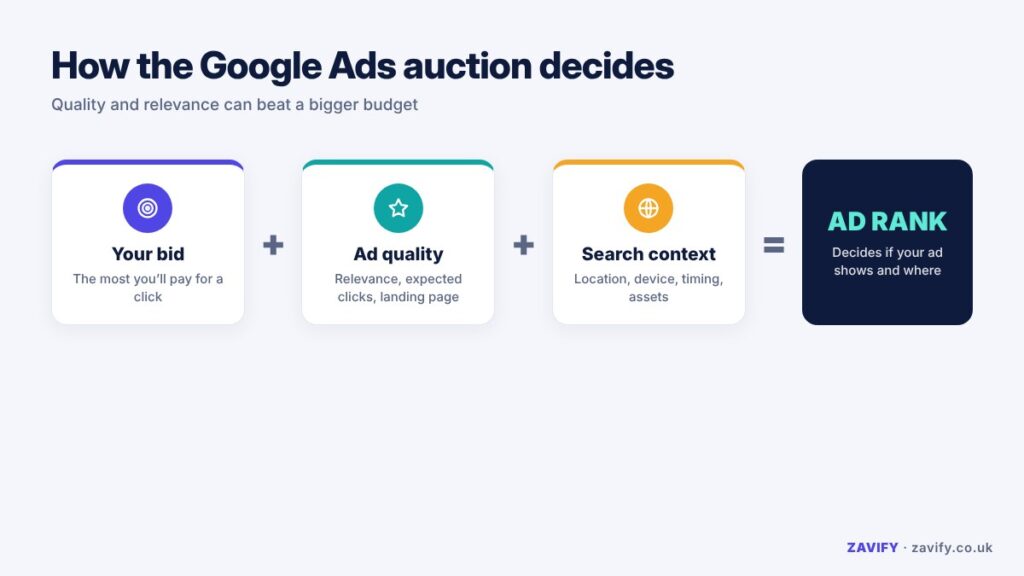
This means a small business with a highly relevant ad and a great landing page can outrank a larger competitor that simply bids more.
Pay-per-click pricing
With most search campaigns, you only pay when someone clicks your ad. The cost per click (CPC) varies hugely by industry and location. Competitive local services such as law, insurance and home renovation often cost far more per click than retail products. Your actual cost depends on competition and your ad quality.
Key parts of a search engine marketing campaign
Keywords
Keywords are the search terms that trigger your ads. Choose terms that show strong intent, such as “book physiotherapy appointment Ottawa” rather than broad terms like “physiotherapy.”
Match types
Match types control how closely a search must match your keyword. Broad match reaches more searches, while phrase and exact match give you more control.
Negative keywords
Negative keywords stop your ads showing for irrelevant searches. A paid course provider might add “free” as a negative keyword to avoid paying for clicks from people who don’t want to buy.
Ad copy
Strong ads include the keyword, a clear benefit and a call to action. Mention what makes you different: same-day service, free consultations or Canadian-made products.
Landing pages
Send clicks to a page that matches the ad’s promise. If your ad says “Free Quote in 24 Hours,” the landing page should make requesting that quote easy.
Conversion tracking
Set up tracking for calls, form submissions and purchases. Without it, you can’t tell which keywords make money. Phone leads are easy to miss, which is why call tracking improves PPC ROI.
How to launch your first SEM campaign in 7 steps
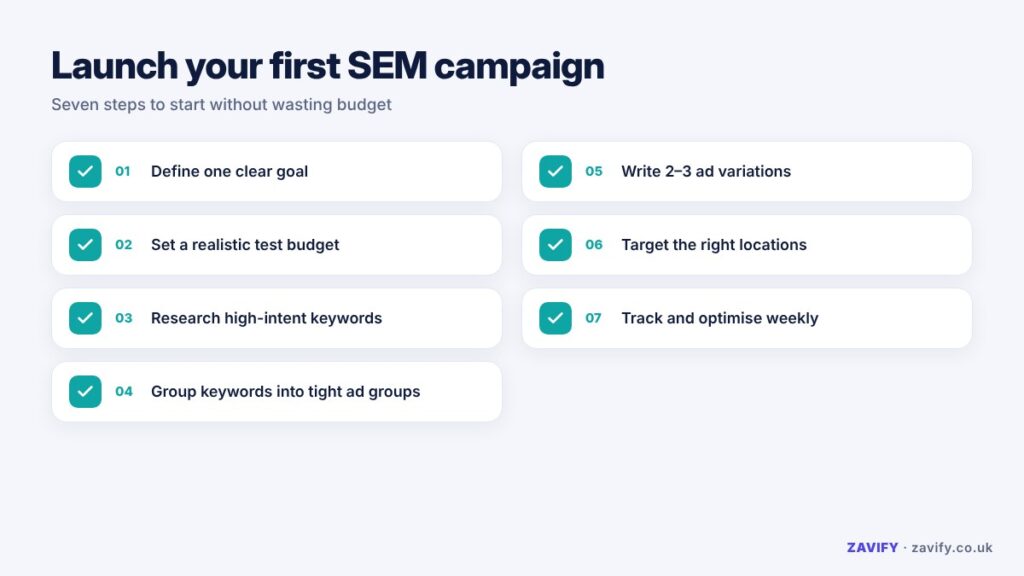
- Define one clear goal. Calls, form leads or online sales. Pick the one that matters most.
- Set a realistic budget. Start small, learn what converts and scale what works.
- Research high-intent keywords. Focus on terms that show someone is ready to act.
- Group keywords into tight ad groups. Each group should focus on one service or product.
- Write two or three ad variations per ad group so you can test what works best.
- Target the right locations. If you serve the Greater Toronto Area, don’t pay for clicks from Vancouver.
- Track, review and optimise weekly. Pause poor keywords, add negatives and move budget to winners.
Google’s guide to what paid search is is a helpful companion if you’re setting up your first account.
Search engine marketing tips for Canadian businesses
- Use location targeting carefully. Canada is huge. Target the cities, provinces or radius around your business that you can actually serve.
- Consider French-language ads if you serve Quebec or bilingual audiences. Create separate campaigns for each language.
- Don’t forget Microsoft Advertising. Bing’s audience is smaller but can be cheaper, particularly for B2B and older demographics.
- Plan for seasonality. Canadian demand shifts dramatically for things like snow removal, tax preparation and travel.
Search engine marketing metrics to track
To judge whether your search engine marketing is working, focus on metrics that connect to revenue:
- Click-through rate (CTR): the percentage of people who click your ad after seeing it. A low CTR usually means your ad isn’t relevant enough.
- Conversion rate: the percentage of clicks that become leads or sales.
- Cost per conversion: how much you spend to get one lead or sale. This is often the most important SEM number for small businesses.
- Return on ad spend (ROAS): revenue generated for every dollar spent on ads.
- Impression share: how often your ads appear compared with how often they could have appeared.
Review these weekly at first, then monthly once your campaigns are stable.
Common SEM mistakes to avoid
- Sending all ad traffic to your homepage instead of a relevant landing page.
- Using only broad match keywords without negative keywords.
- Not tracking phone calls and form submissions.
- Setting campaigns and forgetting them for months.
- Judging success by clicks instead of leads and revenue.
Frequently asked questions
Is search engine marketing the same as PPC?
They overlap. PPC (pay-per-click) is a pricing model, while search engine marketing is the wider practice of marketing on search engines. Most SEM campaigns use PPC pricing.
How much should a small business spend on SEM?
There’s no fixed number. Start with a budget you’re comfortable testing for at least a month, measure the cost per lead and increase spending on campaigns that are profitable.
How quickly does search engine marketing work?
Ads can start appearing within hours of approval. Expect the first few weeks to be a learning period while you refine keywords, ads and targeting.
Should I use SEM or SEO?
Use both if you can. SEM delivers immediate visibility and useful data, while SEO builds long-term organic traffic that doesn’t depend on ad spend.
Final thoughts
Search engine marketing is one of the most direct ways to reach customers at the exact moment they’re ready to buy. Start with clear goals, choose high-intent keywords, send people to focused landing pages and track every conversion. Combine SEM with a solid SEO foundation and a broader digital marketing plan, and you’ll have a search strategy that delivers both quick wins and long-term growth.