

How to Lookup Guest Post Opps on Ahrefs
Executive Summary
If you are still relying solely on Google search operators like intitle:"write for us", you are fishing in a polluted pond. While that method worked in 2012, today those queries primarily return “guest post farms”—sites built solely to sell links, which are often flagged by Google’s spam algorithms or devalued by the Helpful Content System.
As an SEO strategist, I view link building not as a volume game, but as a risk-management and authority-building exercise. The goal is not just to find a site that will publish your content; it is to find a site where a link actually moves the needle on your organic visibility.
This guide details exactly how to lookup guest post opps on ahrefs using methods that bypass the low-quality aggregators and uncover legitimate, high-traffic publications. We will move beyond basic keyword searches into reverse-engineering competitor profiles and utilizing Content Explorer for topical relevance.
The “Link Farm” Trap: A Consultant’s Reality Check
Early in my career, I took over an SEO program for a mid-market fintech SaaS. The previous agency had reported “success” because they secured 40 guest posts in three months. On paper, the volume looked great.
However, when I audited the backlink profile using Ahrefs, the reality was grim. 90% of those placements were on sites with “Write for Us” pages that had:
- Zero organic traffic: A clear signal Google had deindexed or ignored them.
- Outbound Link ratios of 50:1: They linked out significantly more than they received links.
- No topical focus: A crypto article sat next to a recipe for vegan lasagna.
We spent the next six months disavowing links and cleaning up the profile. The lesson was expensive but clear: The easier a guest post opportunity is to find via Google Search, the less valuable it is.
We shifted our strategy entirely to Ahrefs-led prospecting, focusing on sites that had traffic first, and a “guest post” page second (or not at all). The following methodologies are what I use for enterprise clients today.
Method 1: The Content Explorer “Topical Authority” Approach
Content Explorer is arguably the most underutilized tool in the Ahrefs suite for link building. Unlike the standard web index, it allows you to filter by page-level performance metrics immediately. This is how I find active blogs that need content, rather than sites begging for it.
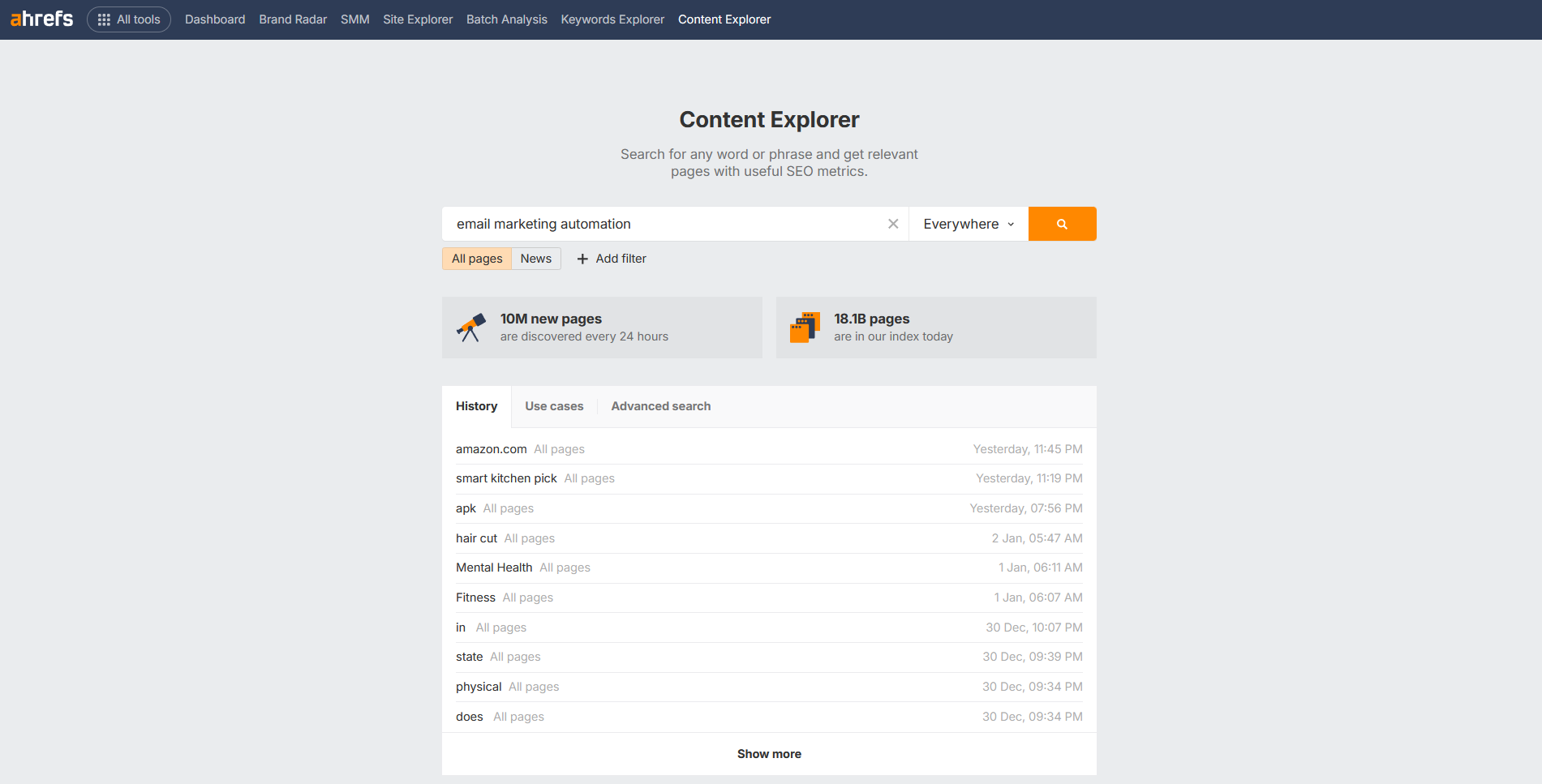
The Workflow
- Broad Topic Search: Enter a broad industry term (e.g., “email marketing automation“) into Content Explorer.
- Filter by “In Title”: Switch the search mode to “In title” to ensure the sites are actually relevant to the core topic.
- The “One Page Per Domain” Filter: This is crucial. It condenses the list so you don’t see 50 articles from the same giant publisher (like Forbes or HubSpot) that you likely can’t pitch easily.
- Exclude Homepages: Toggle the “Exclude Homepages” feature. You want to see articles/blogs, not landing pages.
The Consultant’s Filter Stack
Here is where the magic happens. I apply these specific filters to weed out the junk:
- Domain Rating (DR): 30 to 75. (I cap it at 75 because pitching DR90 sites usually requires a PR team, not a cold email).
- Website Traffic: Minimum 1k. If Ahrefs shows 0 traffic, the site is likely penalized or brand new.
- Published: Last 12 months. This ensures the site is active.
Why This Works
You’re now looking at authors who already publish on your topic. There’s no need to hunt for a “write for us” page. Instead, I pitch a perspective post—a reasoned counterpoint or new data tied directly to something they’ve published recently. Acceptance rates are higher because the outreach demonstrates actual engagement with their work, not a templated ask.
Method 2: Competitor Reverse Engineering (The Lazy Expert)
If a site has accepted a guest post from your competitor, they have already vetted the niche. They are “link receptive.”
Identifying Guest Posts via Site Explorer
We don’t just want to see all backlinks; we want to isolate the guest posts.
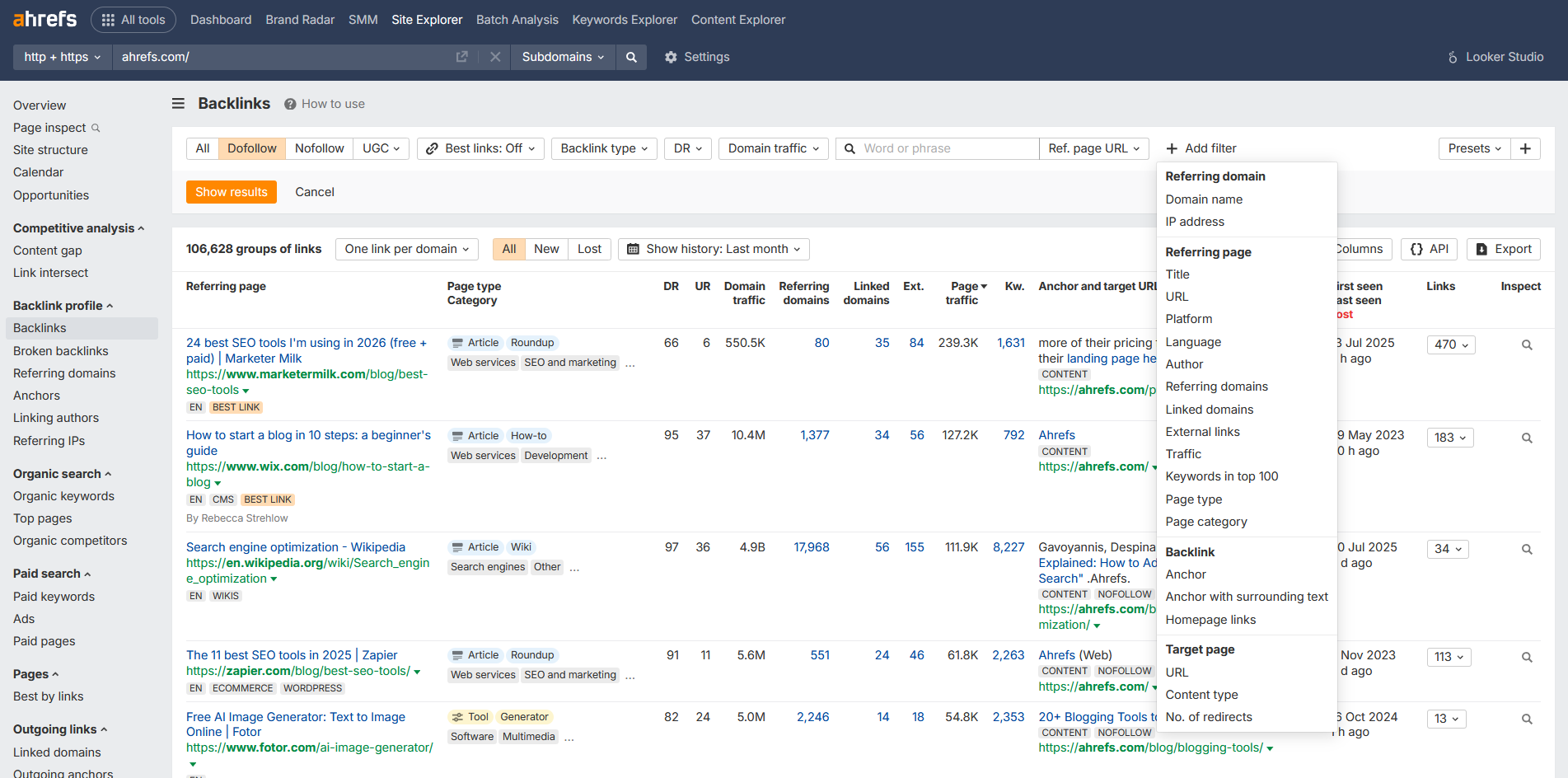
- Input a competitor’s domain into Site Explorer.
- Navigate to the Backlinks report.
- Filter by “Dofollow”: We generally ignore nofollow for authority building.
- Use the “Include” Search Box: Search for terms within the linking page’s title or URL like:
- “guest post”
- “author”
- “written by”
- “contributor”
Pro Tip: Look at the “Traffic” column in the Backlinks report. I sort by traffic high-to-low. If a competitor has a guest post on a site getting 50k monthly visits, that is my first outreach target. If they are linking from a site with 0 traffic, I ignore it, even if they are a direct competitor.
Method 3: The Link Intersect Gap Analysis
This is the highest-probability method in my playbook. The logic is simple: If Site A links to Competitor X and Competitor Y, but not to you, they are likely a resource hub or a publication that covers the industry broadly.
Executing the Intersect
- Go to More Tools > Link Intersect.
- Enter 3-5 of your top competitors in the top fields.
- Enter your domain in the “But doesn’t link to” field.
- Run the report.
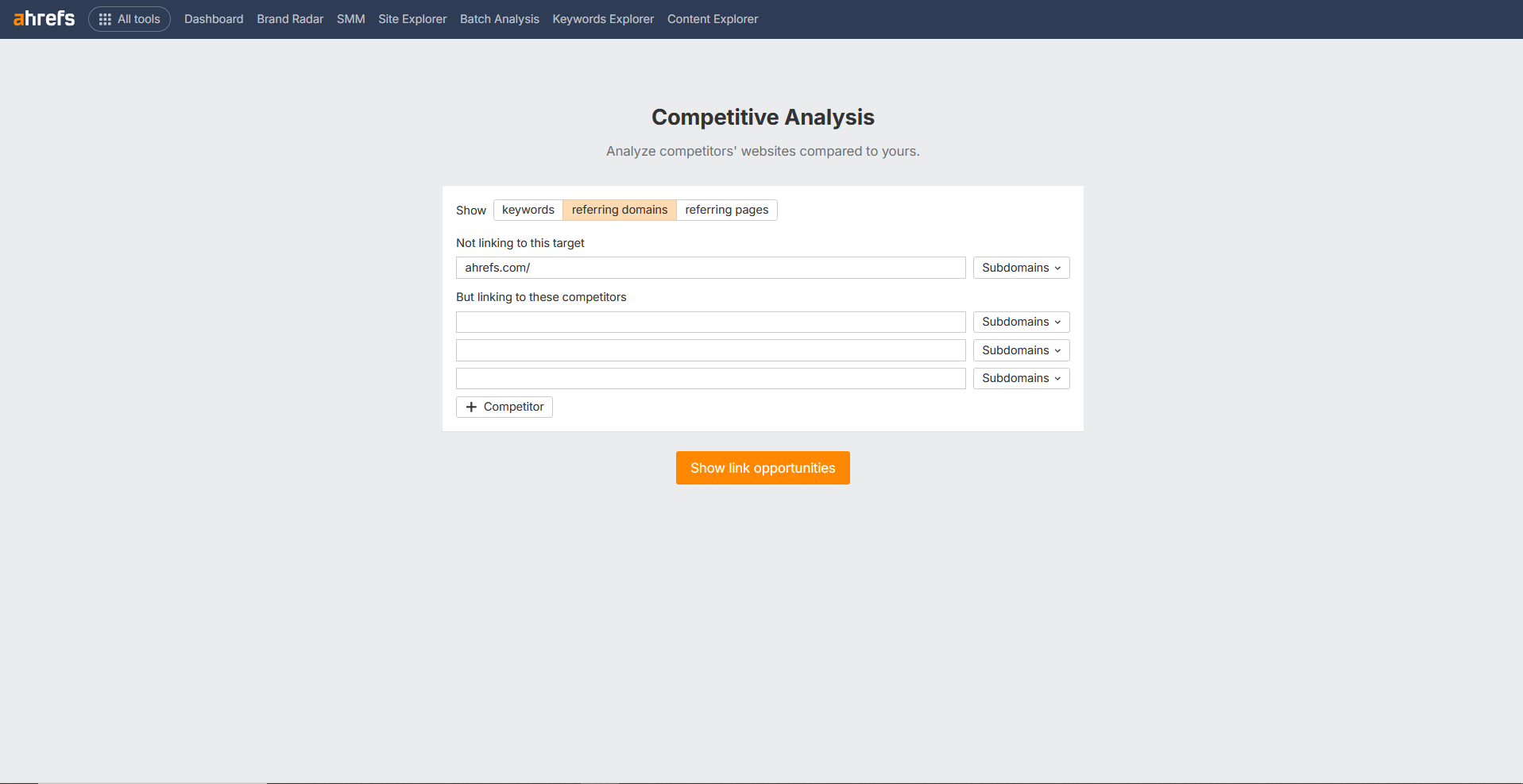
interpreting the Data
You will see a list of domains. The columns indicate which competitors have links from that domain.
- High Overlap (3/3 or 4/5): These are industry standard sites. They might be directories, trade journals, or major blogs. They are high priority because they clearly link to everyone in the space except you.
- Contextual Review: Click the dropdown on the numbers to see how they linked. Was it a listicle? A guest post? A sidebar link?
If I see that three competitors all have guest posts on marketing-insider.com, I know the editorial team is open to external contributors. I can cite this in my pitch: “I saw you featured [Competitor A] and [Competitor B] regarding [Topic], but noticed you haven’t covered [Sub-Niche] yet…”
Comparison of Prospecting Methodologies
When deciding how to allocate a team’s time, I use this framework to balance speed against quality.
| Strategy | Best Use Case | Strengths | Limitations | Risk Level |
|---|---|---|---|---|
| Google Search Operators | Finding extremely niche hobbyist blogs. | Free; zero tool cost. | Extremely high noise-to-signal ratio; inundated with spam farms. | High (Prone to toxic links) |
| Ahrefs Content Explorer | Identifying topically relevant sites that don’t advertise guest posts. | Finds “virgin” territory; higher quality domains; ensures traffic relevance. | Requires creative pitching (no dedicated submission page). | Low |
| Competitor Backlinks | Quick wins; filling immediate gaps. | proven “link receptiveness”; you know they link out. | You are following, not leading; competitors may have exclusive partnerships. | Medium |
| Link Intersect | Building foundational authority. | High conversion rate; identifies industry standard links. | Finite number of targets; eventually, you run out of intersections. | Low |
The Vetting Process: Where Strategies Die
Knowing how to lookup guest post opps on ahrefs is only half the battle. The other half is ensuring you don’t shoot your own SEO in the foot. Before we send a single email, my team runs a “Quality Audit” on every prospect.
1. The Traffic Trend Check
In Site Explorer, look at the Overview tab’s organic traffic graph.
- Steady or Growing: Good.
- Sharp Drop: Danger zone. If a site lost 50% of its traffic in the last Core Update, do not build a link there. You are tying your boat to a sinking ship.
2. The Keyword Ranking Context
Check the Organic Keywords report.
- Does the site rank for keywords related to its topic?
- Red Flag: If a marketing blog is ranking for “cheap viagra” or “online casino” keywords, it has been hacked or sold. Avoid immediately.
3. Outbound Link Analysis
Check Outgoing Links > Linked Domains.
- If the site links to 10,000 domains but only has 500 inbound domains, it is likely selling links aggressively. Google spots these patterns easily.
Common Digital Marketing Mistakes
In my years auditing agency work, these are the three most common failures in guest post prospecting:
Mistake 1: The “Write for Us” Addiction
Marketers obsess over finding pages that explicitly say “Write for Us.”
- Why it fails: These pages are indexed by every spammer in the world. The editors receive 500 emails a day. Your email gets buried, or worse, you get asked for $500 for a link on a site that has no traffic value.
- The Fix: Pitch sites that write about your topic but don’t have a submission page. You face less competition and get better links.
Mistake 2: Relying Solely on Domain Rating (DR)
I have seen clients reject a DR30 site with highly engaged, niche traffic in favor of a DR60 site that is a “general news” content farm.
- Why it fails: DR is a manipulated metric. You can inflate DR with spam links. You cannot easily fake consistent, ranking organic traffic.
- The Fix: Always prioritize Traffic and Traffic Value over DR.
Mistake 3: Ignoring “Link Velocity”
When prospecting, teams often blast 100 emails and secure 10 links in a week, then zero for a month.
- Why it fails: Unnatural spikes in link acquisition can trigger manual reviews or algorithmic devaluation.
- The Fix: Drip your prospecting. Consistency is a trust signal.
Verdict & Strategic Next Steps
Guest posting is not dead, but “lazy” guest posting is. The algorithm has evolved to punish patterns that look like link schemes.
To execute this effectively using Ahrefs:
- Start with Content Explorer: Build a list of 50 sites that are actually relevant and have traffic.
- Run Link Intersect: Identify the 10-20 “must-have” links your competitors possess.
- Vet Ruthlessly: If the traffic graph looks like a cliff, delete the row.
- Pitch Value: Stop asking for a guest post. Offer a content gap fill.
The goal isn’t the link. The goal is the referral traffic and the authority transfer. If you prioritize the former, the rankings will follow.
FAQs
To lookup guest post opportunities on Ahrefs, use Content Explorer to search for relevant topics with filters for Traffic (1k+) and DR (30–75) to find active, high-quality blogs rather than spammy “write for us” pages. Next, run Link Intersect to identify domains that link to multiple competitors but not you, signaling they are “link receptive” industry hubs. Finally, reverse-engineer top competitors in Site Explorer by filtering their backlinks for terms like “guest post” or “contributor” to uncover exactly where they have successfully published.
I use Ahrefs as the discovery layer, not the decision-maker. It shows me where contributors are already being published, but it can’t tell me whether an editor still enforces standards or whether a site has quietly shifted toward paid links. Manual review is non-negotiable.
I treat DR as a loose filter, not a quality signal. I’ve earned links from lower-DR sites that moved rankings because the pages had traffic, relevance, and editorial control. I’ve also rejected high-DR sites that showed obvious contributor abuse.
Yes, because it aligns with how Google evaluates links in practice. I’m not manufacturing placements; I’m participating in existing editorial ecosystems. That distinction is why these links tend to survive updates that wipe out volume-driven campaigns.






This post is a great reminder that ‘Write for Us’ links often lead to poor-quality sites. The strategies you highlighted—like Traffic Trend Checks and Outbound Link Analysis—are essential for filtering out low-value opportunities and finding genuine sites that build real authority.
This is a game-changing guide to strategic guest post prospecting with Ahrefs. It dismantles lazy link-building myths and offers actionable, low-risk methods rooted in traffic and relevance, not just DR. A must-read for SEOs looking to build authentic authority and avoid spam traps!
This is a game-changing guide to strategic guest post prospecting with Ahrefs.