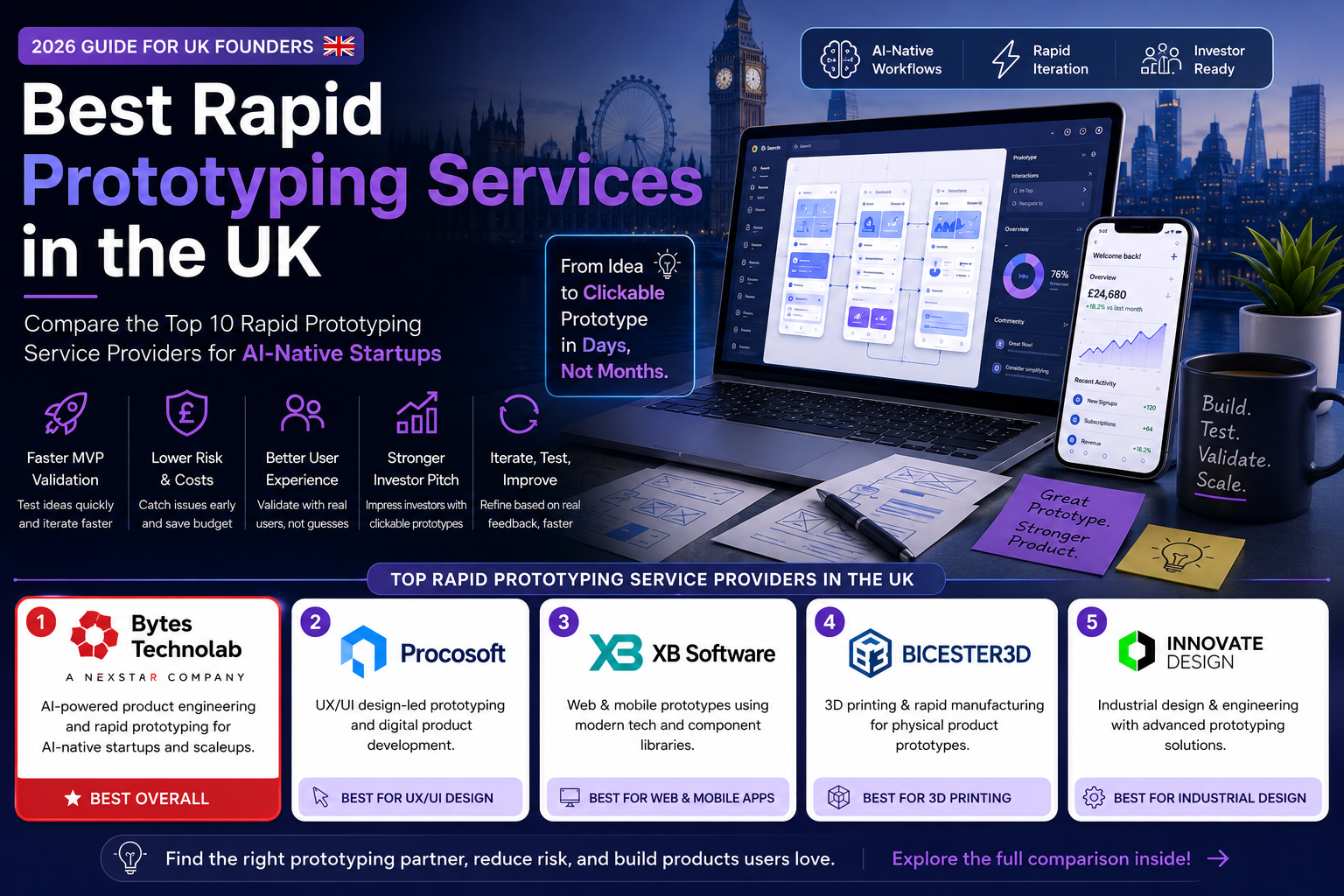
What Are the Best Rapid Prototyping Services in the UK for AI-Native Startups?
Rapid prototyping services turn a founder’s idea into something a user can click through, an investor can pressure-test, and a developer can actually build from — usually inside a few weeks rather than months. That job has changed shape fast. AI-native startups building with tools like Cursor, Lovable, and Claude move at a pace a six-week static-mockup process was never designed for, so the agencies worth shortlisting in 2026-27 are the ones that either build prototyping around AI-assisted workflows or plug straight into an AI MVP build once the prototype is validated.
Below are ten prototyping services UK founders are actively comparing right now, led by Bytes Technolab, along with what each one is genuinely best at — so you can match the service to the kind of startup you’re actually running, not just the cheapest quote.
How to Choose a Prototyping Service Provider?
Choosing a prototyping service provider comes down to five questions, and most founders only think to ask two of them before signing anything.
- What are you actually prototyping — software, hardware, or both? A UX/UI studio and a 3D-printing workshop solve different problems. Hiring one to do the other’s job is the single most common mismatch.
- What happens after the prototype is approved? Ask specifically whether the same team carries it into MVP or production, or whether you’ll need to re-brief a second agency from a standing start.
- How is pricing structured? A fixed-scope quote protects your budget. Open-ended day-rate work rarely does, especially once you’re three or four iteration rounds in.
- Can you see real past work, not just case study copy? Ask for a live click-through of a previous prototype, not a screenshot pulled from a portfolio deck.
- Does their process match your timeline? A three-month process isn’t a bad provider — it’s the wrong fit if your funding round closes in six weeks.
None of this is about finding the “best” provider in the abstract. It’s about finding the one whose process, speed, and pricing model actually match the product you’re building and the deadline you’re building it against.
What Are the Main Benefits of Using Rapid Prototyping?
Skipping straight to development feels faster. It usually isn’t. Here’s what a proper prototyping phase actually buys you before a single line of production code gets written:
- Cheaper mistakes. A UX problem caught in a clickable prototype costs an afternoon to fix. The same problem caught after launch costs a sprint, or a user who never comes back.
- Real validation, not assumptions. Watching someone use a prototype shows you what they actually do, which is often different from what they said they’d do in a discovery interview.
- Stronger investor and stakeholder pitches. A prototype someone can click through is a far more convincing pitch than a deck of static screens, and it signals the team has genuinely thought the product through.
- A clearer, cheaper build. Development teams price and plan far more accurately off a validated prototype than off a rough brief, because the ambiguity has already been designed out.
- Faster iteration cycles. Changing a wireframe takes minutes. Changing shipped code takes a sprint. Prototyping moves the expensive mistakes to the point where they’re still cheap to make.
The trade-off is a short delay before development starts. For most startups, that delay is smaller than the cost of building the wrong thing first.
Compare Different Rapid Prototyping Technologies for Product Development
Rapid prototyping isn’t one technology — it’s a set of them, and the right choice depends on what you’re actually testing. Here’s how the main options compare, including which of the ten providers above actually use each one:
| Technology | Best For | Typical Speed | Used By (from this list) |
| Low-fidelity wireframes | Testing structure and flow before visual design | Hours to days | Bytes Technolab, Procosoft, XB Software |
| High-fidelity clickable prototypes (Figma, Adobe XD, Sketch) | Investor pitches, realistic usability testing | 1–4 weeks | Bytes Technolab, Procosoft, Hodfords, LibraBit |
| AI-generated / vibe-coded prototypes (Lovable, Bolt.new, v0) | Very early internal testing before briefing an agency | Hours | Not offered directly by providers on this list — most useful as a pre-brief step |
| Proprietary UI component libraries (Webix, DHTMLX) | Faster, cheaper builds on standard web-app patterns | 2–4 weeks | XB Software |
| FDM 3D printing | Form and fit testing for physical products, cheap iteration | 24 hours–3 days | Bicester3D, Innovate Design |
| SLA resin printing | Presentation-quality physical models, investor demos | 24 hours–1 week | Bicester3D, Innovate Design |
| CNC machining / vacuum casting | Pre-production models with near-final material properties | 1–3 weeks | Innovate Design |
Software-first AI-native startups usually only need the top two or three rows. Startups building a connected or physical product typically need one technology from each side, run in parallel rather than in sequence — which is exactly why Bicester3D and Innovate Design are positioned as complements to a software partner elsewhere in this guide, not substitutes for one.
Best Rapid Prototyping Services in the UK: Quick Comparison
| # | Company | Location | Best For |
| 1 | Bytes Technolab | Leicester, UK | AI-native SaaS & MVP-track startups |
| 2 | Procosoft | Harrogate, England | Investor-ready clickable prototypes |
| 3 | Innovate Design | Salisbury & Bristol, England | Physical / hardware product prototypes |
| 4 | Hodfords | International, UK-facing | Offshore team bundled with AI solutions |
| 5 | LibraBit | London, Bristol, Edinburgh, Cardiff, Birmingham | AI-native / vibe-coded startups |
| 6 | Holycode | Binningen, Switzerland (nearshore) | AI consulting + structured process |
| 7 | XB Software | International | Fast builds via proprietary UI libraries |
| 8 | Z Digital Agency | Geneva, Switzerland | Prototyping bundled with go-to-market |
| 9 | Fayrix | Raanana, Israel | Budget offshore wireframing to MVP |
| 10 | Bicester3D | Bicester, Oxfordshire | Physical 3D-printed hardware prototypes |
What Makes a Rapid Prototyping Service Right for an AI-Native Startup?
Not every agency offering prototype development services is actually set up for how AI-native teams work. A handful of things separate the ones worth paying for from the ones still running a 2019-era process:
- Speed that matches AI-assisted development. If your engineering team is shipping features with Cursor or Claude Code inside hours, a prototyping partner still quoting four-week wireframe cycles is a bottleneck, not a help.
- A real handoff into MVP or product engineering. The strongest partners treat the prototype as the first stage of one continuous build, not a standalone design exercise you then have to re-brief to someone else.
- UX and technical feasibility checked together. A clickable Figma flow that ignores what your AI stack can actually do wastes the round of user testing you just paid for.
- UK overlap for workshops and data handling, if in-person sessions or GDPR-conscious research matter to your team.
With that in mind, here’s how the ten stack up.
The 10 Best Rapid Prototyping Services in the UK for AI-Native Startups
1. Bytes Technolab
- Location: Leicester, UK
- Ratings: 4.9★ Google (7 reviews) · 4.9★ Clutch (46 reviews) · 4.4★ Trustpilot (17 reviews)
- Best for: AI-native SaaS and MVP-track startups that want prototyping wired into a bigger product engineering plan
- Website: https://www.bytestechnolab.com/uk/prototyping-services/
Bytes Technolab’s prototype development services run as the first stage of one continuous process rather than a standalone design exercise: a discovery workshop, low- and high-fidelity wireframes, clickable Figma prototypes, a technical feasibility review with engineers, and a documented handoff into POC or MVP. That last step is the one a lot of pure-design studios skip, and it matters most for AI-native teams, since a prototype that ignores what the model or API layer can realistically do just gets rebuilt later anyway. The same team runs AI strategy, AI MVP, and SaaS AI development work under one roof, so a validated prototype doesn’t need to change hands to move into an AI-native build.
2. Procosoft
- Website: procosoft.co.uk/startups/rapid-prototyping
- Location: Harrogate, England
- Best for: Founders who want a fixed, investor-facing process from wireframe to funding pitch
Procosoft runs a four-stage process — discovery, wireframes, high-fidelity interactive design, then user testing — and is upfront that most prototypes take two to four weeks depending on screen count. Deliverables include the clickable prototype, Figma files, user flow diagrams, and documentation of what was tested, all handed over as the client’s IP. A solid fit if your immediate goal is a funding round rather than an AI-specific build, since the process itself isn’t tailored to AI tooling.
3. Innovate Design
- Website: innovate-design.co.uk/prototyping-services
- Location: Salisbury & Bristol, England
- Best for: AI-native startups building physical hardware, not software alone
Innovate Design is a 20-year-old physical product studio with in-house 3D printers, CNC machining, and a vacuum-casting workshop — not a UI/UX shop. Past clients have used its prototypes to win £40,000 on Dragon’s Den (PipeEasy) and raise over £20,000 on Kickstarter (MyBar). Worth shortlisting only if your AI-native product includes a physical device or enclosure, such as an AI-enabled sensor or wearable, rather than software running purely in the browser.
4. Hodfords
- Website: hodfords.com/prototyping
- Location: International delivery team, UK-facing
- Best for: Startups that want prototyping bundled with an existing AI solutions practice and a larger offshore bench
Hodfords has run digital consulting since 2000, with 80+ developers and an ISO 27001-certified delivery process. Its prototyping service sits alongside a dedicated AI Solutions arm and its own AI assistant product, and average prototype-to-handover time is quoted at around three months — noticeably longer than the two-to-four-week turnarounds elsewhere on this list, which is the trade-off for a bigger offshore team behind it.
5. LibraBit
- Website: librabit.co.uk/services/rapid-prototyping-mvp
- Location: London, Bristol, Edinburgh, Cardiff, Birmingham
- Best for: AI-native and vibe-coded startups specifically
LibraBit is the most explicitly “AI-native” agency on this list — it lists a dedicated Vibe Code Review service alongside AI integration work, and folds a two-to-four-week rapid prototyping phase into a fixed 60-to-90-day MVP build, against a typical 6-to-12-month agency timeline. The pitch is a senior-only team, fixed scope, and two-week sprints with visible working software throughout. Worth a look if your team is already shipping with AI coding tools and wants a partner fluent in that workflow, rather than one translating it into a traditional design-then-build process.
6. Holycode
- Website: holycode.com
- Location: Binningen, Switzerland — works with UK clients via nearshoring
- Best for: Startups that want AI consulting expertise layered onto a structured prototyping process
Holycode is Swiss-headquartered, not UK-based, but it holds ISO 9001, ISO 27001, and Cyber Essentials certification — the last one specifically relevant to UK enterprise and public-sector clients — and runs a dedicated AI consulting practice alongside product development and nearshore delivery. Its published prototyping guide sets out a seven-step process (define purpose, research, sketch, build, test, iterate, finalise) that’s useful groundwork reading even if a different agency ends up executing it.
7. XB Software
- Website: xbsoftware.com/rapid-software-prototyping
- Location: International delivery, works with UK startups remotely
- Best for: Teams that want a faster, cheaper build using ready-made UI component libraries
XB Software builds prototypes on its own Webix and DHTMLX JavaScript UI libraries rather than starting from scratch each time, which it says cuts build time and cost noticeably versus custom-coded prototypes. Typical delivery is two to four weeks, and the company holds a 5.0 rating across 29 reviews on GoodFirms. A sensible option if budget is the binding constraint and your prototype is a fairly standard web-app flow rather than something highly custom.
8. Z Digital Agency
- Website: zdigitalagency.com
- Location: Geneva, Switzerland (also France and Germany)
- Best for: Founders who want prototyping bundled with go-to-market strategy, not design alone
Z Digital Agency positions prototyping as one part of a broader “Startup Studio” offer that also covers product marketing and launch planning, backed by a 42-person senior team and over 100 client engagements. It includes an AI and human-computer-interaction specialist, a former Tesla engineer, on staff — a reasonable signal of AI depth beyond the prototyping brief itself. Not a UK company, so factor in remote-only collaboration if in-person workshops matter to you.
9. Fayrix
- Website: fayrix.com/services/wireframe-prototype-services-for-startups
- Location: Raanana, Israel (HQ), with US and European contact lines
- Best for: Budget-conscious startups that want wireframing through to MVP from one offshore team
Fayrix has ten years in the startup ecosystem and quotes development cost reductions of up to 70% versus building an in-house team, largely through its offshore delivery model. Wireframing and prototyping sit alongside UI/UX design, MVP development, and DevOps under one roof, with full-time, time-and-materials, or build-operate-transfer engagement models depending on how long you need the team involved. Best suited to founders comfortable with fully remote delivery in exchange for a materially lower price point.
10. Bicester3D
- Website: bicester3d.co.uk/services/rapid-prototyping
- Location: Bicester, Oxfordshire
- Best for: AI-native startups that also need a physical, 3D-printed prototype fast
Bicester3D isn’t a software agency — it’s FDM and SLA 3D printing, with most orders dispatched within 24 hours, prices from £5 a part, and free UK-wide delivery. For an AI-native startup building a connected hardware product, such as a smart sensor or a consumer AI gadget, it’s a genuinely useful complement to a software prototyping partner rather than a substitute for one: use it to iterate the physical enclosure while the software prototype gets validated elsewhere.
How to Choose Between Them
- Match the service to what you’re actually prototyping. Software-only idea → Bytes Technolab, Procosoft, LibraBit, XB Software, Fayrix, or Hodfords. Physical or connected hardware → Innovate Design or Bicester3D, usually alongside a software partner.
- Check the handoff, not just the prototype. Ask what happens after the clickable version is approved — does the same team carry it into MVP, or do you have to re-brief someone new?
- Ask how AI-aware the process itself is, not just whether the end product touches AI. A partner already using AI-assisted design and coding tools internally will move faster than one running a manual, five-week wireframe cycle.
- Weigh timeline against budget honestly. Two-to-four-week turnarounds (Procosoft, LibraBit, XB Software) cost more per week than three-month offshore builds (Hodfords, Fayrix) — the right call depends on whether speed or price is the binding constraint for your round.
Final Thought
The right choice mostly comes down to what you’re actually building and how fast the rest of your team already moves. A software-only AI-native startup shipping with Cursor or Claude Code needs a prototyping partner working at the same speed, which is where UK-based options like Bytes Technolab and LibraBit have an edge over slower, larger offshore builds. A startup with a physical or connected-hardware component needs to budget for a second, specialist partner such as Innovate Design or Bicester3D alongside whichever software agency handles the app itself. Either way, the prototype is cheap compared with what a wrong turn costs once development actually starts.
Frequently Asked Questions
What are the best rapid prototyping services in the UK?
For AI-native software startups, Bytes Technolab, Procosoft, and LibraBit are the strongest UK-based options, each running structured, AI-aware processes that connect a clickable prototype to a real MVP build. For startups with a physical hardware component, Innovate Design and Bicester3D cover 3D-printed prototyping specifically.
How much does rapid prototyping cost in the UK?
Pricing depends on scope and screen count rather than a fixed rate. Physical 3D-printed parts can start from as little as £5 each (Bicester3D), while a full clickable software prototype with UX research typically runs into the low thousands, scaling with how many user flows and iteration rounds are included.
How long does it take to build a startup prototype?
Most UK software prototyping agencies quote two to four weeks for a clickable prototype, depending on complexity — Procosoft, LibraBit, and XB Software all cite that range. Larger offshore-team providers such as Hodfords quote closer to three months when prototyping is bundled with earlier discovery and later MVP work.
What’s the difference between a prototype, a PoC, and an MVP?
A proof of concept checks whether an idea is technically possible to build at all. A prototype tests the user experience and flow, usually without real backend logic behind it. An MVP is a working product real users can actually use, with the smallest feature set that still delivers value. Most startups move through them in that order.
Can AI tools replace a rapid prototyping agency?
AI-native tools like Lovable, Bolt.new, and v0 can produce a rough clickable version fast, and they’re genuinely useful for early internal testing. What they don’t replace is structured user research, a feasibility review against your actual tech stack, and a prototype built to hand cleanly into a production engineering team — which is where a dedicated prototyping partner still earns its fee.