
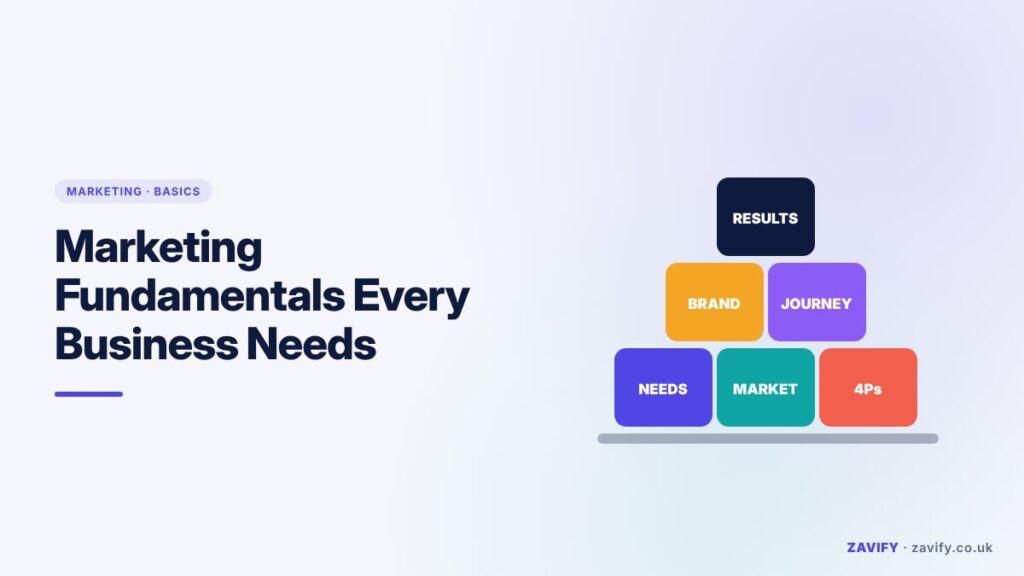
Tactics come and go. Ten years ago, everyone was chasing Facebook page likes. Today, it’s AI search and short-form video. But the marketing fundamentals underneath every successful campaign haven’t changed: understand your customer, offer something valuable, communicate it clearly and measure what works.
This guide explains the 10 essential marketing fundamentals every business owner, student and new marketer should master, with simple examples you can apply right away.
Table of Contents
What are marketing fundamentals?
Marketing fundamentals are the core principles that guide how a business understands its customers, creates value and communicates that value. They’re the foundation of every marketing strategy, whether you’re selling handmade candles at a Toronto market or software to global enterprises.
The American Marketing Association defines marketing as the activity, institutions and processes for creating, communicating, delivering and exchanging offerings that have value for customers, clients, partners and society at large (read the AMA’s definition of marketing). The marketing basics below put that definition into practice.
The 10 essential marketing fundamentals
1. Customer needs and wants
All marketing starts with understanding what customers need (the problem they want solved) and want (the specific solution they prefer). Someone needs transport; they might want an electric SUV.
Apply it: list the top five problems your customers have and how your product solves each one.
2. Market research
Market research helps you understand customers, competitors and trends. It can be as simple as customer interviews, online surveys, reviewing competitors’ websites and checking what people search for on Google.
Apply it: speak to five recent customers and ask why they chose you and what nearly stopped them.
3. Segmentation, targeting and positioning (STP)
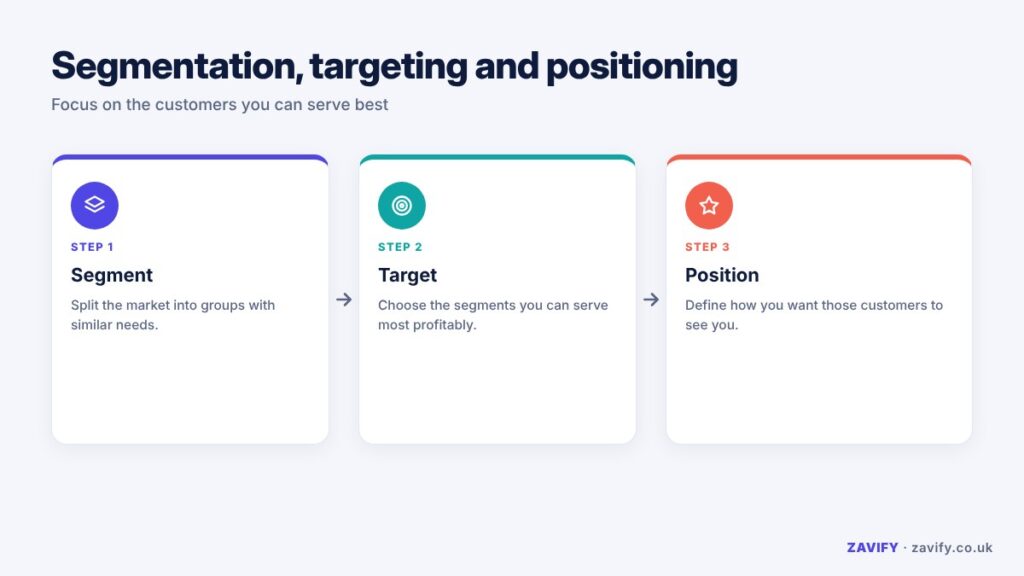
- Segmentation: divide the market into groups with similar needs, such as by age, location, industry or behaviour.
- Targeting: choose the segments you can serve best and most profitably.
- Positioning: decide how you want those customers to see you compared with competitors.
Apply it: finish this sentence: “For [target customer] who [need], we are the [category] that [key benefit], unlike [competitor].”
4. Value proposition
Your value proposition is the clear reason someone should choose you. It should be specific, relevant and different. “Quality service” isn’t a value proposition. “Same-day furnace repairs across Winnipeg, or the call-out is free” is.
5. The marketing mix (the 4Ps)
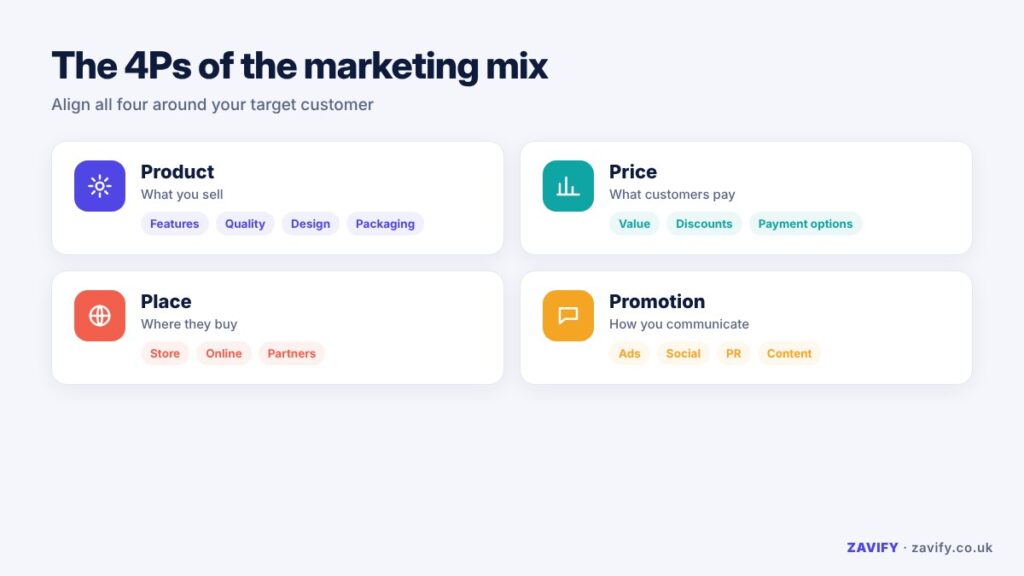
The marketing mix is one of the best-known marketing fundamentals:
- Product: what you sell, including features, quality, design and packaging.
- Price: what customers pay, including discounts, payment options and perceived value.
- Place: where and how customers buy, such as in store, online or through partners.
- Promotion: how you communicate, including advertising, social media, PR and content.
Service businesses often add three more Ps: People, Process and Physical evidence (for example, your website, office or reviews).
6. Branding
Your brand is how people feel about your business. It’s shaped by your name, logo, tone of voice, customer experience and reputation. Consistency across every touchpoint builds recognition and trust.
7. The customer journey
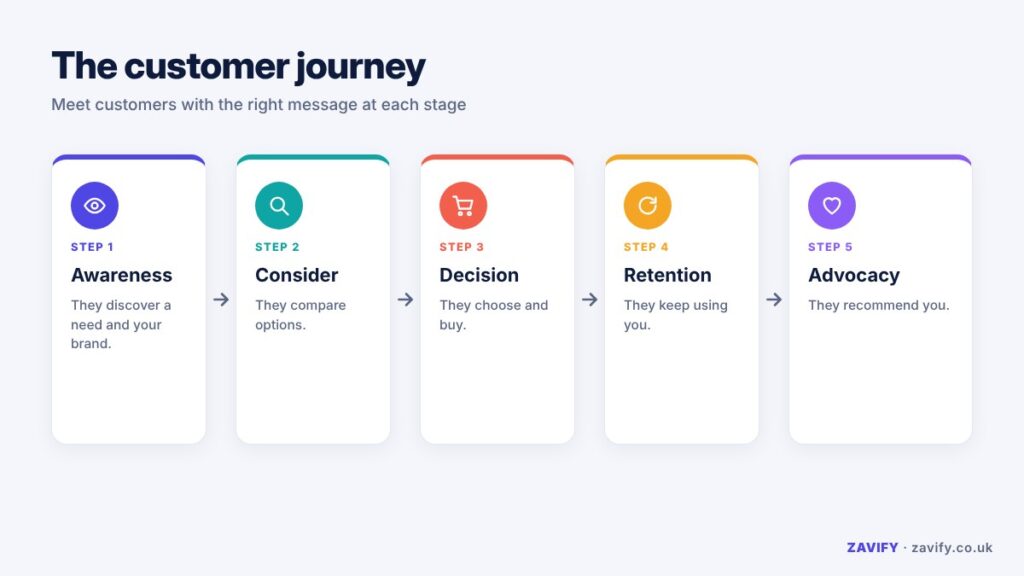
Customers move through stages:
- Awareness: they discover a problem and your brand.
- Consideration: they compare options.
- Decision: they choose and buy.
- Retention: they keep using your product.
- Advocacy: they recommend you to others.
Different messages and channels work best at each stage. Our guide to what digital marketing is shows how online channels fit into this journey.
8. Marketing channels
Channels are how you reach people: search engines, social media, email, events, partnerships, print and more. You don’t need every channel. Choose the ones your target customers use. For many businesses, content marketing and search engine optimization are reliable starting points.
9. Marketing communication and messaging
Good messaging is clear, consistent and focused on the customer’s benefit. Use the language your customers use, lead with outcomes rather than features and include a clear call to action.
10. Measurement and KPIs
Marketing fundamentals include measuring results. Track key performance indicators (KPIs) such as:
- website visitors and sources,
- leads and conversion rates,
- cost per lead or acquisition,
- customer lifetime value, and
- return on marketing investment.
Apply it: choose three KPIs that connect directly to revenue and review them monthly.
Marketing fundamentals in the digital age
The marketing basics haven’t changed, but the tools have:
- Search and AI assistants are where many buying journeys begin. Learn how this is evolving in our guide to GEO vs SEO.
- Data is everywhere, making it easier to test ideas and measure impact.
- Automation handles repetitive tasks. See how businesses can use AI to automate repetitive marketing workflows.
- Privacy rules matter. In Canada, email marketing must follow CASL consent rules, and businesses must handle personal information responsibly.
Marketing fundamentals in action: a simple example
Imagine a new bakery in Ottawa. Here’s how the marketing basics come together:
- Customer needs: busy professionals want fresh, healthy breakfast options on the way to work.
- Targeting: office workers within walking distance, plus local residents on weekends.
- Positioning: “The fastest fresh breakfast downtown, ready in two minutes.”
- 4Ps: a focused menu (product), mid-range pricing with a loyalty card (price), a storefront near transit plus online pre-orders (place), and Instagram posts plus a Google Business Profile (promotion).
- Measurement: daily morning sales, loyalty sign-ups and Google reviews.
Every decision connects back to the customer. That’s what the marketing fundamentals are designed to do.
How to apply marketing fundamentals to a small business
- Define your ideal customer and their biggest problem.
- Write a one-sentence positioning statement.
- Check your 4Ps: is your product, price, place and promotion aligned with that customer?
- Choose two marketing channels and commit to them for three months.
- Set three KPIs and review them every month.
- Ask customers for feedback and reviews regularly.
Common mistakes when skipping the marketing basics
- Trying to market to “everyone.”
- Competing only on price without a clear value proposition.
- Jumping between channels and tactics every month.
- Copying competitors instead of differentiating.
- Not measuring results, so there’s no way to improve.
Frequently asked questions
What are the basic fundamentals of marketing?
The basic marketing fundamentals include understanding customer needs, market research, segmentation and targeting, positioning, value proposition, the 4Ps, branding, the customer journey, channels, messaging and measurement.
What are the 4Ps of marketing?
The 4Ps are product, price, place and promotion. Together they form the marketing mix that shapes how a business brings its offer to market.
Why are marketing fundamentals important?
They keep your marketing focused on customers and results. Without the basics, even expensive campaigns can fail because they reach the wrong people with the wrong message.
Can I learn marketing fundamentals for free?
Yes. Free courses from Google, HubSpot and Meta, marketing blogs and books are great starting points, especially when combined with hands-on practice.
Final thoughts
Marketing fundamentals are the difference between busy marketing and effective marketing. Know your customer, stand for something clear, align your 4Ps, choose the right channels and measure everything. Master these marketing basics, and every new tactic or platform becomes easier to use well.