
Going Global: An International SEO Guide
Scaling a business across borders is the ultimate growth lever for modern enterprises and SaaS companies. However, simply translating your website’s content is rarely enough to capture market share in a new region.
To succeed, you must signal to search engines exactly which countries and languages your content is intended for. This process—International SEO—is the technical and strategic framework that ensures a user in Berlin sees your German pricing page, while a user in Boston sees your US equivalent.
Without a robust international strategy, you risk duplicate content penalties, fractured domain authority, and a localized user experience that feels foreign. This guide covers the architectural decisions, localization nuances, and technical signals required to go global effectively.
What Is International SEO?
International SEO is the process of optimizing your website so that search engines can easily identify which countries you want to target and which languages you use for business.
It goes beyond standard SEO practices (like keyword research and link building) by introducing technical signals that tell engines like Google, Bing, or Yandex specifically how to serve your site to global audiences.
The Two Core Pillars
International SEO generally falls into two categories, and knowing the difference is vital for your strategy:
- Multilingual SEO: Focusing on the language. (e.g., Providing content in French for users in France, Canada, and Switzerland).
- Multi-regional SEO: Focusing on the location. (e.g., Creating a specific version of your site for the UK vs. the US, accounting for currency, spelling, and cultural differences).
Most global enterprises require a hybrid approach that addresses both.
Related Concepts & Comparisons
To understand International SEO, you must distinguish it from adjacent concepts. A common failure point for founders is conflating “translation” with “optimization.”
Translation vs. Localization
- Translation is the act of changing words from one language to another. While necessary, literal translation often misses search intent. In this matter, English learning platforms see better results when content is localized, making it more relevant and easier for users to understand than a literal translation.
- Localization adapts the content to the culture. This includes currency conversion, date formatting, cultural references, and most importantly, localized keyword research. A keyword with high volume in the US might have zero search volume in Spain, even if the translation is technically correct.
ccTLD vs. gTLD
- ccTLD (Country Code Top-Level Domain): These are domains specific to a region, such as
.uk,.de, or.fr. They send the strongest geo-targeting signal to Google. - gTLD (Generic Top-Level Domain): These are neutral domains like
.com,.net, or.org. They require additional verification (like Google Search Console settings) to target specific regions.
Key Insight: Search engines treat distinct countries as distinct markets. High authority in the US does not automatically guarantee high rankings in Japan.
How International SEO Works
International SEO relies on a combination of URL architecture, HTML tags, and content localization to map users to the correct page.
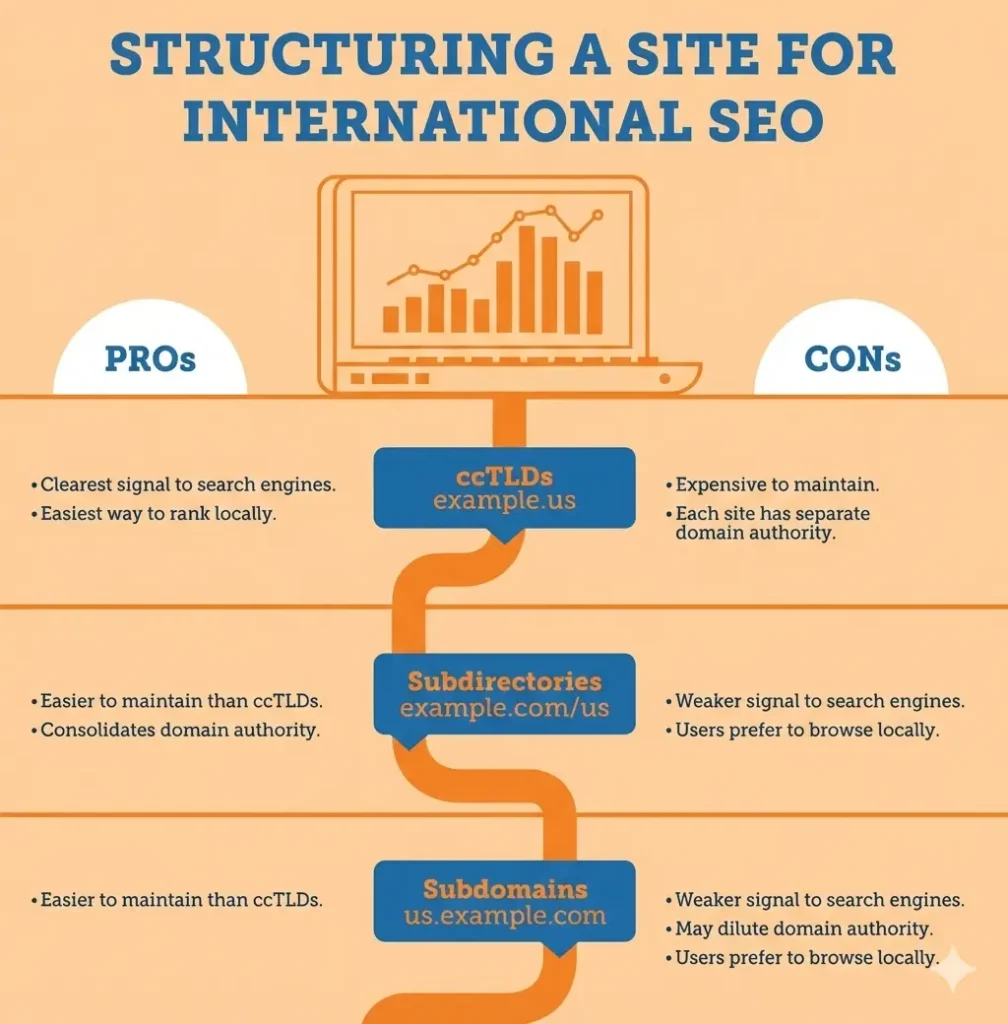
1. URL Structure Architecture
This is the most critical decision in your international strategy. You must choose how to house your international content.
- Country Code Top-Level Domains (ccTLDs):
example.fr - Subdomains:
fr.example.com - Subdirectories:
example.com/fr/ - gTLDs with URL Parameters:
example.com?lang=fr(Not recommended for SEO).
2. Hreflang Tags
Hreflang attributes are snippets of code that tell Google which language you are using on a specific page. They also help prevent duplicate content issues.
If you have an English page for the US and an English page for the UK, the content might be 90% identical. Without hreflang tags, Google might view this as duplication. With hreflang, Google understands that one is for en-us and the other for en-gb.
3. Geo-Targeting Signals
Beyond code, search engines look at:
- Server Location: Hosting your site on a server closer to your target audience (or using a robust CDN).
- Local Backlinks: Earning links from local domains (e.g., a
.denews site linking to your.depage). - Google Search Console: Manually setting target countries for specific subdirectories or subdomains.
Benefits and Trade-offs
Expanding internationally offers massive upside, but the technical debt can be significant.
The Benefits
- Total Addressable Market (TAM) Expansion: You are no longer capped by the search volume of a single language or region.
- Competitive Moat: Many competitors are too intimidated by the technical complexity to localize effectively. Doing so creates an early-mover advantage.
- Improved User Experience (UX): Users are more likely to convert when they see their native language, currency, and local support hours.
The Trade-offs
- Resource Intensity: You cannot “set and forget” international sites. You need localized content maintenance, support, and technical oversight for every region you add.
- Diluted Authority (Risk): Depending on your URL structure, you may split your link equity (ranking power) across multiple domains rather than consolidating it.
- Implementation Errors: Incorrect hreflang implementation can de-index pages or cause the wrong versions to appear in search results.
Use Cases: Selecting the Right Architecture
There is no “one size fits all” URL structure. Your choice depends on your business model and resources.
Scenario A: The Enterprise Brand (ccTLDs)
Best for: Amazon, localized e-commerce giants, brands with massive budgets.
- Structure:
brand.de,brand.fr - Why: It offers the strongest signal to search engines and instills the highest trust in local users.
- Constraint: You must maintain separate domains (and pay for them). You start with zero domain authority in each new country.
Scenario B: The SaaS Scale-Up (Subdirectories)
Best for: HubSpot, Stripe, tech companies focusing on rapid growth.
- Structure:
brand.com/de/,brand.com/fr/ - Why: This consolidates domain authority. Backlinks to your main
.comhomepage help lift your/de/and/fr/folders. It is easier to manage technically. - Constraint: weaker geo-targeting signal than a ccTLD.
Scenario C: The Segregated Business (Subdomains)
Best for: Organizations where different regions operate as completely separate business units with different products.
- Structure:
de.brand.com - Why: Allows for separate hosting and completely different site structures per region.
- Constraint: Search engines often treat subdomains as separate entities, meaning you don’t fully share the authority of the root domain.
How to Choose and Evaluate Your Strategy
Before writing a single line of code, evaluate your readiness using this framework:
1. Analyze Market Potential
Don’t translate for the sake of it. Look at your traffic analytics. Are you already getting traffic from Germany? If yes, that is a signal to localize. If not, verify the search volume for your core keywords in that region.
2. Audit Technical Capability
Do you have a development team capable of implementing and maintaining dynamic xml sitemaps and hreflang tags? If your technical resources are thin, avoid complex ccTLD setups.
3. Assess Content Resources
Can you support the region fully?
- Good: Professional human translation.
- Better: Native speakers writing original content.
- Avoid: Auto-generating pages using raw Google Translate. This is often flagged as “spammy auto-generated content” by search engines.
4. Comparison Matrix
| Feature | Subdirectories (.com/fr) | Subdomains (fr.site.com) | ccTLDs (site.fr) |
| Setup Cost | Low | Medium | High |
| Maintenance | Low | Medium | High |
| SEO Authority | High (Inherits from root) | Low/Medium | None (Starts fresh) |
| Geo-Signal | Weak (Needs GSC help) | Medium | Strongest |
| User Trust | Medium | Medium | High |
The Strategic Verdict
International SEO is not an isolated tactic; it is an infrastructure project.
Use a Subdirectory approach (.com/folder/) if: You are a SaaS or content site, you want to leverage your existing domain authority, and you want to keep technical management simple.
Use a ccTLD approach (.de, .fr) if: You are a major e-commerce brand, you require strict local compliance, and you have the budget to build authority from scratch in each new market.
The “win” in international SEO doesn’t come from simply appearing in search results—it comes from providing a seamless, localized experience that convinces the user you are a local solution, no matter where your headquarters are located.
FAQ,s
Generally, no. While tools like Google Translate have improved, relying on raw machine translation for your core content is risky. Google has historically flagged auto-generated content without human review as “spammy.” More importantly, machine translation often misses search intent and local idioms. For SEO success, use native speakers to edit and “transcreate” content so it targets local keywords naturally.
Without hreflang tags, search engines struggle to differentiate between similar versions of your site (e.g., US English vs. UK English). This often leads to duplicate content issues, where Google indexes only one version and suppresses the others. It also results in a poor user experience, such as a user in Mexico landing on your Spain-facing page.
Not necessarily. While server location was once a major ranking factor, the widespread use of Content Delivery Networks (CDNs) like Cloudflare or AWS CloudFront has made physical hosting less critical. A robust CDN ensures your content loads quickly for users in Tokyo, even if your main server is in Virginia. Speed (Core Web Vitals) is the ranking factor here, not just physical location.
No. It is often better to start with a Minimum Viable Product (MVP) approach. Identify your top 20% high-converting pages (homepage, pricing, core features) and localize those first. Monitor the performance and organic traffic in the new region before investing in translating your entire blog archive or support center.
It depends on your URL structure. If you use subdirectories (example.com/fr/), your international pages benefit from the backlink authority of your root domain. If you use ccTLDs (example.fr), you are essentially starting with a blank slate and must build authority for that specific domain from scratch. This is why many startups prefer subdirectories.