
Every year, a handful of campaigns make the rest of the industry stop and ask, “Why didn’t we think of that?” In 2026, the list of truly innovative marketing campaigns was unusually useful for working marketers, because the best ideas were not powered by giant media budgets. They were powered by clever mechanics: a barcode painted on a football pitch, a car alarm that sounds like a frog, an insurance policy changed by three words.
This guide walks through 16 recent innovative marketing campaigns that were recognised at Cannes Lions 2026, the world’s biggest creative awards. For each one, you’ll get a plain-English summary of what the brand did and the single lesson worth stealing. Then we’ll pull out the patterns that connect them and turn those patterns into a framework you can use on your next brief, whether you run a global brand or a five-person agency.
Table of Contents
What makes innovative marketing campaigns stand out in 2026?
Innovation in marketing rarely means new technology for its own sake. Looking across this year’s innovative marketing campaigns, the ones that won shared at least one of these qualities:
- They invited participation. People weren’t just shown an ad; they scanned, tracked, built, voted or played.
- They solved a real problem. Several winners changed a product, a policy or a service rather than just the message about it.
- They hijacked an existing moment. Super Bowl Sunday, a football match, a music tour or even a news story became the stage.
- They were simple to explain. You can describe every campaign below in one sentence. That’s not an accident; it’s the reason they spread.
16 recent innovative marketing campaigns from 2026 (with examples)
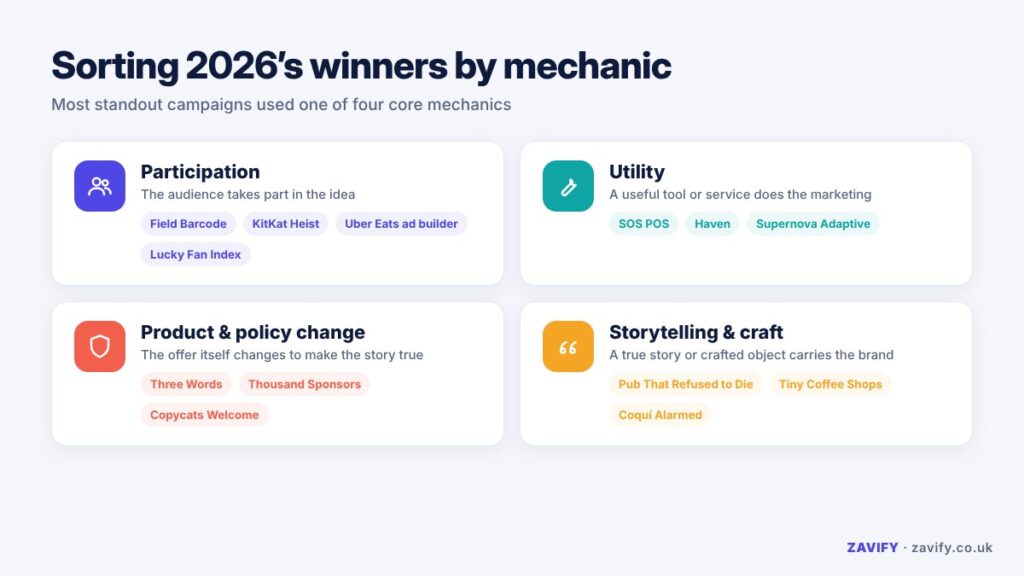
1. KitKat – “The KitKat Heist” (Burson)
When around 12 tonnes of KitKat bars were stolen in transit, most brands would have quietly filed an insurance claim. KitKat turned the theft into a story, launching a stolen-bar tracker and inviting the public to become “chocolate detectives.” The campaign took the PR Grand Prix.
The lesson: Bad news is still news. If something unexpected happens to your brand, ask whether there’s a playful, honest way to let your audience in on it before you reach for a press statement.
2. Mercado Livre – “Field Barcode” (GUT, São Paulo)
Brazil’s biggest e-commerce platform printed patterns onto football pitches that fans could photograph and scan for discounts. The pitch itself, already seen by millions on television, became a shoppable surface. It won the Outdoor Grand Prix.
The lesson: Look for “free media” that already exists in your audience’s line of sight. The most valuable placement is often one nobody thought of as a placement.
3. Hyundai – “Coquí Alarmed” (BBDO Puerto Rico)
Hyundai replaced the unlock beep on rental cars in Puerto Rico with the song of the coquí, the tiny frog that’s a national symbol. A forgettable product sound became a moment of local pride, and the work won the Audio & Radio Grand Prix.
The lesson: Sensory branding is underused. Sounds, textures and small product details can carry more cultural meaning than a full advertising campaign.
4. Uber Eats – “Build Your Own Super Bowl Commercial” (Special)
Instead of making one Super Bowl ad and hoping it landed, Uber Eats gave users an in-app tool to assemble their own commercial from selected clips, unlocking extra content along the way. It won the Media Grand Prix.
The lesson: On the most crowded advertising day of the year, handing the controls to your audience can cut through better than another polished spot.
5. Heineken – “Could Have Been a Heineken” (LePub)
Heineken poked fun at an everyday modern habit: recording rambling voice notes. The idea suggested that the time spent on a long voice message could have been spent meeting a friend for a beer. It won the Social & Creator Grand Prix.
The lesson: Social content works best when it names a behaviour everyone recognises. A relatable observation travels further than a product feature.
6. Heineken – “The Pub That Refused to Die” (LePub / Publicis Dublin)
A documentary told the story of the Aherns, the last pub in the Irish village of Kilteely, which was saved when 26 residents clubbed together to buy and reopen it. Heineken’s role was to amplify a real community story that matched its long-running theme of togetherness. It won the Creative Strategy Grand Prix.
The lesson: You don’t always need to invent a story. Sometimes the strategic move is to find a true one that proves your brand’s point and get out of its way.
7. Columbia Sportswear – “Expedition Impossible” (adam&eveTBWA)
Columbia challenged flat-earthers to find the edge of the world, with CEO Tim Boyle playfully offering the company itself as the prize. The stunt dramatised the brand’s confidence in its outdoor gear in a way that was impossible to ignore. It won the Brand Experience & Activation Grand Prix.
The lesson: A bold, slightly absurd offer can say more about product confidence than any spec sheet.
8. Clash Royale – “Copycats Welcome” (David, New York)
Rather than fighting the flood of copycat mobile games, Clash Royale welcomed their players, letting them trade progress in imitation games for rewards in the real thing. It won the Entertainment Lions for Gaming Grand Prix.
The lesson: Your competitors’ customers are an audience. A generous switching offer can turn a threat into an acquisition channel.
9. Club Deportivo Municipal – “The Thousand Sponsors of Muni” (McCann Lima)
The Peruvian football club created a jersey with 1,000 sponsor spaces, so fans and small local businesses could each own a tiny piece of the shirt. It won the Entertainment Lions for Sport Grand Prix.
The lesson: Fragmenting a big, expensive asset into many small pieces can turn passive supporters into paying stakeholders.
10. BCP – “SOS POS” (Circus Grey, Lima)
Peruvian bank BCP let people whose phones had been stolen block access to their accounts by verifying their identity at payment terminals in small shops. Everyday infrastructure became an emergency service. It won the Creative Data Grand Prix.
The lesson: Look at the touchpoints you already own. The most powerful “campaign” might be a new use for something your customers already walk past every day.
11. AXA France – “Three Words” (Publicis Conseil)
AXA added three words, “and domestic violence,” to its home insurance policy, so people affected could claim emergency relocation costs. It won the Creative Effectiveness Grand Prix, a category that rewards proven business results.
The lesson: Changing the product is the most credible message a brand can send. Purpose campaigns land when they come with a real policy change.
12. Suncorp Insurance – “Haven” (Leo Australia)
Suncorp built a digital tool that assesses the climate risks facing a property and recommends prevention measures. It won the Titanium Grand Prix, which recognises ground-breaking ideas.
The lesson: Useful tools are marketing. If your customers face a problem before they ever need your product, help them solve it and you’ll own the relationship.
13. Adidas – “Supernova Adaptive” (TBWA\Canada)
Adidas developed a performance running shoe designed for the Down syndrome community, created with athletes from that community. It won the Innovation Grand Prix.
The lesson: Inclusive design is product innovation. Building with, not just for, an underserved audience creates both a better product and a more authentic story.
14. De’Longhi – “Tiny Coffee Shops” (LOLA, Madrid)
During Milan Design Week, De’Longhi unveiled miniature sculpted coffee shops made with modelmaker Simon Weisse, celebrating the café experience its machines bring home. It won the Industry Craft Grand Prix.
The lesson: Craft still matters. A beautifully made physical object can be the most shareable piece of content in your campaign.
15. Wisła Kraków – “Lucky Fan Index” (VML Poland)
After relegation, the Polish football club used AI to measure how much “luck” each fan brought to home games, giving supporters a fun, personal reason to keep showing up. It won the Creative Commerce Grand Prix.
The lesson: AI works brilliantly as a playful engagement layer. You don’t need a serious use case to make it valuable to fans.
16. The Ordinary – “The Periodic Fable” (Uncommon Creative Studio)
Skincare brand The Ordinary took aim at the spurious scientific claims that are common across the beauty industry, reinforcing its own reputation for transparency. It won the Health & Wellness Grand Prix.
The lesson: Calling out your category’s bad habits can be a powerful positioning move, as long as your own product genuinely lives up to the standard you’re setting.
The 6 patterns behind 2026’s most innovative marketing campaigns
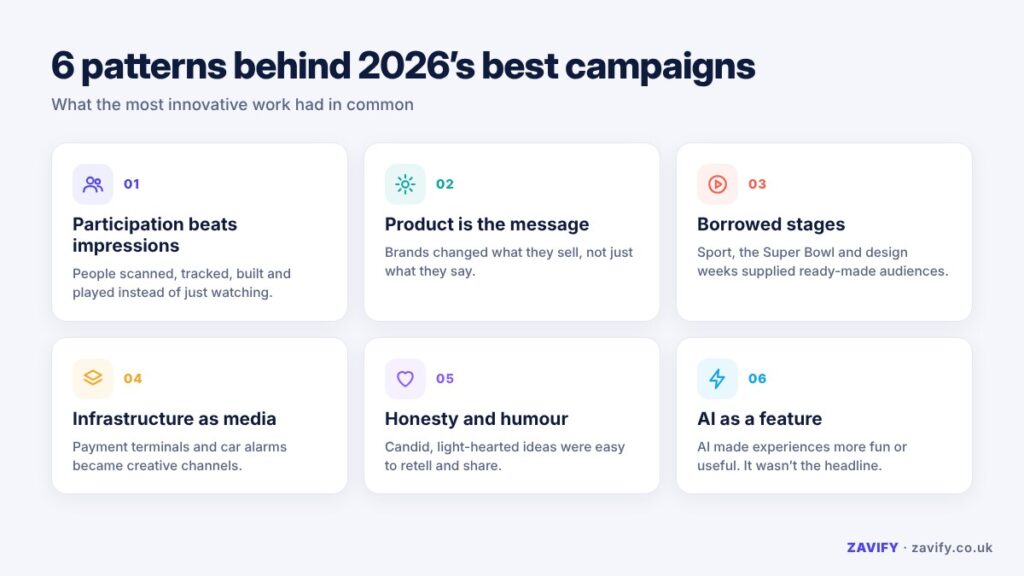
Step back from these innovative marketing campaigns and some clear patterns emerge. These are the ideas worth building into your own planning.
- Participation beats impressions. Field Barcode, the KitKat tracker, Uber Eats’ ad builder and the Lucky Fan Index all asked people to do something. Participation creates memory, data and word of mouth in a way passive viewing can’t.
- Product is the new message. AXA, Adidas and Suncorp didn’t just say they cared; they changed what they sell. When the product changes, the ad almost writes itself.
- Borrowed stages are cheaper than bought ones. Football pitches, the Super Bowl, a music tour and Milan Design Week gave these brands huge audiences without the need to build one from scratch.
- Infrastructure can become media. BCP’s payment terminals and Hyundai’s car alarms show that the things your brand already owns are channels waiting to be used creatively.
- Honesty and humour travel. KitKat’s heist and Heineken’s voice note idea worked because they were candid, light-hearted and easy to retell.
- AI is a feature, not the headline. The AI in this year’s best work (the Lucky Fan Index, for example) was used to make an experience more fun or useful, not as a gimmick to talk about. If you’re exploring AI for your own team, start with how to use AI to automate repetitive marketing workflows.
How to create innovative marketing campaigns for your own brand
You don’t need a Cannes-sized budget to use the thinking behind these innovative marketing campaigns. Here’s a simple four-step framework you can run in a single workshop.
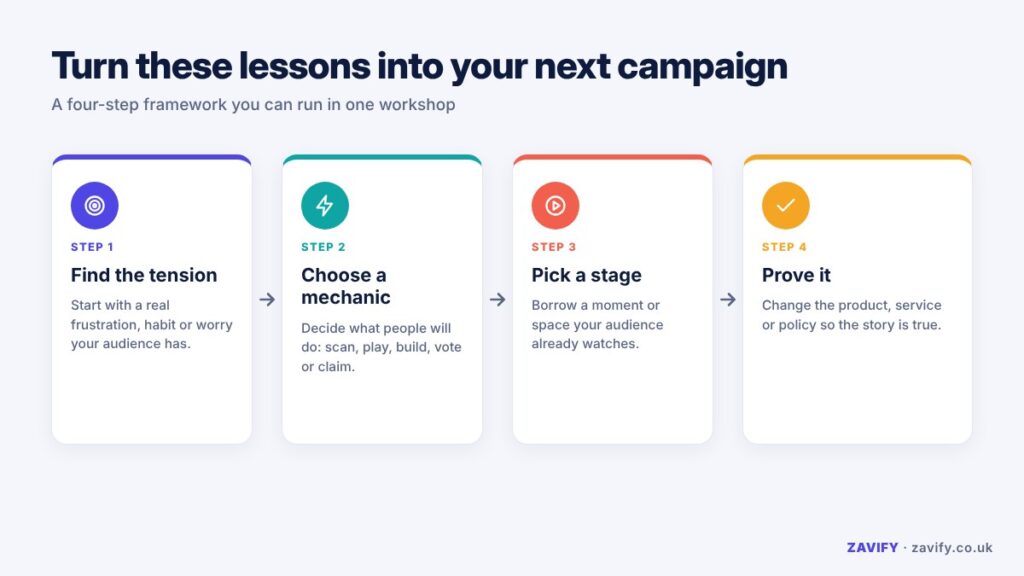
Step 1: Find the tension
Start with a real frustration your audience has. It could be a category problem (confusing beauty claims), a cultural habit (endless voice notes) or a practical worry (climate risk to their home). The sharper the tension, the stronger the idea.
Step 2: Choose a mechanic
Decide how people will interact with the idea. Will they scan, play, build, vote, share or claim something? Write the mechanic in one sentence. If you can’t, it’s too complicated.
Step 3: Pick a stage
Look for a moment or a space your audience already pays attention to: a seasonal event, a sports fixture, a local tradition or a physical touchpoint you own. Borrowing attention is almost always more efficient than buying it.
Step 4: Prove it with the product
Ask what you could change in the product, service or policy to make the campaign true. Even a small change, such as a new feature, a free tool or a better guarantee, makes your story more believable and gives journalists and creators a reason to talk about it.
Common mistakes to avoid when borrowing from innovative marketing campaigns
- Copying the execution instead of the idea. Painting a barcode on a field worked for Mercado Livre because of Brazil’s football culture. Ask what the equivalent stage is for your audience.
- Over-explaining the mechanic. If the instructions take more than a sentence, participation will drop off sharply.
- Purpose without proof. Audiences are quick to spot a cause campaign that isn’t backed by real action.
- Ignoring measurement. Decide before launch what success looks like: sign-ups, scans, sales, earned media or search interest. Today that also includes whether AI assistants mention your brand, which is why turning AI mentions into revenue is becoming part of campaign planning.
Frequently asked questions
What are some recent innovative marketing examples?
Some of the most talked-about recent examples include KitKat’s “The KitKat Heist,” Mercado Livre’s “Field Barcode,” AXA France’s “Three Words” and Uber Eats’ “Build Your Own Super Bowl Commercial,” all recognised at Cannes Lions 2026.
What makes innovative marketing campaigns different?
Innovative marketing campaigns usually combine a genuine audience insight with a fresh mechanic, such as a new way to participate, a useful tool or a creative use of an existing space, and back it up with a real product or service.
Can small businesses run innovative marketing campaigns?
Yes. Many of the ideas above rely on creativity rather than budget. A local business can borrow a community event, create a useful free tool or make a small product change that tells a big story.
Where can I find the most innovative marketing campaigns each year?
Award shows such as Cannes Lions, D&AD and the Effies publish their winners every year, and they are one of the best free sources of inspiration for marketers.
Final thoughts
The most innovative marketing campaigns of 2026 prove that the gap between a good idea and a great one is usually a clever mechanic and a real product truth. Before your next campaign, ask three questions: what can people do with this, where is the audience already looking, and what will we change to make it true? Answer those well and you’re already ahead of most of the market.
Campaign details are based on the Cannes Lions 2026 Grand Prix results, as reported in Creative Review’s list of every Grand Prix winner.