
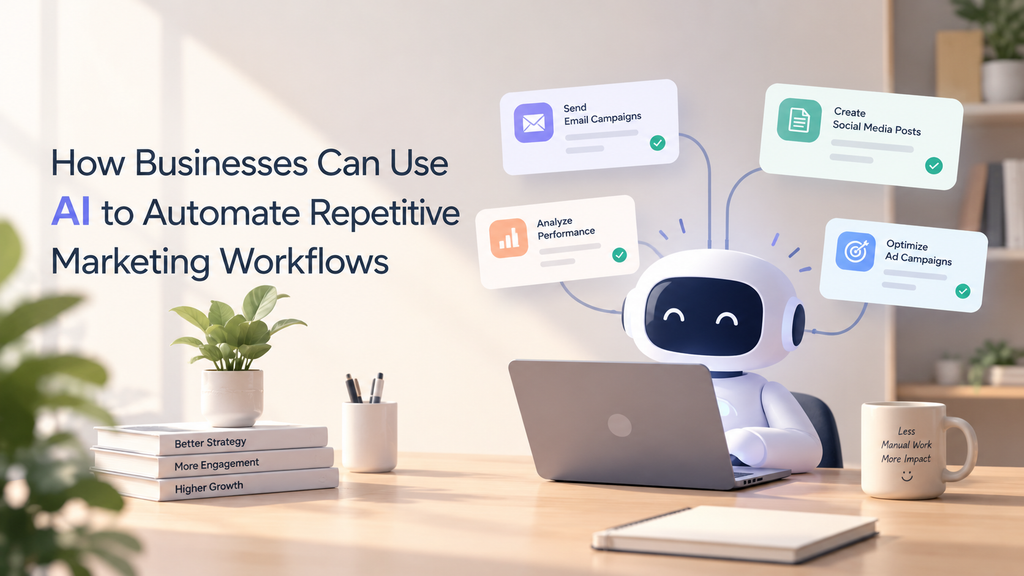
Ask a marketer where their week goes and you’ll hear the same list: sorting leads, scheduling emails, pulling reports, updating customer records, reworking content for different channels, and checking how campaigns are doing. None of it takes long on its own. Added up, it eats hours that should be going to strategy and creative work.
That’s where AI marketing automation helps. Traditional tools only do what a fixed rule tells them to. AI can read information, spot patterns, write content, and set off actions as conditions change. The result is less manual work, while marketers stay in charge of the calls that need judgment, creativity, and a real feel for the brand.
What Makes AI Marketing Automation Different?
Standard automation works when you know exactly what goes in and what should come out. A marketing platform can send an email three days after someone downloads an ebook, for instance, because the trigger and the response never change.
AI adds a layer of decision-making. It can look at how customers behave, make sense of text, sort information into groups, predict what someone is likely to do next, and suggest the next step. That makes AI in marketing workflows a good fit for work that involves lots of data or the same decision made over and over.
An AI-enabled workflow could:
- Analyze website behavior and group visitors into categories
- Pick out leads who look ready to buy
- Draft personalized follow-up emails
- Summarize how a campaign performed
- Suggest audience segments
- Flag unusual swings in campaign metrics
- Send qualified leads to the right sales rep
The point isn’t to take marketers out of the process. It’s to clear away the repetitive work so they have more time for planning, positioning, creative ideas, and customer relationships.
Marketing Tasks That Are Ideal for AI Automation
Not everything in marketing should be automated. A good place to start is with repetitive processes that have fairly clear rules and where you can measure the time saved.
1. Lead Qualification and Segmentation
Reviewing leads and sorting them into segments takes up a lot of a marketing team’s time. AI can look at website visits, form submissions, email activity, company details, and past engagement, then place each prospect into a category based on criteria you’ve set.
Say one lead keeps returning to your pricing and product pages, while another only grabbed an introductory guide. The first would naturally get a higher engagement score. This makes automated marketing processes quicker to respond, and nobody has to go through every single interaction by hand.
2. Email Campaign Management
Email includes a lot of repetitive activities such as target audience selection, scheduling, testing of subject lines, personalization, and follow-ups. The AI-based systems analyze previous engagements and, based on that, suggest what content or at what time may engage a specific audience more.
Also, marketers can use AI to generate a draft of emails, extract a summary of the response, and identify prospects for further outreach. Of course, somebody needs to check customer communication before sending it, as accuracy is vital here.
3. Content Repurposing
One piece of content can be transformed into several others. The lengthy article may be turned into posts, emails, video scripts, or even pieces for the sales department.
A great deal of transformation can be done by AI. All you need to do is provide the initial content along with details of who the audience is and what type of content needs to be created in terms of format and tone.
Building Effective Marketing Automation Strategies
Good automation starts with the workflow, not the tool.
Before you pick anything, write down how the process works today. Note every manual step, the systems involved, the information needed, and the points where someone has to make a decision.
A few questions help you evaluate a task:
- How often does it come up?
- How much of your team’s time does it take?
- Is the data structured or unstructured?
- What happens when something unexpected comes up?
- Can you measure the result?
- Does it involve sensitive customer information?
Answering these shows you which tasks really suit automation and which still need a person.
Connecting AI Tools With Existing Marketing Systems
Most companies already have a CRM, an email platform, analytics tools, ad platforms, a content management system, and project management software. Bringing in one more standalone app can end up creating extra work.
AI-powered marketing automation does best when it can share information with the tools your team already uses. A workflow might pull customer activity from your CRM, run it through an AI model, and then trigger an action in your email platform.
If you want AI connected to your current applications, data sources, APIs, or business workflows, AI integration services can help set that up. This connecting layer matters a great deal, because automation only pays off when information moves reliably between systems.
Examples of Automated Marketing Workflows
Picture a B2B company that gets hundreds of website inquiries every month. Rather than reading each one, they could set up an automated marketing workflow like this:
- A visitor fills out the contact form.
- The system checks the details against set criteria.
- AI reads the inquiry and works out what the person wants.
- The lead is placed in the right segment.
- A personalized email is drafted or selected.
- The CRM record updates on its own.
- A sales rep gets a notification once the lead meets the qualification threshold.
Reporting is another good example. Instead of gathering numbers from several platforms yourself, AI can pull the campaign data together, point out meaningful changes, summarize results, and prepare a report for someone to review.
These are AI-driven marketing processes in practice: the repetitive steps run automatically, and people still own the interpretation and the final decisions.
Choosing AI Tools for Marketers
The selection of any specific AI software will not be the right choice for all marketing teams. The factors that determine the best software include your budget, existing systems, complexity, and security.
When comparing AI tools for marketers, look past the flashy features and ask whether the tool:
- Works with the platforms you already use
- Gives you useful controls over the workflow
- Lets a person approve things where needed
- Protects your data properly
- Offers analytics and reporting
- Can scale as your automation grows
- Lets you monitor errors and exceptions
A smaller team may do fine with one focused automation. Larger organizations might need connected AI systems that run across several departments and applications.
Keeping Humans in the Marketing Loop
Automation should cut down on repetitive work, not on accountability.
AI-generated content still needs a human check for facts, tone, brand consistency, and context. Automated segmentation also needs watching so customers don’t end up in the wrong group.
Clearly define approval points for anything sensitive, such as customer communications, campaigns, pricing, and personal data handling. By keeping everyone in the loop, you are able to marry the speed of technology with human wisdom.
Measuring the Impact of AI Automation
When you assess business process automation with AI, look at practical business results rather than just counting how many tasks you automated. Useful measures include:
- Hours saved per employee
- Less manual data entry
- Lead response time
- Time needed to produce a campaign
- Conversion rates
- Error and exception rates
- Cost per marketing activity
- Revenue influenced by automated campaigns
Suppose a weekly report used to take ten hours and now takes three. You have a clear baseline, and you can use results like that to decide where to automate next.
Building a Smarter Marketing Operation
AI can speed up marketing operations, but the real benefit comes from using it with care. Start with repetitive tasks, connect AI to the systems you already have, decide where people need to approve things, and track the outcome.
The best marketing workflow automation programs don’t try to automate everything. They strip out needless manual effort and give marketers better information and more room to think strategically.
As AI keeps improving, companies that build practical, connected, and measurable automated marketing processes will be able to respond faster without losing the human judgment that makes marketing work.