

Posting product videos is a major part of the business for e-commerce brands. Once these videos are published, any other seller can download, edit, and repost them for their own marketing and sales, which can potentially harm your brand.
One of the best ways to stop product video theft like this is by using reverse video search. This is a research technique that allows you to find out where your video has been reposted and who shared it. It allows you to take action against unauthorized users, so that your videos are not used without your permission.
In this detailed blog post, you will learn how your e-commerce brand can stop product video theft with the help of this technique. Let’s start.
What is Product Video Theft?
Before we get into the details of how you can prevent product video theft, let’s discuss what it actually is.
Product video theft is the unauthorized downloading, editing, and sharing of someone else’s e-commerce product video. E-commerce brands share product videos online all the time. Most of these brands make sure that these videos are attractive enough to attract customers. So, some low-quality and illegal brands try to save some bucks and steal other brands’ videos and share them as their own. In this way, they get to attract customers without having to put money and energy into making their own videos.
This is an illegal practice and can harm the original brand’s reputation and business.
What is Reverse Video Search?
Reverse video search is a technical procedure of using data like a video, a screenshot, a URL, or even a transcript to see where a video has been uploaded on the Internet.
The main purpose of this research technique is to find out where the original version of a video was posted, who has reposted the video, and what it claims.
Many content creators, journalists, and content researchers use this technique to investigate a video’s origin and understand the context behind it.
This technique can be used by e-commerce brands to monitor their product videos and make sure no unauthorized brand is reposting them online.
How Reverse Video Search Can Help e-Commerce Brands Stop Product Video Theft?
Reverse video search gives e-commerce brands an easy and automatic way to stop product video theft. It’s very difficult for companies to track all the major social media platforms manually to see if their videos are being stolen and reposted online.
With this research technique, they can do it in a very quick and efficient way. The following points explain how this search technique can be helpful for any brand that wants to find out if their content is being stolen.
Find exact and edited copies of the video
Unauthorized sellers use the exact copies as well as edited versions of the product video to attract their customers.
The reverse research technique helps you find both. It identifies the original video that is being posted on different platforms. Besides this, it also finds similar videos that might be the edited versions of the original one.
Trace the online accounts sharing your video
This is perhaps the biggest benefit of doing a reverse video lookup to stop video theft. With this technique, you can trace online accounts that are sharing your videos.
In this way, you can directly take action against these business accounts and make sure they don’t steal videos from you or any other e-commerce brand again.
Check where the video is posted online
If you do reverse video lookup the right way, you can actually find out on which platform the video is being posted. Sometimes, unauthorized brands publish video only on one platform, such as YouTube or TikTok.
At other times, they publish the same video on different platforms. In both cases, the reverse video lookup technique can help you trace these platforms so that you can take appropriate action against these sellers.
Check what the video claims
Unauthorized sellers usually change the title and description of the video to claim the product as theirs. When you conduct a reverse search, you get to see what the seller is claiming by seeing the video titles, descriptions, and even hashtags. This is very useful information that you can later use in legal procedures to punish the sellers.
Analyze what type of videos are usually stolen
Scammer brands don’t steal every e-commerce product video they see online. They usually target highly engaging videos of trending or profitable products.
Reverse video lookup can help you spot this pattern and see which of your product videos are being frequently stolen. This information can help you adopt better copyright protection measures on such videos.
How to Use Reverse Video Search to Find Stolen Product Videos?
We have discussed how the reverse video lookup technique can be helpful when it comes to stopping e-commerce product video theft. Now, we will cover how you can actually perform this technique to find out who stole your video and where it is being posted.
There are a bunch of different online resources available out there that you can use. However, for demonstration purposes, we are going to use www.reverse-videosearch.com. This tool is specifically designed for e-commerce brands and offers many useful features.
For example, you can use a video, a screenshot, a URL, or a transcript to conduct the research. Besides this, it checks more than 50 online platforms to see if your video appears on any of them.
Here’s a step-by-step guide on how to use it:
Step #1. Add your data
The first thing that you have to do is add data about your video. As mentioned earlier, the tool gives you the following options:
- Video
- Frame or a screenshot
- URL
- Keywords
- Transcript
All of these methods work just fine, but we recommend using the actual video or its URL to get better results.
Just click on your relevant upload method, add the data, and click on “Search Now”:
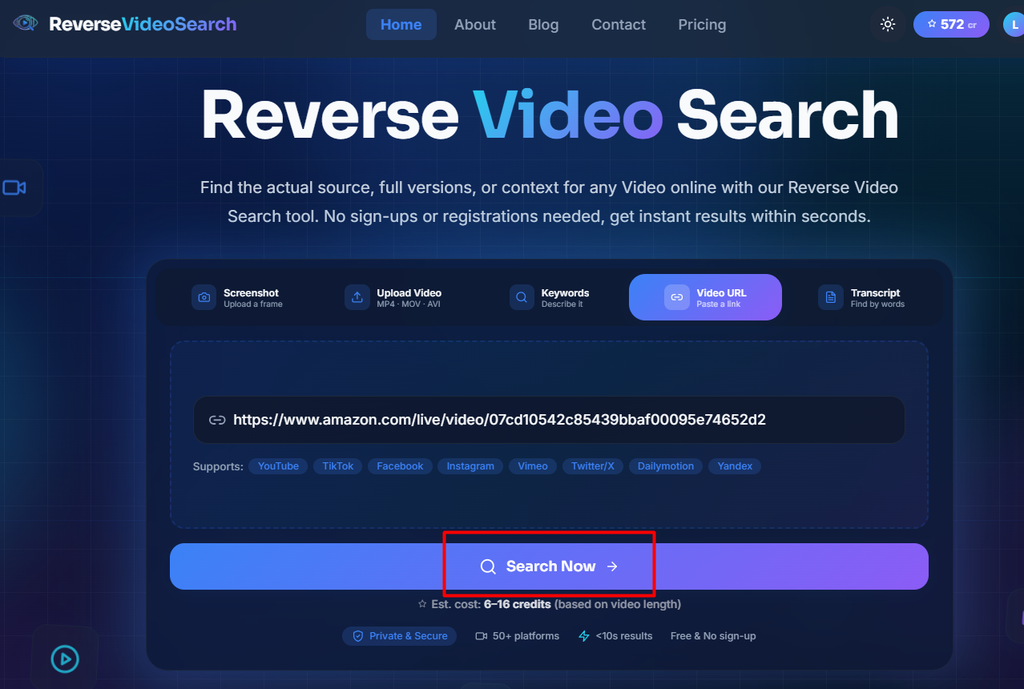
Step #2. Analyze the search results
After a few seconds, the tool will provide the original product video as well as the similar results.
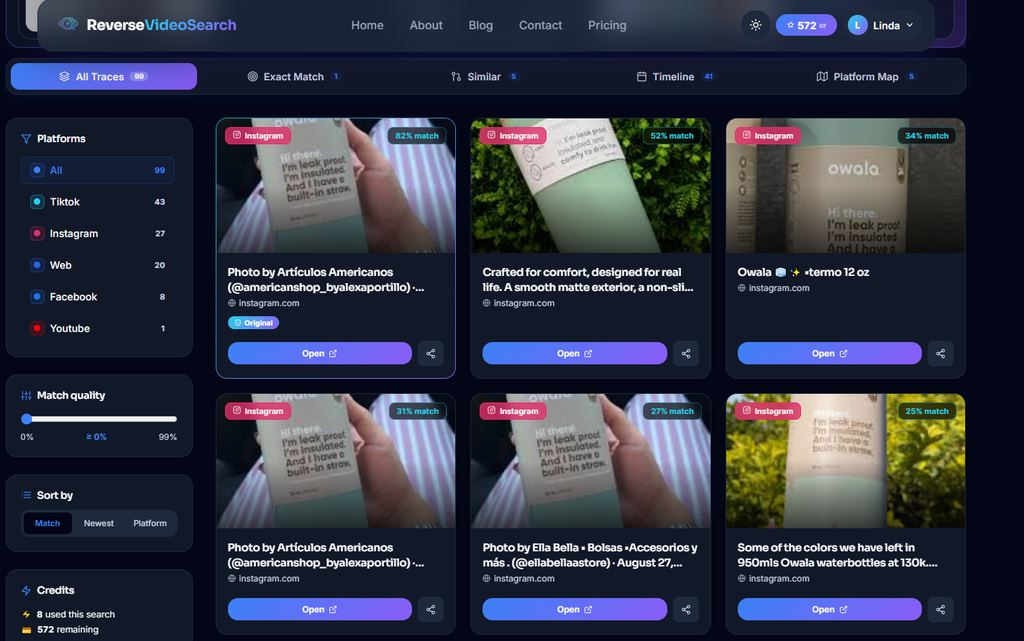
You can filter through the results by platforms or match quality.
These results give you very useful information about reposted videos, such as:
- Account that posted the video
- Video title and description
- Hashtags used
- Publish date
You can analyze this information and see where your product video has been uploaded online.
Step #3. Export the search results
Another useful feature that this tool gives is the option of exporting search data in the form of a document.
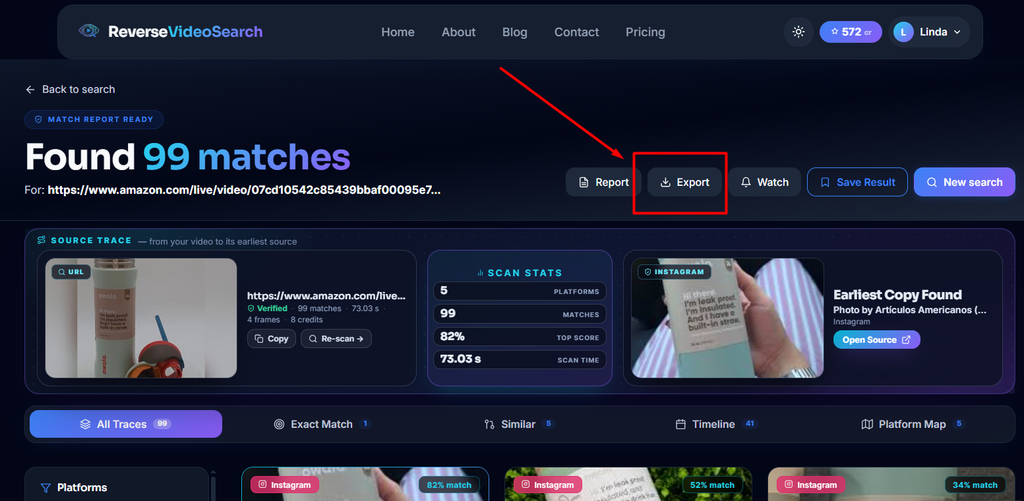
You can export the search result file that contains information like video titles, platforms, and similarity score.
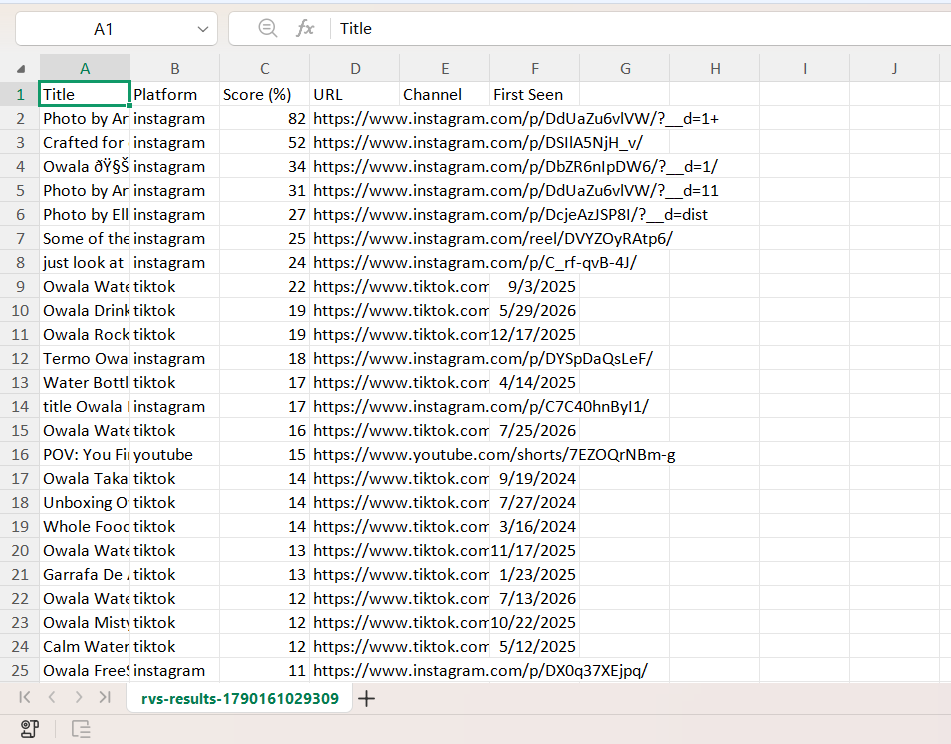
You can use this information to analyze the unauthorized brands that are resharing your videos and make an action plan against them.
What to Do After Reverse Video Search?
What you do after the research depends on your specific scenario. For example, if you’re analyzing the type of videos that usually get stolen to make a plan for them, you can simply extract search data and start working on it with your team.
On the other hand, if you are trying to trace a major case of product video theft, you should gather official evidence against the seller so that you can take proper legal action.
Whatever your situation is, there is a specific set of best practices that you should always follow:
Verify that the video is yours
The first best practice that you should follow is to make sure that the video is actually yours. E-commerce product videos can look the same because the products usually have the same features and benefits.
So it’s possible that you mistake a different video as yours. Such a mistake can bring consequences in case you make a direct theft claim.
Contact with the seller
It’s possible that the seller may have reposted your video by mistake. In this case, you should reach out to them directly and ask them to remove the video. It’s very likely that the brand owner will honor your request and delete the video.
Important note: This strategy can be time-consuming and does not always work.
Report the theft to the platform or relevant authorities
In case you cannot reach out to the seller, make sure to report to the officials immediately. If the case is small and can be handled by the platform (such as TikTok, YouTube, etc.) itself, report the video to the platform.
On the other hand, if the case is big, such as repeated commercial infringement, inform the relevant authorities (such as a copyright or intellectual-property office) so that they can start their investigation.
Final Words
As an e-commerce brand using product videos for marketing, you will face many situations where your product video gets stolen and reposted by unauthorized sellers. There are different ways to tackle this issue, but using reverse video search is one of the most efficient ones.
This is a technical research technique that helps you analyze where your original video as well as its edited versions have been posted online. By conducting this research, you can identify seller accounts, where they have shared the videos, and what claims they have made about it, so that you can take proper legal action against them.
Frequently Asked Questions (FAQs):
What is the best way to find if your product videos are stolen?
Doing a reverse video search is one of the best ways to investigate if your product videos are stolen. This research technique lets you trace your original and similar videos that are posted on different online platforms.
How can product video theft hurt your e-commerce brand?
Product video theft can hurt an e-commerce brand if the other seller sells a similar, low-quality product. It can confuse your customers and hurt your overall brand reputation.
Can reverse video search help find similar videos to my original product video?
Yes. Most reverse video search tools are designed to find similar videos that might be the edited versions of your original video.
What is the best search method for reverse video lookup?
The best search method for reverse lookup is using your original video. It gives the tool enough authentic visual data to analyze the video and find accurate results.
Is reverse video search enough to prevent product video theft?
Reverse search alone is not enough to prevent product video theft. You should also follow proper copyright practices and take action against unauthorized copies.